
Gabriel's Horn Example
Loading the math board and drawing, please wait…
In collections
Curves and Surfaces
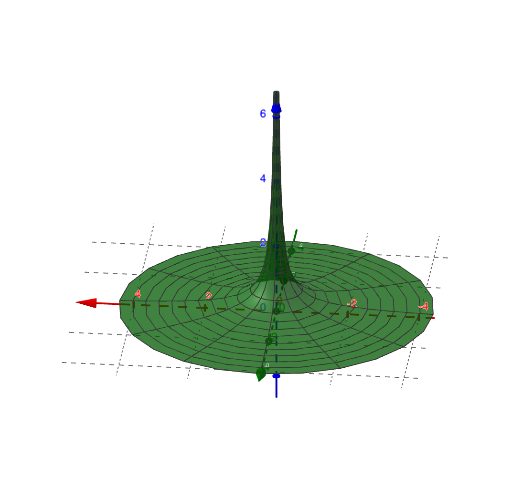
This example demonstrates the 3D surface generated by rotating the curve y=1/x (x>0), illustrating the paradoxical mathematical phenomenon where the volume is finite but the surface area is infinite. Core concepts include integration, limits, solid geometry, and improper integrals. Constructed using GeoGebra's Surface command and objects a, b for parameterization. Suitable for high school and above students studying calculus and advanced mathematics to understand the practical applications of improper integrals and infinite series.
GeoGebra Commands & Parameters
Surface(((a * u) * cos(v)), ((a * u) * sin(v)), a / u, u, 0, (2 * π), v, 0, (2 * π)) → b
AI Drawing Prompt Reference
Create a 3D surface by rotating the curve y = 1/x for x > 0 around a vertical axis. Use parameters u and v to define the surface, with u representing the positive variable and v acting as the rotation angle. Set v to range from 0 to 2π, and build the surface using the parametrization x = (a·u)cos(v), y = (a·u)sin(v), z = a/u, where a is a scaling parameter. Render the resulting “Gabriel’s horn” style surface so its solid-of-revolution structure is clearly visible, illustrating the connection to improper integrals and limits.
The prompt above was compiled from the original drawing commands and is for reference only.