
Interior and Exterior Angles in Regular Polygons by Nicola Trubridge
Loading the math board and drawing, please wait…
In collections
GCSE Higher Ch5 Angles & Trigonometry
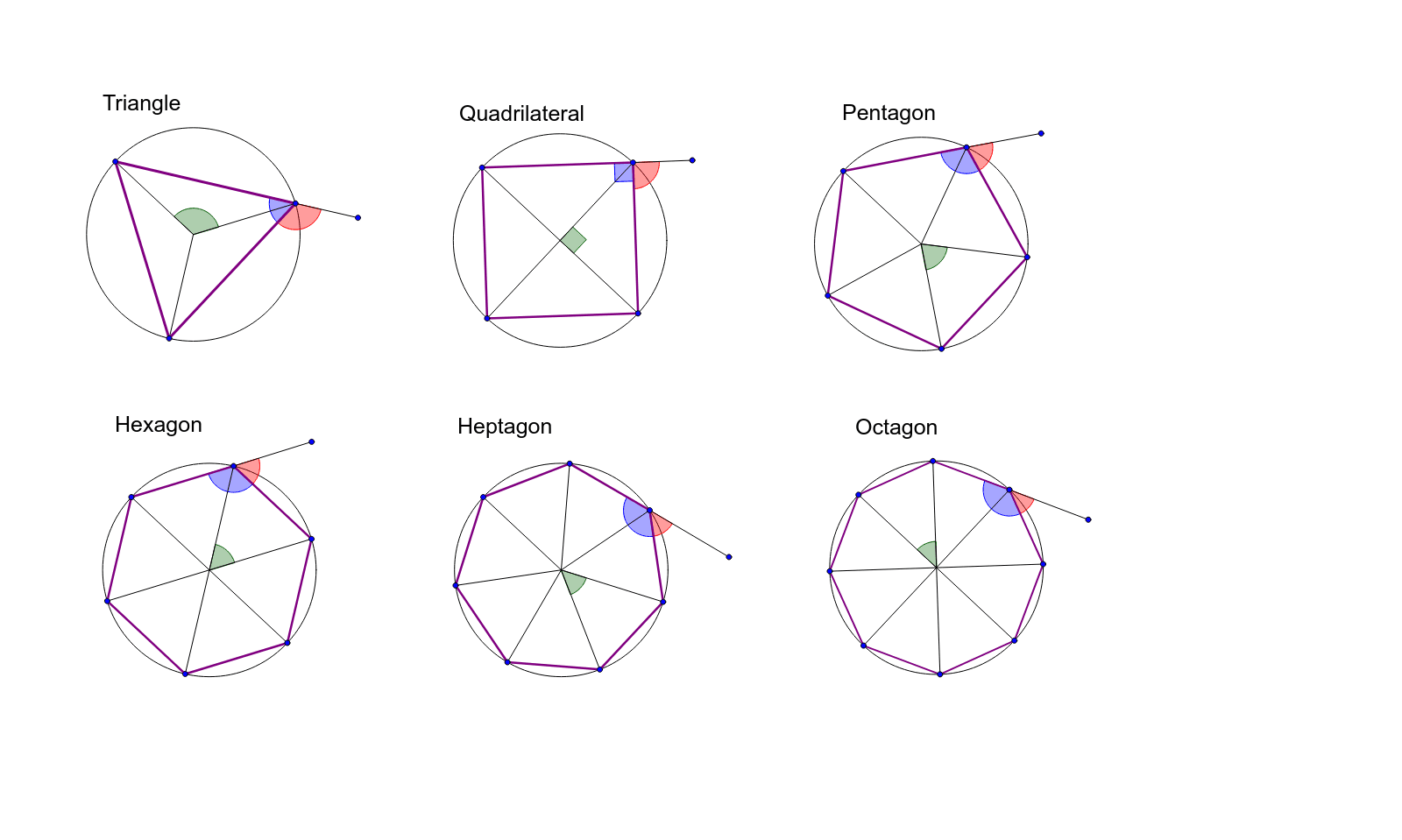
This example demonstrates the calculation and relationship between interior and exterior angles of regular polygons. Key math concepts include the sum of interior angles formula, exterior angle theorem, and trigonometric function applications. GeoGebra commands used are Circle, Segment, Point, Rotate, and Angle for construction. Suitable for high school mathematics teaching to understand geometric properties and calculations of regular polygons.
GeoGebra Commands & Parameters
Circle(M_7, N_7) → r_7Segment(M_7, N_7) → s_6Segment(M_7, N_7) → a_6Point(a_6) → C_3Rotate(N_7, 240*°, C_3) → E_1Angle(E_1, C_3, N_7) → α_1Rotate(E_1, 240*°, C_3) → E'_1Segment(E_1, C_3) → f_4Segment(C_3, E'_1) → g_4Segment(E_1, N_7) → h_4Segment(E'_1, E_1) → i_4Segment(E'_1, N_7) → j_4Angle(N_7, E_1, E'_1) → θ_2Angle(E'_1, E_1, K_1) → ο_1Segment(E_1, K_1) → n_4Circle(M_{10}, N_8) → r_8Segment(M_{10}, N_8) → s_2Rotate(N_8, 300*°, M_{10}) → N'_3Segment(M_{10}, N'_3) → a_7Rotate(N'_3, 300*°, M_{10}) → O_2Angle(O_2, M_{10}, N'_3) → γ_2Segment(M_{10}, O_2) → b_5Segment(O_2, N'_3) → g_5Segment(N'_3, N_8) → h_5Angle(N_8, N'_3, O_2) → ε_1Circle(M_{15}, N_3) → r_3Segment(M_{15}, N_3) → s_3Segment(M_{15}, N_3) → a_1Rotate(N_3, 288*°, M_{15}) → A_2Segment(M_{15}, A_2) → b_1Rotate(A_2, 288*°, M_{15}) → A'_2Segment(M_{15}, A'_2) → c_1Rotate(A'_2, 288*°, M_{15}) → A''_2Angle(A''_2, M_{15}, A'_2) → θ_3Segment(M_{15}, A''_2) → d_1Rotate(A''_2, 288*°, M_{15}) → A'''_2Segment(M_{15}, A'''_2) → e_1Segment(A'''_2, N_3) → f_1Segment(N_3, A_2) → g_1Segment(A_2, A'_2) → h_1Segment(A'_2, A''_2) → i_1Segment(A''_2, A'''_2) → j_1Angle(N_3, A_2, A'_2) → γ_1Angle(A'_2, A_2, F_1) → κ_1Segment(A_2, F_1) → k_1Circle(M_{16}, N_1) → r_1Segment(M_{16}, N_1) → s_9Segment(M_{16}, N_1) → a_3Point(a_3) → C_1Rotate(N_1, 270*°, C_1) → D_1Rotate(D_1, 270*°, C_1) → D'_1Angle(D'_1, C_1, D_1) → β_1Rotate(D'_1, 270*°, C_1) → D''_1Segment(D_1, C_1) → p_1Segment(D'_1, C_1) → q_1Segment(D''_1, C_1) → r_9Segment(D'_1, D_1) → s_1Segment(D_1, N_1) → t_2Segment(N_1, D''_1) → d_2Segment(D''_1, D'_1) → e_2Angle(N_1, D_1, D'_1) → ι_1Angle(D'_1, D_1, I_1) → ν_1Segment(D_1, I_1) → q_2Circle(M_{17}, N_2) → r_2Segment(M_{17}, N_2) → s_5Rotate(N_2, 60*°, M_{17}) → N'_1Segment(N'_1, M_{17}) → t_1Rotate(N_2, 300*°, M_{17}) → N'_2Segment(M_{17}, N'_2) → a_2Rotate(N'_2, 300*°, M_{17}) → O_1Angle(O_1, M_{17}, N'_2) → γ_3Segment(M_{17}, O_1) → b_2Rotate(O_1, 300*°, M_{17}) → O'_1Segment(M_{17}, O'_1) → c_2Rotate(O'_1, 300*°, M_{17}) → O''_1Segment(O''_1, M_{17}) → d_3Segment(O''_1, O'_1) → e_3Segment(O'_1, O_1) → f_2Segment(O_1, N'_2) → g_2Segment(N'_2, N_2) → h_2Segment(N_2, N'_1) → i_2Segment(N'_1, O''_1) → j_2Angle(N_2, N'_2, O_1) → ε_2Angle(O_1, N'_2, G_1) → λ_1Segment(N'_2, G_1) → l_1Circle(M_{18}, N_4) → r_4Segment(M_{18}, N_4) → s_4Segment(M_{18}, N_4) → a_4Rotate(N_4, 308.57*°, M_{18}) → A_1Rotate(A_1, 308.57*°, M_{18}) → A'_1Rotate(A'_1, 308.57*°, M_{18}) → A''_1Rotate(A''_1, 308.57*°, M_{18}) → A'''_1Angle(A'''_1, M_{18}, A''_1) → δ_1Rotate(A'''_1, 308.57*°, M_{18}) → B_1Rotate(B_1, 308.57*°, M_{18}) → B'_1Segment(M_{18}, A_1) → b_3Segment(M_{18}, A'_1) → c_3Segment(M_{18}, A''_1) → d_4Segment(M_{18}, A'''_1) → e_4Segment(M_{18}, B_1) → f_3Segment(M_{18}, B'_1) → g_3Segment(A_1, A'_1) → h_3Segment(A'_1, A''_1) → i_3Segment(A''_1, A'''_1) → j_3Segment(A'''_1, B_1) → k_2Segment(B_1, B'_1) → l_2Segment(B'_1, N_4) → m_1Segment(N_4, A_1) → n_1Angle(A_1, A'_1, A''_1) → η_1Angle(A''_1, A'_1, J_1) → ξ_1Segment(A'_1, J_1) → p_2Circle(M_{19}, N_5) → r_5Segment(M_{19}, N_5) → s_8Segment(M_{19}, N_5) → k_3Rotate(N_5, 315*°, M_{19}) → B_3Angle(B_3, M_{19}, N_5) → κ_3Segment(M_{19}, B_3) → l_3Rotate(B_3, 315*°, M_{19}) → B'_3Segment(B'_3, M_{19}) → m_2Rotate(B'_3, 315*°, M_{19}) → B''_1Rotate(B''_1, 315*°, M_{19}) → B'''_1Rotate(B'''_1, 315*°, M_{19}) → C_4Rotate(C_4, 315*°, M_{19}) → C'_1Rotate(C'_1, 315*°, M_{19}) → C''_1Segment(B''_1, M_{19}) → n_2Segment(M_{19}, C''_1) → p_3Segment(C'_1, M_{19}) → q_3Segment(C_4, M_{19}) → k_6Segment(B'''_1, M_{19}) → l_6Segment(B''_1, B'''_1) → m_3Segment(B'''_1, C_4) → n_6Segment(C_4, C'_1) → p_6Segment(C'_1, C''_1) → q_6Segment(C''_1, N_5) → t_4Segment(N_5, B_3) → a_8Segment(B_3, B'_3) → b_6Segment(B'_3, B''_1) → c_5Angle(B_3, B'_3, B''_1) → ζ_2Angle(B''_1, B'_3, H_2) → μ_2Segment(B'_3, H_2) → m_7
AI Drawing Prompt Reference
Draw a regular polygon with its interior and exterior angles. Start by drawing a circle, then create two line segments from a point on the circle to form the sides of the polygon. Rotate these segments around the point to construct the other sides of the polygon, and mark the interior and exterior angles.
The prompt above was compiled from the original drawing commands and is for reference only.