
Interactive Exploration of Scalene Triangle Congruence and Centroid
Loading the math board and drawing, please wait…
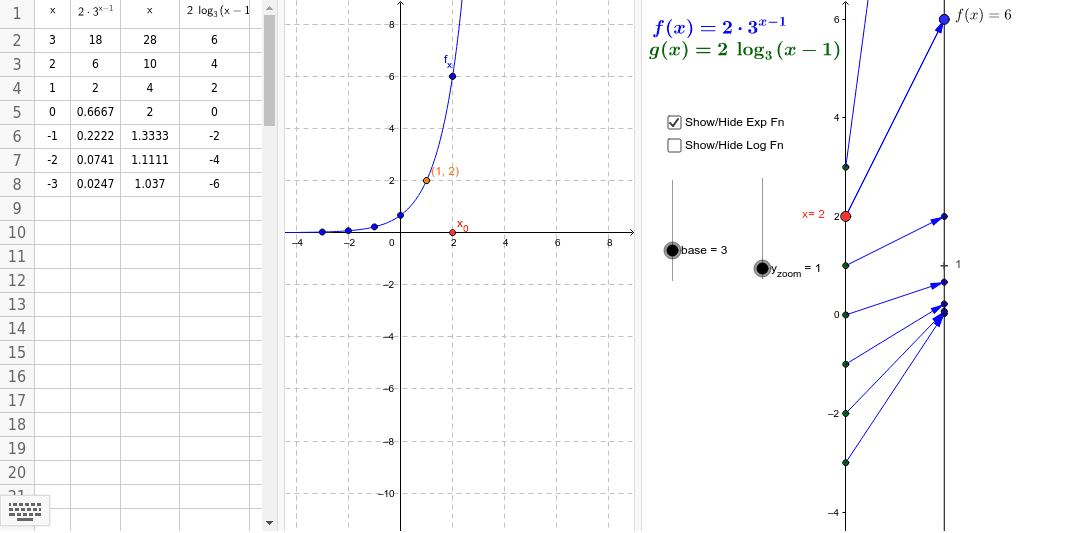
①This example demonstrates how to dynamically construct a set of scalene triangles in GeoGebra, using points, vectors, text fields, and sequences to explore triangle congruence and the properties of the centroid (barycenter). ②Core mathematical concepts include congruence criteria for scalene triangles, the geometric meaning of the centroid as the intersection of medians, and the use of natural number sequences to generate multiple points. ③Construction highlights: from the summary, commands such as Point, Vector, Textfield, and Sequence are used, creating multiple vertices (A1-A8, B1-B8) and auxiliary points (C1-C5, D1), with an input box (inputBox1) and variables (x_0, y_zoom) for interactive control, possibly involving scaling and dynamic adjustment. ④This is suitable for middle school geometry or introductory college geometry courses, to visually understand congruence conditions, the relationship between centroid position and triangle shape, and to study patterns via batch-generated points.
GeoGebra Commands & Parameters
Point(yAxis) → A_1Vector(A_1, B) → uTextfield(f) → inputBox1Sequence((0, k), k, -3, 3) → SourcePtsMDSequence((k, f(k)), k, -3, 3) → ExpGraphptsVector(A_1, B_2) → vSequence(Vector[(0, k), (2, (y_{zoom} * f(k)))], k, -3, 3) → ExpMDSequence((2, (y_{zoom} * f(k))), k, -3, 3) → ExpTargPtsSequence(Vector[(2, k), (4, (y_{zoom} * f(k)))], k, -3, 3) → InvLogMDSequence(Vector[(0, f(k)), (2, (y_{zoom} * g(f(k))))], k, -3, 3) → logMDSequence((k, g(k)), k, 2, 8) → logGraphpts
AI Drawing Prompt Reference
Draw a set of scalene triangles on a coordinate plane, generated by a sequence of natural numbers, sharing a common side and with adjustable vertices. Start with a point on the vertical axis, create a vector from it to a fixed point, then another vector to a second dynamic point, forming the triangle skeleton. Include an input box to control a zoom factor, which scales all subsequent triangle vertices vertically. Additionally, generate multiple point sets and vectors across different horizontal intervals, representing original function points, scaled target points, and their mapping relationships, resulting in a series of triangles and their centroids to illustrate congruence conditions and centroid variation with shape.
The prompt above was compiled from the original drawing commands and is for reference only.