
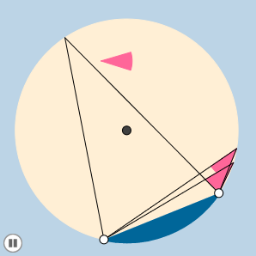
Inscribed Angle Dance
Loading the math board and drawing, please wait…
In collections
Circles (Theorems)
This example demonstrates the dynamic changes of inscribed angles. It involves the basic properties of inscribed angles, such as the inscribed angle being half of the arc it subtends. Using GeoGebra commands like Circle, CircumcircleArc, and Rotate, one can observe the changes in inscribed angles as points on the circle move. Suitable for students at the middle school level and above to learn about inscribed angles.
GeoGebra Commands & Parameters
Circle(A, B) → cSegment(B, A) → aPoint(c) → CSegment(A, C) → bPoint(c) → DCircumcircleArc(C, D, B) → dCircleArc(A, B, C) → ePoint(d) → ESegment(C, E) → fSegment(E, B) → gCircle(E, 1.5) → hRay(E, C) → iRay(E, B) → jIntersect(h, j) → F,Intersect(h, i) → G,CircleSector(E, F, G) → kSegment(E, A) → lLine(A, xAxis) → mDilate(E, If[0 ≤ n ≤ 1, 1 - n, 0], A) → E'Vector(E, E') → uTranslate(k, u) → k'Line(E, a) → pLine(E, b) → qIntersect(h, p, 1) → HAngle(H, E, B) → αIntersect(h, q, 2) → IAngle(C, E, I) → βDilate(E, If[1 < n ≤ 2, 2 - n, 0], A) → E'_1Vector(E, E'_1) → vTranslate(k, v) → k'_1Rotate(k'_1, If[1 < n ≤ 2, ((n - 1) * β), β], E'_1) → k''Rotate(k', If[0 < n ≤ 1, ((-n) * α), (-α)], E') → k''_1Circle(A, 1.5) → rIntersect(r, a, 1) → JIntersect(r, b, 1) → KCircleSector(A, J, K) → sPoint(d) → LPoint(d) → MPoint(d) → NPoint(d) → OPoint(d) → PSegment(L, B) → tSegment(L, C) → a_1Segment(M, B) → b_1Segment(M, C) → c_1Segment(N, B) → d_1Segment(N, C) → e_1Segment(O, B) → f_1Segment(O, C) → g_1Segment(P, C) → h_1Segment(P, B) → i_1Vector(E, L) → w_2Vector(E, P) → j_1Circle(L, 1.5) → k_1Circle(M, 1.5) → p_1Circle(N, 1.5) → q_1Circle(O, 1.5) → r_1Circle(P, 1.5) → s_1Intersect(k_1, t, 1) → QIntersect(k_1, a_1, 1) → RIntersect(p_1, b_1, 1) → SIntersect(p_1, c_1, 1) → TIntersect(q_1, d_1) → U,Intersect(q_1, e_1, 1) → VIntersect(r_1, f_1, 1) → WIntersect(r_1, g_1, 1) → ZIntersect(s_1, i_1, 1) → A_1Intersect(s_1, h_1, 1) → B_1CircleSector(M, S, T) → t_1CircleSector(L, Q, R) → c_2CircleSector(N, U, V) → d_2CircleSector(O, W, Z) → e_2CircleSector(P, A_1, B_1) → f_2Dilate(E, If[0 < w < 1, 1 - w, 0], L) → E'_2Vector(E, E'_2) → l_1Translate(k, l_1) → k'_2Line(E, a_1) → m_1Point(m_1) → C_1Angle(C, E, C_1) → γRotate(k'_2, If[0 < w < 1, (w * γ), 0], E'_2) → g_2Dilate(L, If[1 < w < 2, 2 - w, 0], O) → L'Vector(L, L') → u_1Line(L, f_1) → n_1Translate(c_2, u_1) → h_2Intersect(k_1, n_1, 2) → D_1Angle(D_1, L, Q) → δRotate(h_2, If[1 < w < 2, ((-(w - 1)) * δ), 0], L') → k_2Dilate(O, If[2 < w < 3, 3 - w, 0], M) → O'Vector(O, O') → w_1Translate(e_2, w_1) → p_2Line(O, c_1) → a_2Intersect(r_1, a_2, 2) → E_1Angle(Z, O, E_1) → εRotate(p_2, If[2 < w < 3, ((w - 2) * ε), 0], O') → q_2Dilate(M, If[3 < w < 4, 4 - w, 0], P) → M'Vector(M, M') → v_1Translate(t_1, v_1) → r_2Line(M, i_1) → b_2Intersect(p_1, b_2, 2) → F_1Angle(S, M, F_1) → ζRotate(r_2, If[3 < w < 4, ((w - 3) * ζ), 0], M') → s_2Dilate(P, If[4 < w < 5, 5 - w, 0], N) → P'Vector(P, P') → u_2Translate(f_2, u_2) → t_2Line(P, e_1) → i_2Intersect(s_1, i_2, 2) → G_1Angle(B_1, P, G_1) → ηRotate(t_2, If[4 < w < 5, ((w - 4) * η), 0], P') → c_3