
Infinite Series of Squares
Loading the math board and drawing, please wait…
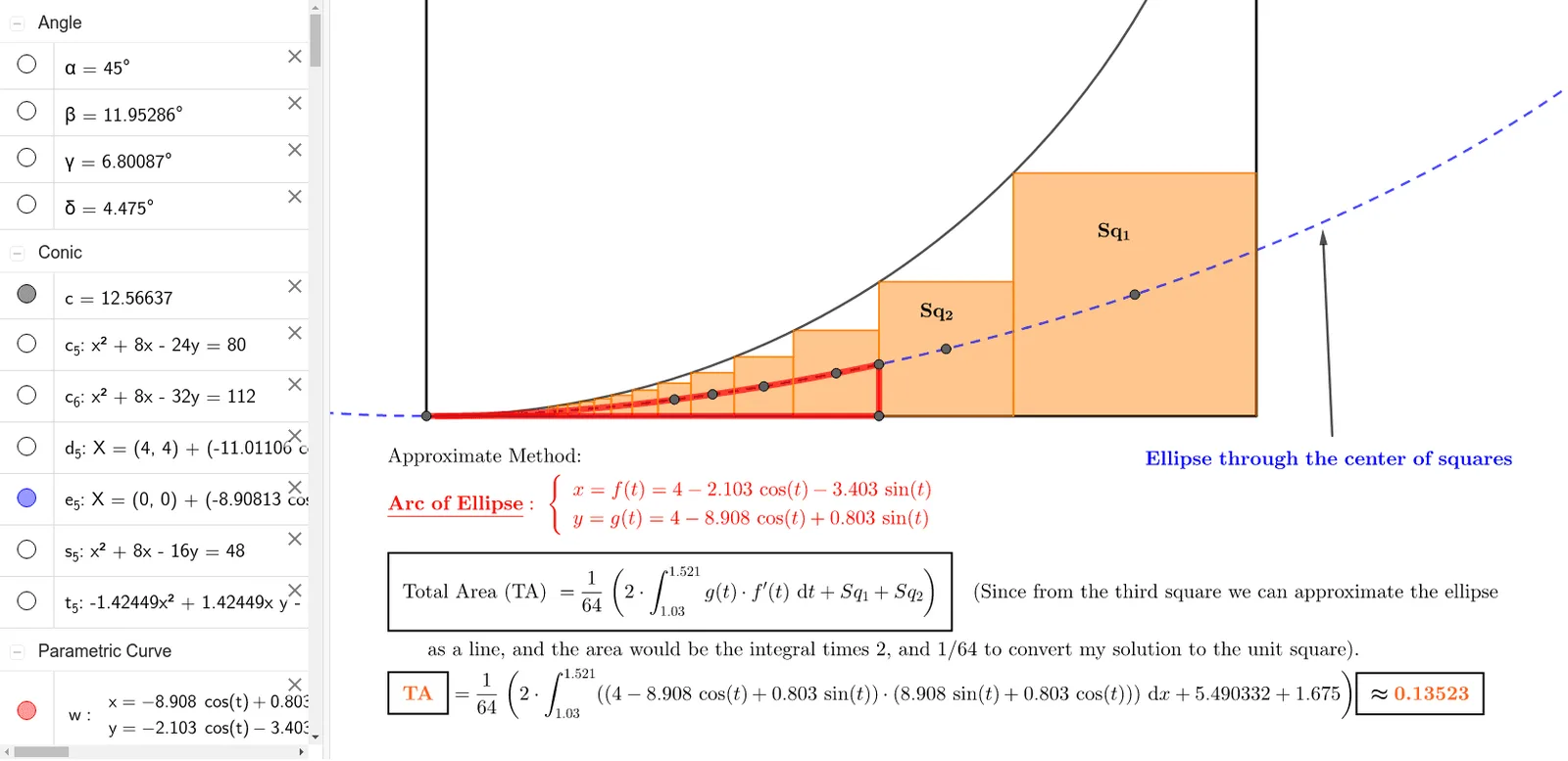
This GeoGebra example dynamically constructs and illustrates the geometric pattern of an infinite series of squares, exploring the convergence of areas and side lengths. Core mathematical concepts include series limits, geometric sequencing, trigonometric relationships, and analytic geometry. Construction employs commands such as Polygon, Sequence, Sum, IntegralBetween, and OrthogonalLine, along with points, lines, and Conic objects to model progressive square arrangements. It is suitable for high school and higher education calculus, series, and geometry instruction, serving as a visual aid for limit processes and spatial reasoning.
GeoGebra Commands & Parameters
Polygon(A, B, 4) → polígono1, f, g, h, i, C, DCircleArc(D, A, C) → cSegment(D, B) → jIntersect(c, j, 1) → EOrthogonalLine(E, g) → kOrthogonalLine(E, f) → lIntersect(k, g) → FIntersect(l, f) → GLine(G, j) → mIntersect(c, m, 1) → HLine(H, k) → nLine(H, l) → pIntersect(l, n) → IIntersect(p, f) → JLine(J, m) → qIntersect(c, q, 1) → KLine(K, n) → rLine(K, p) → sIntersect(p, r) → LIntersect(s, f) → MLine(M, q) → tIntersect(c, t, 1) → NLine(N, r) → aLine(N, s) → bIntersect(a, s) → OIntersect(f, b) → PLine(P, t) → dIntersect(c, d, 1) → QLine(Q, a) → eLine(Q, b) → f_1Intersect(b, e) → RIntersect(f_1, f) → SLine(S, d) → g_1Intersect(c, g_1, 1) → TLine(T, e) → h_1Line(T, f_1) → i_1Intersect(f_1, h_1) → UIntersect(i_1, f) → VLine(V, g_1) → j_1Intersect(c, j_1, 1) → WLine(W, h_1) → k_1Line(W, i_1) → l_1Intersect(k_1, i_1) → ZIntersect(f, l_1) → A_1Line(A_1, j_1) → m_1Intersect(c, m_1, 1) → B_1Line(B_1, k_1) → n_1Line(B_1, l_1) → p_1Intersect(l_1, n_1) → C_1Intersect(p_1, f) → D_1Line(D_1, m_1) → q_1Intersect(c, q_1) → E_1,Line(E_1, n_1) → r_1Line(E_1, p_1) → s_1Intersect(p_1, r_1) → F_1Intersect(s_1, f) → G_1Line(G_1, q_1) → t_1Intersect(c, t_1, 1) → H_1Line(H_1, s_1) → a_1Line(H_1, r_1) → b_1Intersect(b_1, s_1) → I_1Intersect(a_1, f) → J_1Line(J_1, t_1) → c_1Intersect(c, c_1, 1) → K_1Line(K_1, b_1) → d_1Line(K_1, a_1) → e_1Intersect(a_1, d_1) → L_1Intersect(e_1, f) → M_1Line(M_1, c_1) → f_2Intersect(c, f_2, 1) → N_1Line(N_1, d_1) → g_2Line(N_1, e_1) → h_2Intersect(e_1, g_2) → O_1Intersect(h_2, f) → P_1Line(P_1, f_2) → i_2Intersect(c, i_2) → Q_1,Line(Q_1, g_2) → j_2Line(Q_1, h_2) → k_2Intersect(h_2, j_2) → R_1Intersect(k_2, f) → S_1Polygon(S_1, P_1, 4) → p2, l_2, m_2, n_2, p_2, T_1, U_1Polygon(P_1, M_1, 4) → p3, q_2, r_2, s_2, t_2, V_1, W_1Polygon(M_1, J_1, 4) → p4, a_2, b_2, c_2, d_2, Z_1, A_2Polygon(J_1, G_1, 4) → p5, e_2, f_3, g_3, h_3, B_2, C_2Polygon(G_1, D_1, 4) → p6, i_3, j_3, k_3, l_3, D_2, E_2Polygon(D_1, A_1, 4) → p7, m_3, n_3, p_3, q_3, F_2, G_2Polygon(A_1, V, 4) → p8, r_3, s_3, t_3, a_3, H_2, I_2Polygon(V, S, 4) → p9, b_3, c_3, d_3, e_3, J_2, K_2Polygon(S, P, 4) → p10, f_4, g_4, h_4, i_4, L_2, M_2Polygon(P, M, 4) → p11, j_4, k_4, l_4, m_4, N_2, O_2Polygon(M, J, 4) → p12, n_4, p_4, q_4, r_4, P_2, Q_2Polygon(J, G, 4) → p13, s_4, t_4, a_4, b_4, R_2, S_2Polygon(G, B, 4) → p14, c_4, d_4, e_4, f_5, T_2, U_2Sequence(2, 14) → l2Sum(lista1) → oIntersect(h, i) → V_2Intersect(g, h) → W_2Angle(E, V_2, W_2) → αAngle(H, V_2, E) → βAngle(K, V_2, H) → γAngle(N, V_2, K) → δSequence((Element[l2, i], Element[lista1, i]), i, 1, 13) → l3Intersect(h, i) → Z_2Intersect(c, f, 1) → A_3Point(f) → B_3Line(A_3, B_3) → g_5Parabola((-4, 2), y = -10) → c_5Conic(F, I, L, O, R) → d_5Tangent((-4, -4), d_5) → h_5,Midpoint(E, B_3) → C_3Midpoint(H, G) → D_3Midpoint(K, J) → E_3Midpoint(N, M) → F_3Midpoint(Q, P) → G_3Midpoint(T, S) → H_3Conic(H_3, G_3, F_3, E_3, D_3) → e_5Intersect(e_5, q_5) → I_3, J_3Tangent(I_3, e_5) → i_5,Midpoint(J_3, I_3) → K_3Line(K_3, i_5) → j_5Intersect(e_5, j_5) → L_3, M_3Intersect(Y, d_5) → N_3, O_3Intersect(d_5, p_5) → P_3, Q_3Segment(N_3, O_3) → k_5Segment(Q_3, P_3) → l_5Segment(Z_2, B) → r_5Slope(l_5) → m_6Slope(k_5) → m_7Segment(W_2, A) → m_5Intersect(r_5, m_5) → R_3Parabola((-4, 0), y = -8) → s_5IntegralBetween(s_5, (0 * x) - 4, -4, 4) → uMidpoint(Q, R) → S_3Midpoint(N, O) → T_3Midpoint(K, L) → U_3Midpoint(H, I) → V_3Midpoint(E, F) → W_3Conic(W_3, V_3, U_3, T_3, S_3) → t_5Parabola((-4, 4), y = -12) → c_6IntegralBetween(c_6, (0 * x) - 4, -4, 4) → vIntersect(e_5, g) → B_4, C_4Intersect(e_5, i) → Z_3, A_4Intersect(f, g) → D_4Segment(Z_3, D_4) → n_5Segment(D_4, C_4) → a_5CurveCartesian((-8.908 * cos(t)) + (0.803 * sin(t)), (-2.103 * cos(t)) - (3.403 * sin(t)), t, 1.03, 1.521) → wIntersect(b_4, f) → E_4Segment(E_4, Z_3) → b_5Intersect(e_5, b_4) → F_4,Segment(F_4, E_4) → f_6Vector(G_4, H_4) → v_1
AI Drawing Prompt Reference
Draw an infinite series of squares, starting with a square and then constructing a series of squares where each new square's side is perpendicular to the previous square's side and gradually gets smaller. Begin with a square and use rotation and intersection to construct a series of squares, forming an infinite series of square patterns.
The prompt above was compiled from the original drawing commands and is for reference only.