
Infinite Purple Sum (2) — Artistic Visualization of a Geometric Series
Loading the math board and drawing, please wait…
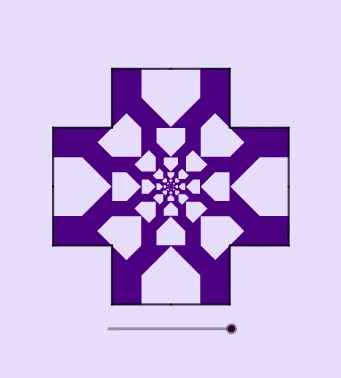
This example artistically demonstrates the summation of an infinite series, turning an abstract infinite sum into a visually striking geometric pattern. The core mathematical concepts include sequences and series, limits, convergence of geometric series, along with complex numbers and conic sections. Construction highlights: using GeoGebra commands such as Sequence to generate infinite terms, Point, Polygon, Vector, Line, Mirror, Midpoint, Segment to build iterative shapes, and Intersect, If to control the number of terms, resulting in a purple gradient infinite-sum artwork. Suitable for high school and above to grasp the idea of infinite series convergence, and also valuable for university-level visual demonstrations or mathematical art projects.
GeoGebra Commands & Parameters
If(Mod[k, 2] ≟ 0, k / 2, (k - 1) / 2) → n_kIf(Mod[k, 2] ≟ 0, k / 2, (k + 1) / 2) → m_kPoint(yAxis) → APolygon(A, B, C, D) → q1, a, b, c, dVector(A, E) → uSequence(Polygon[Dilate[L_0, (1 / 2)^(i), A] + ((2^(i) - 1) / 2^(i - 1) * u)], i, 1, n) → L_2Point(xAxis) → GIntersect(xAxis, yAxis) → FPolygon(A, F, G, D) → q2, a_1, f, g, d_1Polygon(L_1) → q3Sequence(Dilate[q3, (1 / 2)^(i - 1), G], i, 1, m) → L_3Line(D, G) → hMirror(A, h) → A'Mirror(B, h) → B'Mirror(C, h) → C'Mirror(D, h) → D'Mirror(A, h) → A'_1Mirror(G, h) → G'Mirror(D, h) → D'_1Mirror(A, xAxis) → A'_4Mirror(B, xAxis) → B'_2Mirror(C, xAxis) → C'_2Mirror(D, xAxis) → D'_4Mirror(A, xAxis) → A'_5Mirror(F, xAxis) → F'_2Mirror(G, xAxis) → G'_2Mirror(D, xAxis) → D'_5Mirror(A', xAxis) → A''_1Mirror(B', xAxis) → B''_1Mirror(C', xAxis) → C''_1Mirror(D', xAxis) → D''_1Mirror(A'_1, xAxis) → JMirror(G', xAxis) → G''_1Mirror(D'_1, xAxis) → KMirror(D, E) → D'_2Midpoint(g) → IPolygon(A, F, G, D) → q4, a_2, f_1, g_1, d_2Polygon(A, F, G, D) → q5, a_3, f_2, g_2, d_3Line(D, G) → qMirror(L_2, q) → L_4Mirror(L_3, q) → L_5Mirror(A, q) → A'_2Mirror(B, q) → B'_1Mirror(C, q) → C'_1Mirror(D, q) → D'_3Polygon(A'_2, B'_1, C'_1, D'_3) → q1', a'_2, b'_1, c'_1, d'_3Mirror(A, q) → A'_3Mirror(F, q) → F'Mirror(G, q) → G'_1Mirror(D, q) → D'_6Polygon(A'_3, F', G'_1, D'_6) → q5', a'_3, f', g'_1, d'_6Mirror(C, q) → C'_3Mirror(D'_2, q) → HSegment(C'_3, H) → i'Mirror(C, q) → C'_4Mirror(D, q) → D'_7Segment(C'_4, D'_7) → j'Mirror(E, q) → E'Mirror(D'_2, q) → LSegment(E', L) → l'Mirror(E, q) → E'_1Mirror(I, q) → I'Segment(E'_1, I') → p'Mirror(L_2, f') → L_6Mirror(L_3, f') → L_7Mirror(L_4, f') → L_8Mirror(L_5, f') → L_9Mirror(A, f') → A'_6Mirror(B, f') → B'_3Mirror(C, f') → C'_5Mirror(D, f') → D'_8Polygon(A'_6, B'_3, C'_5, D'_8) → q1'_1, a'_6, b'_3, c'_5, d'_8Mirror(A, f') → A'_7Mirror(F, f') → F'_1Mirror(G, f') → G'_3Mirror(D, f') → D'_9Polygon(A'_7, F'_1, G'_3, D'_9) → q5'_1, a'_7, f'_1, g'_3, d'_9Mirror(A'_2, f') → MMirror(B'_1, f') → NMirror(C'_1, f') → OMirror(D'_3, f') → PPolygon(M, N, O, P) → q1'', m_1, n_1, o, p_1Mirror(A'_3, f') → QMirror(F', f') → F''Mirror(G'_1, f') → RMirror(D'_6, f') → SPolygon(Q, F'', R, S) → q5'', q_1, f'', r, sMirror(C, f') → C'_6Mirror(D'_2, f') → TMirror(C, f') → C'_7Mirror(D, f') → D'_{10}Mirror(E, f') → E'_2Mirror(D'_2, f') → UMirror(E, f') → E'_3Mirror(I, f') → I'_1Mirror(C'_3, f') → VMirror(H, f') → H'Segment(V, H') → i''Mirror(C'_4, f') → WMirror(D'_7, f') → ZSegment(W, Z) → j''Mirror(E', f') → E''Mirror(L, f') → L'Segment(E'', L') → l''Mirror(E'_1, f') → A_1Mirror(I', f') → I''Mirror(L_2, f_2) → L_{10}Mirror(L_3, f_2) → L_{11}Mirror(L_4, f_2) → L_{12}Mirror(L_5, f_2) → L_{13}Mirror(L_6, f_2) → L_{14}Mirror(L_7, f_2) → L_{15}Mirror(L_8, f_2) → L_{16}Mirror(L_9, f_2) → L_{17}Mirror(A, f_2) → A'_8Mirror(B, f_2) → B'_4Mirror(C, f_2) → C'_8Mirror(D, f_2) → D'_{11}Polygon(A'_8, B'_4, C'_8, D'_{11}) → q1'_2, a'_8, b'_4, c'_8, d'_{11}Mirror(A, f_2) → A'_9Mirror(F, f_2) → F'_3Mirror(G, f_2) → G'_4Mirror(D, f_2) → D'_{12}Polygon(A'_9, F'_3, G'_4, D'_{12}) → q5'_2, a'_9, f'_3, g'_4, d'_{12}Mirror(A'_2, f_2) → D_1Mirror(B'_1, f_2) → E_1Mirror(C'_1, f_2) → F_1Mirror(D'_3, f_2) → G_1Polygon(D_1, E_1, F_1, G_1) → q1''_1, d_4, e_1, f_3, g_3Mirror(A'_3, f_2) → H_1Mirror(F', f_2) → F''_1Mirror(G'_1, f_2) → I_1Mirror(D'_6, f_2) → J_1Polygon(H_1, F''_1, I_1, J_1) → q5''_1, h_1, f''_1, i_1, j_1Mirror(A'_6, f_2) → K_1Mirror(B'_3, f_2) → M_1Mirror(C'_5, f_2) → N_1Mirror(D'_8, f_2) → O_1Polygon(K_1, M_1, N_1, O_1) → q6, k_1, m_2, n_2, o_1Mirror(A'_7, f_2) → P_1Mirror(F'_1, f_2) → Q_1Mirror(G'_3, f_2) → R_1Mirror(D'_9, f_2) → S_1Polygon(P_1, Q_1, R_1, S_1) → q7, p_2, q_2, r_1, s_1Mirror(M, f_2) → M'Mirror(N, f_2) → N'Mirror(O, f_2) → O'Mirror(P, f_2) → P'Polygon(M', N', O', P') → q1''', m', n', o', p'_1Mirror(Q, f_2) → Q'Mirror(F'', f_2) → F'''Mirror(R, f_2) → R'Mirror(S, f_2) → S'Polygon(Q', F''', R', S') → q5''', q', f''', r', s'
AI Drawing Prompt Reference
Create an artistic visualization of an infinite geometric series using purple gradient tones. Start with a base quadrilateral near the origin, then generate a sequence of similar polygons scaled by half, extending horizontally to show convergence. Mirror these shapes vertically and reflect them across a diagonal line to create symmetric layered patterns. Use varying purple shades to emphasize the iterative shrinking and the approach to a limit. The composition should highlight the recursive structure and spatial symmetry, suitable for illustrating mathematical convergence.
The prompt above was compiled from the original drawing commands and is for reference only.