
Inclined Plane Simulation: Exploring Forces and Angles
Loading the math board and drawing, please wait…
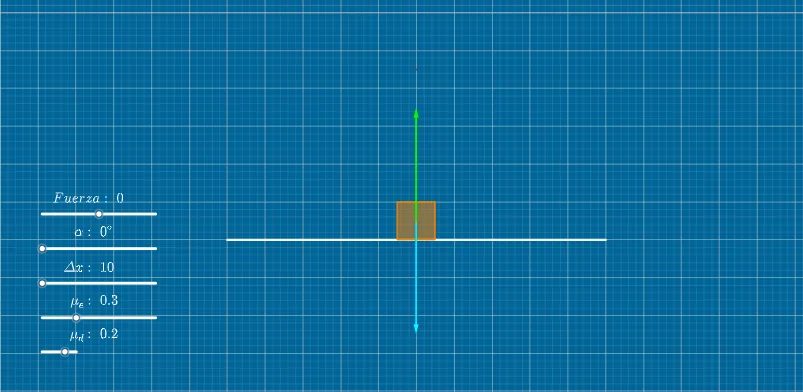
① This interactive GeoGebra example simulates an object on an inclined plane, allowing users to adjust the incline angle, mass, friction coefficients, and gravity to observe how forces and acceleration change. ② Core mathematical concepts include vector decomposition (resolving weight into components parallel and perpendicular to the plane), force composition (gravity, normal force, friction, net force), Newton's second law (F=ma), and static/kinetic friction coefficients affecting motion. ③ Construction highlights: from the summary, the example uses GeoGebra commands such as Polygon (to draw the plane), Vector (to represent force vectors), and Sum (to add vectors). Key objects include peso (weight), peso_x (weight component along plane), friccion (friction), fuerzaNeta (net force), aceleracion (acceleration), and sliders for coef_e, coef_d, masa, gravedad, and angulo to control parameters in real time, with text objects displaying numerical results. ④ Suitable for high school physics or introductory university mechanics, this example serves as an excellent tool for classroom demonstrations or student self-exploration of inclined plane problems, making the relationship between forces and motion intuitive.
GeoGebra Commands & Parameters
Polygon(l1) → t1Polygon(l2) → q1Vector(Z) → planoVector(C, C - (3 * ί)) → pesovVector(C, ((pos + 0.5 + (pesov * plano) + (0.5 * ί)) * Z)) → peso_{x}vVector(C, C + pesov - peso_{x}v) → peso_{y}vVector(C, ((pos + 0.5 - (3 * fuerza / peso) + (0.5 * ί)) * Z)) → fuerza_vSum({fuerza, friccion, peso_x}) → fuerzaNetaVector(C, ((pos + 0.5 - (3 * friccion / peso) + (0.5 * ί)) * Z)) → friccion_vVector(C, C - peso_{y}v) → normalvVector(((pos + 0.5 + (4.5 * ί)) * Z), ((pos + 0.5 + (0.3 * aceleracion) + (4.5 * ί)) * Z)) → aceleracionv
AI Drawing Prompt Reference
Draw an inclined plane with a triangular wedge and a rectangular block resting on its surface. From the block's center, show a vertical downward weight vector, then decompose it into components parallel and perpendicular to the plane. Add a friction vector along the plane opposing motion, and a normal force vector perpendicular to the plane. Combine the parallel weight component, friction, and normal force to show the net force vector, and draw an acceleration vector along the plane. Include sliders to adjust the incline angle, mass, gravity, static friction coefficient, and kinetic friction coefficient, with text displaying the net force and acceleration values.
The prompt above was compiled from the original drawing commands and is for reference only.