
Identifying Sides of Right Triangles by Tim Brzezinski
Loading the math board and drawing, please wait…
In collections
GA Chapter 8: Right Triangles and Trigonometry
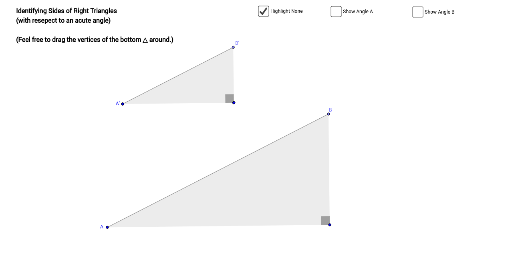
This example demonstrates the concepts of 'OPPOSITE LEG' and 'ADJACENT LEG' with respect to an acute angle in a right triangle. It involves core math concepts like right triangles, acute angles, opposite sides, and adjacent sides. The construction uses GeoGebra commands such as Segment, OrthogonalLine, Point, Angle, Polygon, Vector, Translate, and Dilate. It is suitable for middle school and above students to learn and understand the basic properties of right triangles, aiding in teaching and concept clarification.
GeoGebra Commands & Parameters
Segment(A, B_1) → ADJACENT_AOrthogonalLine(B_1, ADJACENT_A) → bPoint(b) → BSegment(A, B) → HYPOTENUSE_1Segment(B, B_1) → OPPOSITE_AAngle(B, B_1, A) → αPolygon(A, B_1, B) → poly1, c, a, b_1Vector(D, E) → uVector(F, G) → vTranslate(A, v) → A'_3Translate(B_1, v) → B'_3Translate(B, v) → C'Polygon(A'_3, B'_3, C') → poly1', c', a', b'Translate(A, v) → A'_1Translate(B_1, v) → B'_1Segment(A'_1, B'_1) → ADJACENT'Translate(A, v) → A'_2Translate(B, v) → C'_1Segment(A'_2, C'_1) → HYPOTENUSE'Translate(B, v) → C'_2Translate(B_1, v) → B'_2Segment(C'_2, B'_2) → OPPOSITE'Translate(D, v) → D'Dilate(A'_3, 0.5, H) → A'Dilate(B'_3, 0.5, H) → B''Dilate(C', 0.5, H) → B'Polygon(A', B'', B') → poly1'', c'', a'', b''Dilate(A'_1, 0.5, H) → IDilate(B'_1, 0.5, H) → JSegment(I, J) → ADJACENT_A'Dilate(A'_2, 0.5, H) → KDilate(C'_1, 0.5, H) → LSegment(K, L) → HYPOTENUSEDilate(C'_2, 0.5, H) → MDilate(B'_2, 0.5, H) → NSegment(M, N) → OPPOSITE_A'Angle(B_1, A, B) → βAngle(b'', OPPOSITE_A') → δAngle(A, B, B_1) → εAngle(B', B'', A') → ζSegment(A', B'') → OPPOSITE_B'Segment(B'', B') → ADJACENT_B'Segment(A, B_1) → OPPOSITE_BSegment(B_1, B) → ADJACENT_BAngle(B'', A', B') → η
AI Drawing Prompt Reference
Draw a right triangle with the right angle at one endpoint of the base and the other endpoint as an acute vertex. Label the adjacent and opposite legs for that acute angle, and also label the adjacent and opposite legs for the other acute angle. Then add a similar right triangle scaled to half the size, translated and dilated so corresponding angles match, and mark its adjacent and opposite legs for both acute angles. The figure illustrates the adjacent, opposite, and hypotenuse relationships for the acute angles in a right triangle.
The prompt above was compiled from the original drawing commands and is for reference only.