
Hyperbolic Geometric Mean Construction
Loading the math board and drawing, please wait…
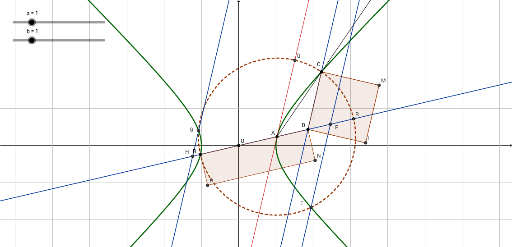
① This example demonstrates how to construct the hyperbolic geometric mean of two points in the Poincaré disk model, highlighting its difference from the Euclidean geometric mean. ② Core mathematical concepts include hyperbolic geometry, geometric mean, tangents, circle-line intersections, and hyperbolic distance properties. ③ Construction details: Based on the summary, it uses GeoGebra commands such as Point, Tangent, Line, Intersect, Circle, Length, Midpoint, Segment, Polygon, OrthogonalLine, Angle, and Ray, involving objects O, a, b, c, A, f, h, B, d, C, g, D, k_1 through k_9, j, i, E, l_1, F, k, m, G, n, H, o, p, q, e, I, J, r, s, K. The construction builds orthogonal circles and tangents to define the hyperbolic structure. ④ Suitable for high school to university geometry classes, especially for intuitive understanding of hyperbolic and non-Euclidean geometry, and as an advanced GeoGebra construction exercise.
GeoGebra Commands & Parameters
Point(c) → ATangent(A, c) → f,Line(A, O) → hIntersect(c, h, 2) → BCircle(A, B) → dIntersect(c, d, 4) → CLine(C, f) → gIntersect(h, g) → DLength(Segment[D, A]) → k_1Length(Segment[D, B]) → k_2Length(Segment[D, C]) → k_3Intersect(c, d, 2) → ELine(E, f) → l_1Intersect(h, l_1) → FLength(Segment[F, E]) → k_4Length(Segment[F, A]) → k_5Length(Segment[F, B]) → k_6Intersect(c, d, 3) → GLine(G, f) → nIntersect(h, n) → HLength(Segment[G, H]) → k_7Length(Segment[B, H]) → k_8Length(Segment[A, H]) → k_9Tangent(B, c) → q,Circle(D, A) → eIntersect(e, h, 2) → IMidpoint(I, B) → JCircle(J, I) → rCircle(D, C) → sIntersect(r, s, 1) → KSegment(D, K) → lPolygon(C, D, 4) → poly1, t, f_1, g_1, h_1, L, MOrthogonalLine(D, h) → i_1Intersect(e, i_1, 2) → NOrthogonalLine(B, h) → j_1Line(N, h) → m_1Intersect(j_1, m_1) → PPolygon(B, D, N, P) → poly2, b_1, d_1, n_1, p_1Intersect(d, f, 1) → QIntersect(d, h, 2) → RAngle(R, A, Q) → αAngle(C, A, Q) → βRay(A, C) → q_1
AI Drawing Prompt Reference
Construct the hyperbolic geometric mean of two points in the Poincaré disk model. Start by drawing a tangent f at point c, then draw a line h through point A that intersects c at point B. Next, draw a circle d with A and B as endpoints of its diameter, which intersects c at point C. Continue with these steps to construct a series of circles, tangents, and intersections, ultimately forming a complex hyperbolic geometric structure.
The prompt above was compiled from the original drawing commands and is for reference only.