
Hyperbola Defined as a Set of Points
Loading the math board and drawing, please wait…
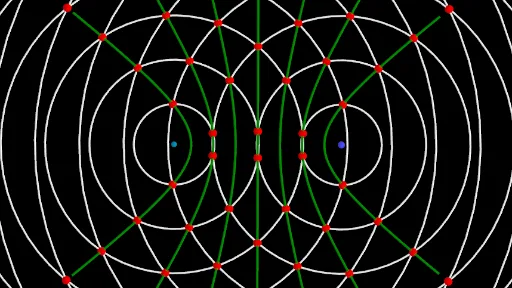
①This example dynamically demonstrates the definition of a hyperbola as the locus of points where the absolute difference of distances to two fixed foci is constant. ②Core mathematical concepts include the geometric definition of a hyperbola, foci, transverse and conjugate axes, and the generation of locus points via circle intersections and reflections. ③Construction highlights: using GeoGebra commands such as Sequence to generate parameterized points, Circle and Line to create auxiliary circles and lines, Mirror for symmetric reflection, and RemoveUndefined to clean invalid objects; key objects include B, λ, v_p, N, a, O, A, S1_1, l3, l1, d, Speed, C, f, g, l4, l5, l2, l2', l6, b, texte1, D, E, and image1. ④Suitable for high school analytic geometry or college conic sections courses, helping students visualize the hyperbola definition and the effect of dynamic parameters on the curve.
GeoGebra Commands & Parameters
Sequence(B + (((-n) * λ) - Mod[(v_p * a), λ], 0), n, 0, N) → l3Sequence(A + ((n * λ) + Mod[(v_p * a), λ], 0), n, 0, N) → l1Circle(O, A, xOyPlane) → dCircle(B, C) → fLine(B, zAxis) → gSequence(Circle[A, Element[l1, i], xOyPlane], i, 1, Length[l1]) → l4Sequence(Circle[B, Element[l3, i]], i, 1, Length[l1]) → l5RemoveUndefined(Join[Sequence[Sequence[Intersect[Element[l5, j], Element[l4, i]], i, 1, Length[l4]], j, 1, Length[l5]]]) → l2Mirror(l2, Segment[A, B]) → l2'Sequence(Hyperbola[A, B, Element[l2, i]], i, 1, Length[l2]) → l6