
How a Prism Becomes a Cylinder
Loading the math board and drawing, please wait…
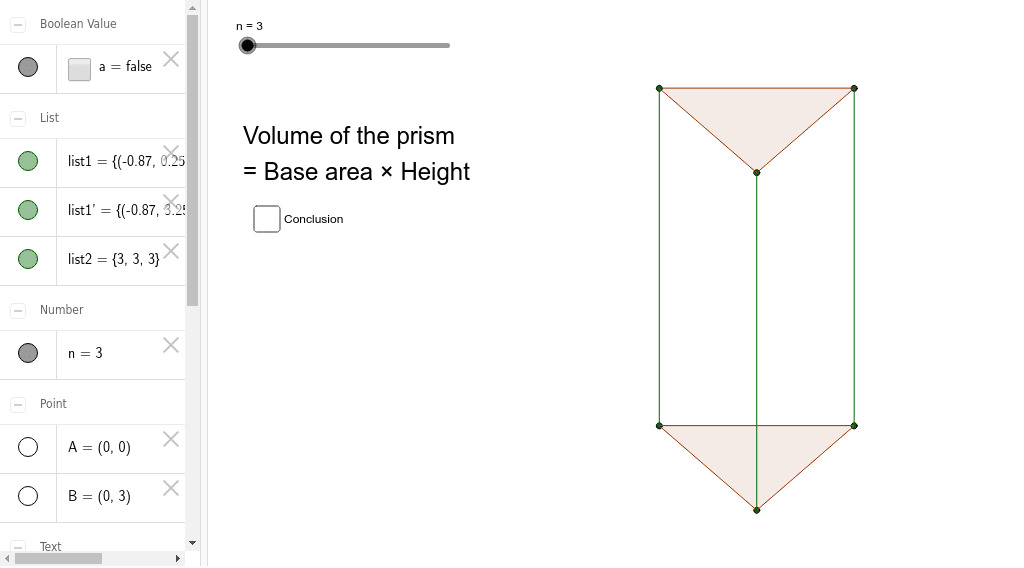
Drag the slider to show how a prism gradually transforms into a cylinder. This example demonstrates the geometric transformation between a prism and a cylinder, illustrating changes in volume. It uses commands like Sequence, Polygon, Vector, and Translate, suitable for middle school and above students studying solid geometry.
GeoGebra Commands & Parameters
Sequence((cos(((2 * π) * i / n) + π / 6), (0.5 * sin(((2 * π) * i / n) + π / 6))), i, 1, n) → list1Polygon(list1) → poly1, , ,Vector(A, B) → uTranslate(poly1, u) → poly1'Translate(list1, u) → list1'Sequence(Segment[(cos(((2 * π) * i / n) + π / 6), (0.5 * sin(((2 * π) * i / n) + π / 6))), (cos(((2 * π) * i / n) + π / 6), 3 + (0.5 * sin(((2 * π) * i / n) + π / 6)))], i, 1, n) → list2
AI Drawing Prompt Reference
Show how a prism gradually transforms into a cylinder using a slider. Start by drawing a polygon as the base, then create a prism by translating the base along a vertical vector. As the slider moves, increase the translation distance to make the prism's sides curve, eventually forming a cylinder. Display the base polygon, the translation vector, and the dynamic relationship between the geometric shapes during the transformation.
The prompt above was compiled from the original drawing commands and is for reference only.