
Homothety & Symmetry Demonstration
Loading the math board and drawing, please wait…
In collections
Homothety, Rotation Symmetry -RO
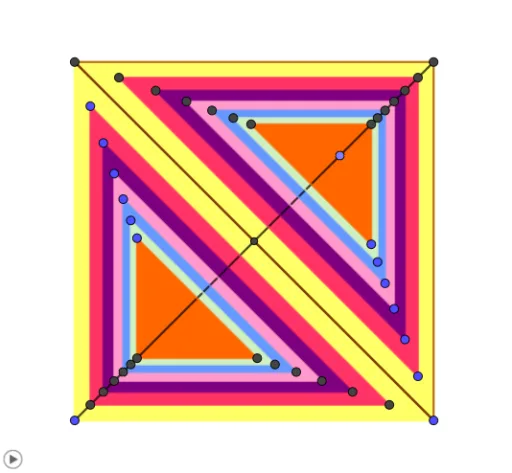
This example demonstrates the application of homothety and symmetry in geometric figures. The core mathematical concepts involved include geometric transformations, similarity, symmetry, and related construction techniques. Using GeoGebra commands such as polygon construction, segment, intersect, point, dilation, and mirror, the effects of these transformations can be visually represented. Suitable for high school students learning geometric transformations and symmetry, as well as providing practical examples for geometric construction.
GeoGebra Commands & Parameters
Polygon(A, B, 4) → poly1, f, g, h, i, C, DSegment(C, A) → jSegment(D, B) → kIntersect(j, k) → EPolygon(D, B, C) → t1, c, d, bPoint(j) → FDilate(D, 5 / 6, F) → D'Dilate(B, 5 / 6, F) → B'Dilate(C, 5 / 6, F) → C'Polygon(D', B', C') → t1', c', d', b'Dilate(D', 5 / 6, F) → D''Dilate(B', 5 / 6, F) → B''Dilate(C', 5 / 6, F) → C''Polygon(D'', B'', C'') → t1'', c'', d'', b''Dilate(D'', 5 / 6, F) → D'''Dilate(B'', 5 / 6, F) → B'''Dilate(C'', 5 / 6, F) → C'''Polygon(D''', B''', C''') → t1''', c''', d''', b'''Dilate(D''', 5 / 6, F) → GDilate(B''', 5 / 6, F) → HDilate(C''', 5 / 6, F) → IPolygon(G, H, I) → t2, i_1, g_1, h_1Dilate(G, 5 / 6, F) → G'Dilate(H, 5 / 6, F) → H'Dilate(I, 5 / 6, F) → I'Polygon(G', H', I') → t2', i', g', h'Dilate(G', 5 / 6, F) → G''Dilate(H', 5 / 6, F) → H''Dilate(I', 5 / 6, F) → I''Polygon(G'', H'', I'') → t2'', i'', g'', h''Mirror(D', E) → D''_1Mirror(B', E) → B''_1Mirror(C', E) → C''_1Polygon(D''_1, B''_1, C''_1) → t1''_1, c''_1, d''_1, b''_1Mirror(D'', E) → D'''_1Mirror(B'', E) → B'''_1Mirror(C'', E) → C'''_1Polygon(D'''_1, B'''_1, C'''_1) → t1'''_1, c'''_1, d'''_1, b'''_1Mirror(D''', E) → JMirror(B''', E) → KMirror(C''', E) → LPolygon(J, K, L) → t3, l, j_1, k_1Mirror(G, E) → G'_1Mirror(H, E) → H'_1Mirror(I, E) → I'_1Polygon(G'_1, H'_1, I'_1) → t2'_1, i'_1, g'_1, h'_1Mirror(G', E) → G''_1Mirror(H', E) → H''_1Mirror(I', E) → I''_1Polygon(G''_1, H''_1, I''_1) → t2''_1, i''_1, g''_1, h''_1Mirror(G'', E) → G'''Mirror(H'', E) → H'''Mirror(I'', E) → I'''Polygon(G''', H''', I''') → t2''', i''', g''', h'''
AI Drawing Prompt Reference
Draw a square. Connect its diagonals, which intersect at a central point. Inside the square, construct a triangle with vertices on the two diagonals. From the intersection point, repeatedly dilate this triangle by a factor of 5/6, creating a series of progressively smaller nested triangles. Simultaneously, reflect each of these dilated triangles about the same intersection point, producing a mirrored series of nested triangles. The final figure shows two symmetric sets of shrinking triangles, illustrating scaling and reflection transformations.
The prompt above was compiled from the original drawing commands and is for reference only.