
Sine Function Graph and Limits
Loading the math board and drawing, please wait…
In collections
Homothety, Rotation Symmetry -RO
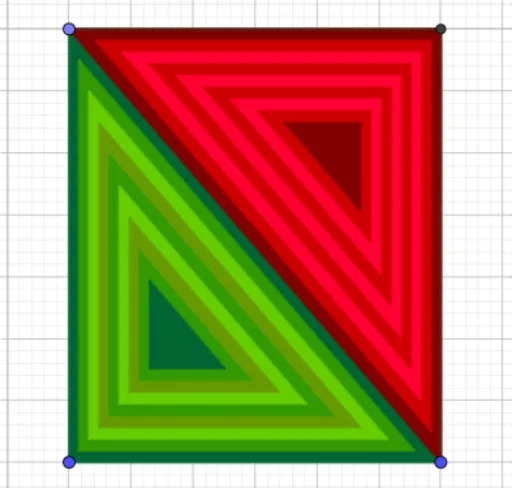
This example demonstrates the graph of the sine function and the concept of limits. By constructing the sine function graph, it helps understand the periodicity and amplitude characteristics of the function. Using GeoGebra commands such as Segment, OrthogonalLine, Point, etc., it illustrates the process of drawing function graphs. Suitable for high school mathematics education, aiding students in understanding basic concepts of function graphs and limits.
GeoGebra Commands & Parameters
Segment(A, B) → fOrthogonalLine(A, f) → gOrthogonalLine(B, f) → hPoint(g) → COrthogonalLine(C, g) → iIntersect(h, i) → DPolygon(C, D, B, A) → q1, c, d, b, aPolygon(C, B, D) → t1, d_1, c_1, b_1AngularBisector(D, C, B) → jSegment(D, A) → kIntersect(k, d_1) → EPoint(k) → FDilate(C, 9 / 10, F) → C'Dilate(B, 9 / 10, F) → B'Dilate(D, 9 / 10, F) → D'Polygon(C', B', D') → t1', d', c', b'Dilate(C, 8 / 10, F) → C'_1Dilate(B, 8 / 10, F) → B'_1Dilate(D, 8 / 10, F) → D'_1Polygon(C'_1, B'_1, D'_1) → t1'_1, d'_1, c'_1, b'_1Dilate(C, 7 / 10, F) → C'_2Dilate(B, 7 / 10, F) → B'_2Dilate(D, 7 / 10, F) → D'_2Polygon(C'_2, B'_2, D'_2) → t1'_2, d'_2, c'_2, b'_2Dilate(C, 6 / 10, F) → C'_3Dilate(B, 6 / 10, F) → B'_3Dilate(D, 6 / 10, F) → D'_3Polygon(C'_3, B'_3, D'_3) → t1'_3, d'_3, c'_3, b'_3Dilate(C, 5 / 10, F) → C'_4Dilate(B, 5 / 10, F) → B'_4Dilate(D, 5 / 10, F) → D'_4Polygon(C'_4, B'_4, D'_4) → t1'_4, d'_4, c'_4, b'_4Dilate(C, 4 / 10, F) → C'_5Dilate(B, 4 / 10, F) → B'_5Dilate(D, 4 / 10, F) → D'_5Polygon(C'_5, B'_5, D'_5) → t1'_5, d'_5, c'_5, b'_5Dilate(C, 3 / 10, F) → C'_6Dilate(B, 3 / 10, F) → B'_6Dilate(D, 3 / 10, F) → D'_6Polygon(C'_6, B'_6, D'_6) → t1'_6, d'_6, c'_6, b'_6Dilate(C, 2 / 10, F) → C'_7Dilate(B, 2 / 10, F) → B'_7Dilate(D, 2 / 10, F) → D'_7Polygon(C'_7, B'_7, D'_7) → t1'_7, d'_7, c'_7, b'_7Mirror(C', E) → C''Mirror(B', E) → B''Mirror(D', E) → D''Polygon(C'', B'', D'') → t1'', d'', c'', b''Mirror(C', E) → C''_1Mirror(B', E) → B''_1Mirror(D', E) → D''_1Mirror(C'_1, E) → GMirror(B'_1, E) → HMirror(D'_1, E) → IPolygon(G, H, I) → t2, i_1, g_1, h_1Mirror(C'_2, E) → JMirror(B'_2, E) → KMirror(D'_2, E) → LPolygon(J, K, L) → t3, l, j_1, k_1Mirror(C'_3, E) → MMirror(B'_3, E) → NMirror(D'_3, E) → OPolygon(M, N, O) → t4, o, m, nMirror(C'_4, E) → PMirror(B'_4, E) → QMirror(D'_4, E) → RPolygon(P, Q, R) → t5, r, p, qMirror(C'_5, E) → SMirror(B'_5, E) → TMirror(D'_5, E) → UPolygon(S, T, U) → t6, u, s, tMirror(C'_6, E) → VMirror(B'_6, E) → WMirror(D'_6, E) → ZPolygon(V, W, Z) → t7, z_1, v, wMirror(C'_7, E) → A_1Mirror(B'_7, E) → B_1Mirror(D'_7, E) → C_1Polygon(A_1, B_1, C_1) → t8, c_2, a_1, b_2