
Homothety and Symmetry - George
Loading the math board and drawing, please wait…
In collections
Homothety, Rotation Symmetry -RO
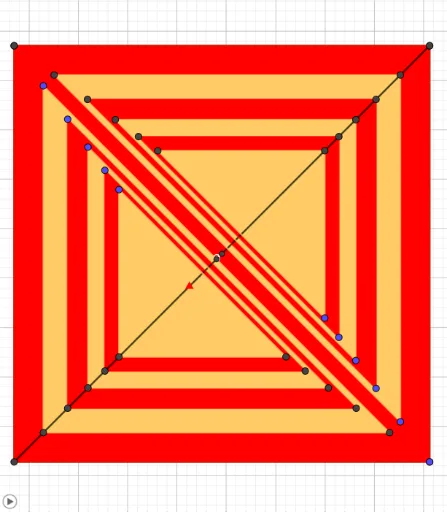
This example illustrates the concepts of homothety and symmetry. Using GeoGebra commands such as Polygon, Segment, Midpoint, Point, Dilate, Mirror, etc., the transformation and symmetry of geometric figures are clearly demonstrated. Suitable for students at the junior high school level and above.
GeoGebra Commands & Parameters
Polygon(A, B, 4) → poly1, f, g, h, i, C, DSegment(A, C) → jMidpoint(A, C) → EPoint(j) → FPolygon(B, D, C) → t1, c, b, dDilate(B, 5 / 6, F) → B'Dilate(D, 5 / 6, F) → D'Dilate(C, 5 / 6, F) → C'Polygon(B', D', C') → t1', c', b', d'Dilate(B', 5 / 6, F) → B''Dilate(D', 5 / 6, F) → D''Dilate(C', 5 / 6, F) → C''Polygon(B'', D'', C'') → t1'', c'', b'', d''Dilate(B'', 5 / 6, F) → B'''Dilate(D'', 5 / 6, F) → D'''Dilate(C'', 5 / 6, F) → C'''Polygon(B''', D''', C''') → t1''', c''', b''', d'''Dilate(B''', 5 / 6, F) → GDilate(D''', 5 / 6, F) → HDilate(C''', 5 / 6, F) → IPolygon(G, H, I) → t2, i_1, g_1, h_1Dilate(G, 5 / 6, F) → G'Dilate(H, 5 / 6, F) → H'Dilate(I, 5 / 6, F) → I'Polygon(G', H', I') → t2', i', g', h'Mirror(B, E) → B'_1Mirror(D, E) → D'_1Mirror(C, E) → C'_1Polygon(B'_1, D'_1, C'_1) → t1'_1, c'_1, b'_1, d'_1Mirror(B', E) → B''_1Mirror(D', E) → D''_1Mirror(C', E) → C''_1Polygon(B''_1, D''_1, C''_1) → t1''_1, c''_1, b''_1, d''_1Mirror(B'', E) → B'''_1Mirror(D'', E) → D'''_1Mirror(C'', E) → C'''_1Polygon(B'''_1, D'''_1, C'''_1) → t1'''_1, c'''_1, b'''_1, d'''_1Mirror(B''', E) → JMirror(D''', E) → KMirror(C''', E) → LPolygon(J, K, L) → t3, l, j_1, kMirror(G, E) → G'_1Mirror(H, E) → H'_1Mirror(I, E) → I'_1Polygon(G'_1, H'_1, I'_1) → t2'_1, i'_1, g'_1, h'_1Mirror(G', E) → G''Mirror(H', E) → H''Mirror(I', E) → I''Polygon(G'', H'', I'') → t2'', i'', g'', h''Dilate(E, 5 / 6, F) → E'
AI Drawing Prompt Reference
Draw a square ABCD, connect its diagonals, find the midpoint E of AC, dilate B, C, D by 5/6 to get B', C', D', then dilate B', C', D' to get B'', C'', D'', and finally dilate B'', C'', D'' to get B''', C''', D'''. Mirror B, C, D about E to get B'_1, C'_1, D'_1, then mirror B'_1, C'_1, D'_1 to get B''_1, C''_1, D''_1, and finally mirror B''_1, C''_1, D''_1 to get B'''_1, C'''_1, D'''_1.
The prompt above was compiled from the original drawing commands and is for reference only.