
Vlad 1
Loading the math board and drawing, please wait…
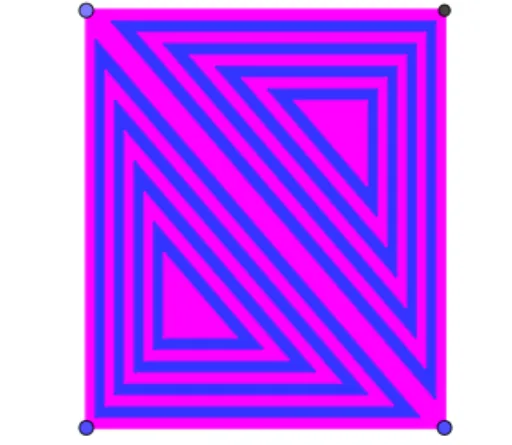
This example demonstrates geometric construction of triangles. Key mathematical concepts include triangles, angles, and transformations. Using GeoGebra commands such as Segment, OrthogonalLine, Point, etc., complex geometric shapes can be constructed. Suitable for middle school and above students to learn geometric construction.
GeoGebra Commands & Parameters
Segment(A, B) → fOrthogonalLine(A, f) → gOrthogonalLine(B, f) → hPoint(g) → COrthogonalLine(C, g) → iIntersect(h, i) → DPolygon(C, D, B, A) → q1, c, d, b, aPolygon(C, B, D) → t1, d_1, c_1, b_1AngularBisector(D, C, B) → jSegment(D, A) → kIntersect(k, d_1) → EPoint(k) → FDilate(C, 9 / 10, F) → C'Dilate(B, 9 / 10, F) → B'Dilate(D, 9 / 10, F) → D'Polygon(C', B', D') → t1', d', c', b'Dilate(C, 8 / 10, F) → C'_1Dilate(B, 8 / 10, F) → B'_1Dilate(D, 8 / 10, F) → D'_1Polygon(C'_1, B'_1, D'_1) → t1'_1, d'_1, c'_1, b'_1Dilate(C, 7 / 10, F) → C'_2Dilate(B, 7 / 10, F) → B'_2Dilate(D, 7 / 10, F) → D'_2Polygon(C'_2, B'_2, D'_2) → t1'_2, d'_2, c'_2, b'_2Dilate(C, 6 / 10, F) → C'_3Dilate(B, 6 / 10, F) → B'_3Dilate(D, 6 / 10, F) → D'_3Polygon(C'_3, B'_3, D'_3) → t1'_3, d'_3, c'_3, b'_3Dilate(C, 5 / 10, F) → C'_4Dilate(B, 5 / 10, F) → B'_4Dilate(D, 5 / 10, F) → D'_4Polygon(C'_4, B'_4, D'_4) → t1'_4, d'_4, c'_4, b'_4Dilate(C, 4 / 10, F) → C'_5Dilate(B, 4 / 10, F) → B'_5Dilate(D, 4 / 10, F) → D'_5Polygon(C'_5, B'_5, D'_5) → t1'_5, d'_5, c'_5, b'_5Dilate(C, 3 / 10, F) → C'_6Dilate(B, 3 / 10, F) → B'_6Dilate(D, 3 / 10, F) → D'_6Polygon(C'_6, B'_6, D'_6) → t1'_6, d'_6, c'_6, b'_6Dilate(C, 2 / 10, F) → C'_7Dilate(B, 2 / 10, F) → B'_7Dilate(D, 2 / 10, F) → D'_7Polygon(C'_7, B'_7, D'_7) → t1'_7, d'_7, c'_7, b'_7Mirror(C', E) → C''Mirror(B', E) → B''Mirror(D', E) → D''Polygon(C'', B'', D'') → t1'', d'', c'', b''Mirror(C', E) → C''_1Mirror(B', E) → B''_1Mirror(D', E) → D''_1Mirror(C'_1, E) → GMirror(B'_1, E) → HMirror(D'_1, E) → IPolygon(G, H, I) → t2, i_1, g_1, h_1Mirror(C'_2, E) → JMirror(B'_2, E) → KMirror(D'_2, E) → LPolygon(J, K, L) → t3, l, j_1, k_1Mirror(C'_3, E) → MMirror(B'_3, E) → NMirror(D'_3, E) → OPolygon(M, N, O) → t4, o, m, nMirror(C'_4, E) → PMirror(B'_4, E) → QMirror(D'_4, E) → RPolygon(P, Q, R) → t5, r, p, qMirror(C'_5, E) → SMirror(B'_5, E) → TMirror(D'_5, E) → UPolygon(S, T, U) → t6, u, s, tMirror(C'_6, E) → VMirror(B'_6, E) → WMirror(D'_6, E) → ZPolygon(V, W, Z) → t7, z_1, v, wMirror(C'_7, E) → A_1Mirror(B'_7, E) → B_1Mirror(D'_7, E) → C_1Polygon(A_1, B_1, C_1) → t8, c_2, a_1, b_2
AI Drawing Prompt Reference
Draw a triangle and construct perpendicular lines from each vertex to the opposite side to find the third vertex. Form a new triangle using these points. Scale this triangle multiple times around the foot of the perpendiculars with decreasing ratios. Finally, reflect the scaled triangles over the midpoints of the perpendiculars to create the final design.
The prompt above was compiled from the original drawing commands and is for reference only.