
Homogeneity of the Dot Product
Loading the math board and drawing, please wait…
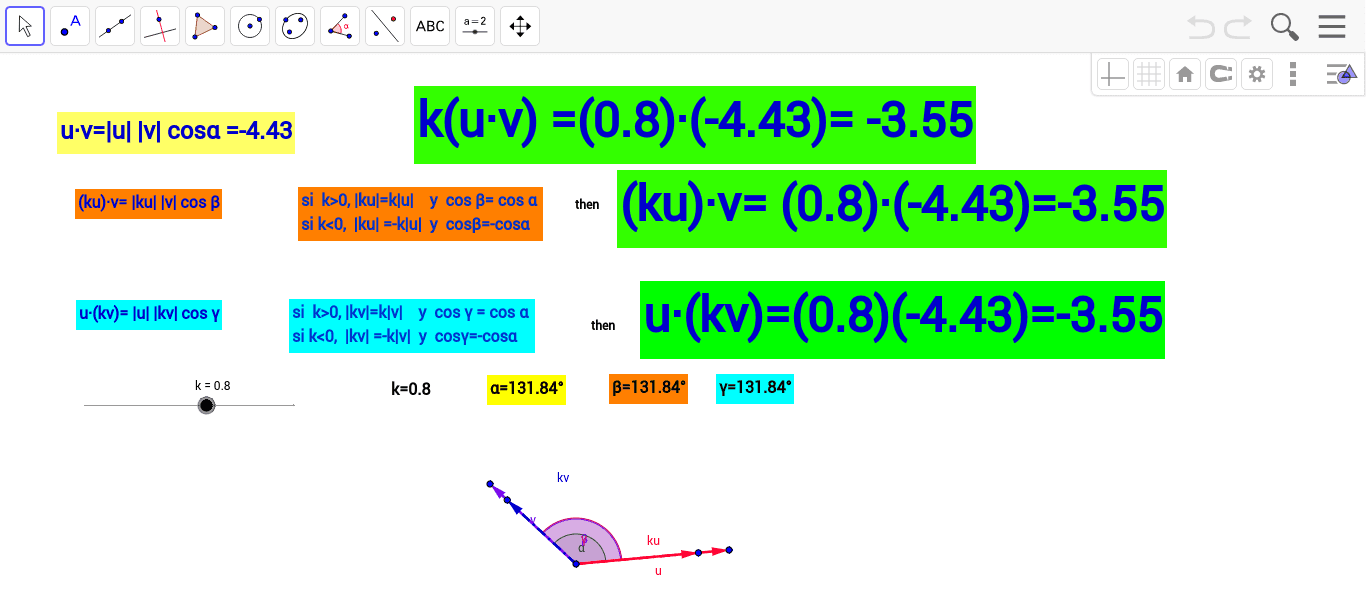
This example demonstrates the property of the dot product being homogeneous: k(u·v) = (ku)·v = u·(kv) for any vectors u and v. Using GeoGebra commands such as Vector, Angle, Distance, and Translate, the example provides a visual understanding of this property. Suitable for high school mathematics education and learning.
GeoGebra Commands & Parameters
Vector(A, B) → uVector(A, C) → vAngle(B, A, C) → αDistance(A, C) → fDistance(A, B) → gTranslate(A, w) → A'Vector(A, A') → kvTranslate(A, m) → A'_1Vector(A, A'_1) → kuAngle(C, A, A'_1) → βAngle(A', A, B) → γ
AI Drawing Prompt Reference
Draw two vectors u and v, and their dot product. Use points A, B, and C, with vector u from A to B and vector v from A to C. Change the lengths of vectors u and v to observe the homogeneity of the dot product, i.e., k(u·v) = (ku)·v = u·(kv).
The prompt above was compiled from the original drawing commands and is for reference only.