
Hexahedron 10 Overlap-A
Loading the math board and drawing, please wait…
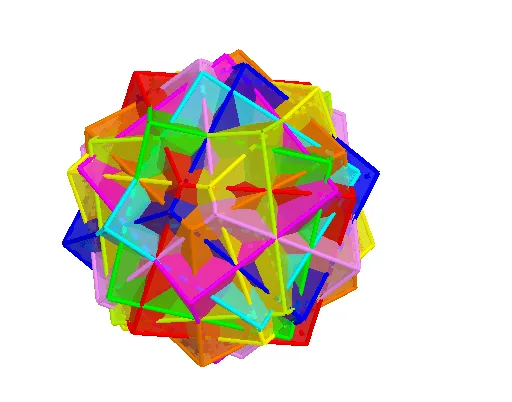
This example demonstrates the geometric construction of a hexahedron 10 overlap. Key mathematical concepts include solid geometry and geometric construction. Using GeoGebra commands such as Intersect, Rotate, Point, etc., multiple hexahedra are constructed and overlapped. Suitable for high school or university students studying solid geometry.
GeoGebra Commands & Parameters
Intersect(c, xAxis, 1) → ARotate(A, 72°, O) → A'Rotate(A', 72°, O) → A''Rotate(A'', 72°, O) → A'''Rotate(A''', 72°, O) → BPoint(Circle[((A * (1 - sqrt(5))) + (A' * (3 + sqrt(5)))) / 4, (Distance[A, A'] * sqrt(10 + (2 * sqrt(5))) / 4), Segment[A, A']]) → CDodecahedron(A, A', C) → a, D, M, N, P, Q, R, S, T, U, faceAA'CDE, faceAEIPJ, E, faceAA'FKJ, faceA'CGLF, faceCDHMG, faceDEINH, faceINTUP, faceJKQUP, faceFKQRL, faceGLRSM, faceHMSTN, faceQRSTU, F, edgeAE, edgeAA', edgeA'C, edgeCD, edgeDE, edgeAJ, edgeEI, edgeIP, edgeJP, edgeJK, G, edgeFK, edgeA'F, edgeFL, edgeGL, edgeCG, edgeGM, edgeHM, edgeDH, edgeHN, edgeIN, H, edgeNT, edgeTU, edgePU, edgeQU, edgeKQ, edgeQR, edgeLR, edgeRS, edgeMS, edgeST, I, J, K, LMidpoint(Q, D) → VVector(V, O) → uTranslate(c, u) → c'Translate(A, u) → B_1Translate(A', u) → B_2Translate(A'', u) → B_3Point(Circle[((B_1 * (1 - sqrt(5))) + (B_2 * (3 + sqrt(5)))) / 4, (Distance[B_1, B_2] * sqrt(10 + (2 * sqrt(5))) / 4), Segment[B_1, B_2]]) → WDodecahedron(B_1, B_2, W) → b, Z, J_1, K_1, L_1, M_1, N_1, O_1, P_1, Q_1, face1, face3, A_1, face2, face4, face5, face6, face10, face11, face7, face8, face9, face12, C_1, edge2, edge1, edge4, edgeWZ, edge7, edge3, edge9, edge17, edge19, edge18, D_1, edge10, edge5, edge11, edge12, edge6, edge13, edge14, edge8, edge15, edge16, E_1, edge23, edge29, edge24, edge26, edge20, edge25, edge21, edge27, edge22, edge28, F_1, G_1, H_1, I_1Intersect(edge12, edge13) → R_1Polygon(P_1, N_1, R_1, E_1) → q1, p_1, n_1, r_1, e_1Prism(q1, L_1) → d, S_1, edge34, edge35, edge30, edge32, edge36, edge37, edge33, T_1, U_1, face15, face17, face14, face13, face16, edge31Line(U_1, N_1) → fOrthogonalLine(P_1, f, space) → gOrthogonalLine(Q_1, f, space) → hIntersect(f, h) → V_1Angle(P_1, V_1, Q_1) → αRotate(d, α, f) → d'OrthogonalLine(O_1, f, space) → iLine(V_1, i) → jPoint(j) → W_1Angle(W_1, V_1, P_1) → βRotate(d, (-β), f) → d'_1Line(G_1, J_1) → kOrthogonalLine(Q_1, k, space) → lOrthogonalLine(S_1, k, space) → mIntersect(m, k) → Z_1Line(Z_1, l) → nPoint(n) → A_2Line(Q_1, J_1) → pPoint(edge20) → C_2Line(C_2, J_1) → qAngle(C_2, J_1, Q_1) → γRotate(d', (-γ), k) → d''Rotate(d'', 72°, zAxis) → d'''Rotate(d'', 144°, zAxis) → d'''_1Rotate(d'', 216°, zAxis) → d'''_2Rotate(d'', 288°, zAxis) → d'''_3Rotate(d'_1, 72°, zAxis) → eRotate(e, 72°, zAxis) → e'Rotate(e', 72°, zAxis) → e''Rotate(e'', 72°, zAxis) → e'''
AI Drawing Prompt Reference
Draw a 3D geometric composition consisting of two overlapping regular dodecahedra. Start by constructing a regular pentagon on a horizontal plane and use it as the base to form the first dodecahedron. Find the midpoint of one edge of this dodecahedron, connect it to the center, and use this vector to translate the entire dodecahedron, creating a second dodecahedron. Then, select points on the intersecting edges of the two dodecahedra to define a polygon, and extrude this polygon into a prism. Adjust the prism's orientation through rotations and reflections to fit the overlapping structure. Finally, rotate the adjusted prism around the vertical axis five times at 72-degree intervals, producing five symmetrically arranged prisms that interlock with the dodecahedra, forming a highly symmetric complex solid.
The prompt above was compiled from the original drawing commands and is for reference only.