
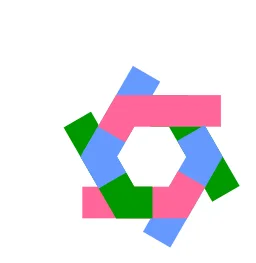
Hex Slider: Dynamic Animation of a Folded Paper Model
Loading the math board and drawing, please wait…
In collections
Action Modular Origami
This example demonstrates a dynamic animation of a hexagonal slider model folded from paper, showcasing geometric changes during the folding motion. Core mathematical concepts include polygons, rotation, translation, dilation (homothety), and vector transformations, involving basic shapes like hexagons and rhombi. Construction highlights: using GeoGebra commands such as Point, Polygon, Rotate, Segment, Intersect, Line, Dilate, Vector, Translate, and Midpoint, the model builds multiple polygons (poly1, poly2, poly3) with associated points (e.g., C', D', E') and uses sliders (nSides, α) to control the number of sides and angle, enabling dynamic folding effects. Suitable for middle/high school geometry lessons, origami-based math exploration, or dynamic geometry demonstrations, helping students intuitively understand transformations and polygon properties.
GeoGebra Commands & Parameters
Point(xAxis) → BPolygon(A, B, C, D) → poly1, a, b, c, dRotate(C, α, C) → C'Rotate(D, α, C) → D'Segment(C', D') → c'Intersect(a, c') → ERotate(E, (-(90°)), C) → E'Line(E', c') → fIntersect(f, c) → FPolygon(A, E, C, E', F, D) → poly2, a_1, e, c_1, e', f_1, d_1Rotate(C, (-α), F) → C'_1Line(C'_1, a_1) → gLine(A, d_1) → hIntersect(g, h) → GPolygon(D, F, E', C, C'_1, G) → poly3, d_2, f_2, e'_1, c_2, c'_1, g_1Rotate(D, (-α), F) → D'_1Rotate(F, (-α), F) → F'Rotate(E', (-α), F) → E''Rotate(C, (-α), F) → C'_2Rotate(C'_1, (-α), F) → HRotate(G, (-α), F) → G'Polygon(D'_1, F', E'', C'_2, H, G') → poly3', d'_1, f', e'', c'_2, h_1, g'Dilate(F', fac, D) → IVector(F, I) → uTranslate(D'_1, u) → JTranslate(F', u) → F''Translate(E'', u) → E'''Translate(C'_2, u) → KTranslate(H, u) → H'Translate(G', u) → G''Polygon(J, F'', E''', K, H', G'') → poly3'', j, f'', e''', k, h', g''Polygon(I, F, nSides) → poly4, i, O, l, m, n, p, q, L, M, NMidpoint(F, N) → PRotate(D, α, P) → D'_2Rotate(F, α, P) → F'_1Rotate(E', α, P) → E''_1Rotate(C, α, P) → C'_3Rotate(C'_1, α, P) → QRotate(G, α, P) → G'_1Polygon(D'_2, F'_1, E''_1, C'_3, Q, G'_1) → poly3'_1, d'_2, f'_1, e''_1, c'_3, q_1, g'_1Rotate(D'_2, α, P) → RRotate(F'_1, α, P) → SRotate(E''_1, α, P) → TRotate(C'_3, α, P) → URotate(Q, α, P) → Q'Rotate(G'_1, α, P) → VPolygon(R, S, T, U, Q', V) → poly5, r, s, t, u_1, q', vRotate(R, α, P) → R'Rotate(S, α, P) → S'Rotate(T, α, P) → T'Rotate(U, α, P) → U'Rotate(Q', α, P) → Q''Rotate(V, α, P) → V'Polygon(R', S', T', U', Q'', V') → poly5', r', s', t', u', q'', v'Rotate(R', α, P) → R''Rotate(S', α, P) → S''Rotate(T', α, P) → T''Rotate(U', α, P) → U''Rotate(Q'', α, P) → Q'''Rotate(V', α, P) → V''Polygon(R'', S'', T'', U'', Q''', V'') → poly5'', r'', s'', t'', u'', q''', v''Polygon(H', K, E''', I, T'', U'') → poly6, h'_1, k_1, e'''_1, i_1, t''_1, u''_1Polygon(U'', T'', S'', T', U', Q''') → poly7, u''_2, t''_2, s''_1, t'_1, u'_1, q'''_1
AI Drawing Prompt Reference
Draw a dynamic folded paper model based on a hexagon. Start with a hexagon, rotate two adjacent vertices around one vertex by an angle to create new edges, and find their intersection with the original side. Use this intersection as a pivot to rotate several vertices by the opposite angle, forming another polygon. Then translate some vertices by a vector to create a copy. Next, take the midpoint of a side as a new pivot, rotate a set of vertices twice by the same angle to generate two more hexagons. The final figure shows multiple interlocking hexagons and rhombus-like regions, illustrating rotation, translation, and folding transformations.
The prompt above was compiled from the original drawing commands and is for reference only.