
Heptagon Angle Theorems
Loading the math board and drawing, please wait…
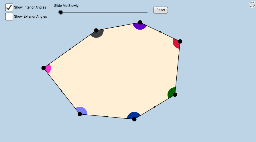
This applet demonstrates how students can explore the sum of the interior angles and the sum of the exterior angles of a heptagon through interactive tools. Key math concepts include the polygon interior angle sum theorem, exterior angle sum theorem, and angle measurement. Construction highlights involve GeoGebra commands like Ray, Circle, Intersect, Segment, CircleSector, Vector, Translate, Dilate, If, Polygon, Point, Midpoint, Rotate, and Line. Suitable for middle school and above students for geometry learning and exploration, helping them understand the basic properties of polygons.
GeoGebra Commands & Parameters
Ray(N_1, D) → l_4Circle(D, 3) → kIntersect(k, l_4) → W_1, Z_1Ray(D, A_1) → a_3Intersect(k, a_3, 1) → D_1Segment(C, A_1) → i_3Circle(C, 3) → hIntersect(h, i_3) → L,Ray(C, D) → cIntersect(h, c, 1) → PRay(A, B) → aRay(B, C) → bRay(E, A) → eCircle(A, 3) → fCircle(B, 3) → gCircle(E, 3) → pSegment(C, A) → iSegment(C, E) → jIntersect(f, a, 1) → FIntersect(f, i, 1) → GIntersect(f, e, 1) → HIntersect(f, e, 2) → IIntersect(p, e) → J,Intersect(p, j) → K,Intersect(k, c, 2) → OIntersect(h, j, 1) → QIntersect(h, i, 1) → RIntersect(h, b, 1) → SIntersect(g, a, 2) → TIntersect(g, b, 1) → UIntersect(g, a, 1) → VCircleSector(A, F, G) → qCircleSector(A, G, H) → rCircleSector(B, U, V) → sCircleSector(C, Q, R) → c_1CircleSector(C, R, S) → d_1Intersect(k, c, 1) → WCircleSector(E, J, K) → h_1CircleSector(A, I, F) → p_1CircleSector(B, T, U) → q_1Intersect(h, b, 2) → ZVector(A, B) → uVector(C, B) → vVector(E, D) → wVector(C, D) → u_1Vector(C, E) → v_1Vector(A, E) → w_1Translate(d_1, v) → s_1Dilate(A, If[0 < l ≤ 1, 1 - l, 0], B) → A'Dilate(C, If[0 < l ≤ 1, 1 - l, 0], B) → C'Dilate(A, If[1 < l ≤ 2, 2 - l, 0], E) → A'_1Dilate(C, If[1 < l ≤ 2, 2 - l, 0], E) → C'_1Dilate(C, If[2 < l ≤ 3, 3 - l, 0], D) → C'_2Dilate(E, If[2 < l ≤ 3, 3 - l, 0], D) → E'Vector(A, B) → a_1Vector(C, C') → b_1Vector(A, A'_1) → i_1Vector(E, E') → j_1Vector(C, C'_2) → l_1Vector(C, C'_1) → m_1Translate(d_1, b_1) → c_2Translate(r, i_1) → r'_1Translate(r, w_1) → r'_2Translate(c_1, v_1) → f_2Translate(c_1, m_1) → g_2CircleSector(C, P, L) → tTranslate(t, u_1) → t'Translate(t, l_1) → t'_1Translate(q, a_1) → r'Translate(d_1, b_1) → h_2Vector(A, A') → n_1Ray(C, E) → i_2Vector(D, C) → u_2Vector(E, C) → v_2Vector(A, C) → w_2Vector(B, C) → l_2Dilate(B, If[0 < o < 1, 1 - o, 0], C) → B'Dilate(A, If[1 < o < 2, 2 - o, 0], C) → A'_2Dilate(E, If[2 < o < 3, 3 - o, 0], C) → E'_1Dilate(D, If[3 < o < 4, 4 - o, 0], C) → D'Vector(B, B') → m_2Vector(A, A'_2) → n_2Vector(E, E'_1) → s_2Vector(D, D') → t_2Translate(q_1, m_2) → c_3Translate(q_1, l_2) → d_3Translate(p_1, w_2) → e_3If(1 < o < 2, Translate[p_1, n_2]) → h_3Ray(A_1, E) → b_3Circle(A_1, 3) → q_3Intersect(q_3, i_3) → M,Intersect(q_3, b_3, 1) → NIntersect(q_3, a_3, 2) → B_1Intersect(k, c, 2) → C_1Intersect(k, c, 1) → E_1CircleSector(C, L, Q) → dIntersect(p, b_3, 1) → F_1Intersect(p, i_2) → G_1, H_2CircleSector(E, G_1, N) → e_1Dilate(E, If[2 < l < 3, 3 - l, 0], A_1) → E'_2Dilate(C, If[2 < l < 3, 3 - l, 0], A_1) → C'_3Dilate(C, If[3 < l < 4, 4 - l, 0], D) → C'_4Dilate(A_1, If[3 < l < 4, 4 - l, 0], D) → H_1Vector(E, A_1) → f_1Vector(C, A_1) → g_1Translate(e_1, f_1) → k_1Translate(d, g_1) → d'Vector(E, E'_2) → a_2Vector(C, C'_3) → b_2Translate(e_1, a_2) → d_2Translate(d, b_2) → d'_1CircleSector(A_1, N, M) → f_3Intersect(q_3, a_3, 1) → I_1CircleSector(A_1, M, I_1) → g_3CircleSector(D, D_1, E_1) → k_3Vector(C, D) → j_2Vector(A_1, D) → u_3Translate(g_3, u_3) → p_3Translate(t, j_2) → t'_2Vector(A_1, H_1) → v_3Vector(C, C'_4) → w_3Translate(g_3, v_3) → s_3Translate(t, w_3) → t'_3Intersect(p, b_3, 2) → J_1Polygon(A, B, C) → poly1, c_4, a_4, b_4Polygon(A, C, E) → poly2, e_4, a_5, c_5Polygon(E, C, A_1) → poly3, a_6, e_5, c_6Polygon(A_1, C, D) → poly4, d_4, a_7, c_7Intersect(p, e, 1) → L_1CircleSector(E, J_1, L_1) → f_4CircleSector(A_1, B_1, N) → g_4Vector(E, C) → j_3Vector(A_1, C) → l_3Vector(D, C) → m_3Translate(f_4, j_3) → k_4Translate(g_4, l_3) → p_4CircleSector(D, Z_1, D_1) → h_4Translate(h_4, m_3) → q_4Dilate(E, If[2 < o < 3, 3 - o, 0], C) → E'_3Dilate(A_1, If[3 < o < 4, 4 - o, 0], C) → M_1Dilate(D, If[4 < o < 5, 5 - o, 0], C) → D'_1Vector(E, E'_3) → n_3Vector(A_1, M_1) → u_4Vector(D, D'_1) → v_4If(2 < o < 3, Translate[f_4, n_3]) → r_4If(3 < o < 4, Translate[g_4, u_4]) → s_4If(4 < o < 5, Translate[h_4, v_4]) → t_4Ray(C, N_1) → i_4Circle(N_1, 3) → d_5Intersect(d_5, i_4, 2) → K_1Intersect(d_5, l_4, 1) → O_1Intersect(d_5, i_4, 1) → P_1Intersect(h, i_4, 1) → Q_1CircleSector(C, Q_1, P) → f_5CircleSector(N_1, O_1, P_1) → g_5Intersect(k, l_4, 1) → R_1CircleSector(D, E_1, R_1) → h_5Dilate(D, If[4 < l < 5, 5 - l, 0], N_1) → D'_2Dilate(C, If[4 < l < 5, 5 - l, 0], N_1) → C'_5Vector(C, N_1) → w_4Vector(D, N_1) → j_4Translate(h_5, j_4) → p_5Vector(D, D'_2) → m_4Vector(C, C'_5) → n_4Translate(h_5, m_4) → r_5Polygon(D, C, N_1) → poly5, n_5, d_6, c_8Segment(D, C) → b_5Ray(C, E) → i_5Ray(C, A_1) → j_5Ray(C, D) → l_5Point(j_5) → T_1Point(l_5) → U_1Ray(A_1, T_1) → m_5Ray(D, U_1) → b_6Polygon(A_1, E, A, B, C, N_1, D) → poly6, a_8, e_6, a_9, b_7, c_9, n_6, d_7Intersect(d_5, l_4, 1) → S_1Intersect(d_5, i_4, 2) → V_1CircleSector(N_1, V_1, S_1) → f_6CircleSector(C, Z, Q_1) → r_1Vector(N_1, C) → u_5Translate(f_6, u_5) → g_6Dilate(N_1, If[5 < o < 6, 6 - o, 0], C) → A_2Vector(N_1, A_2) → v_5Translate(f_6, v_5) → h_6Vector(D, C) → w_5Translate(h_4, w_5) → k_6Segment(E, A) → i_6Segment(A, B) → j_6Segment(B, C) → l_6Segment(C, N_1) → m_6Segment(N_1, D) → p_6Segment(D, A_1) → q_6Segment(A_1, E) → r_6Midpoint(i_6) → B_2Midpoint(j_6) → C_2Midpoint(l_6) → D_2Midpoint(m_6) → E_2Midpoint(p_6) → F_2Midpoint(q_6) → G_2Midpoint(r_6) → I_2Rotate(d_1, If[0 < l ≤ 1, (((-l) * 180))°, -180°], D_2) → t_1Rotate(C, If[0 < l ≤ 1, (((-l) * 180))°, -180°], D_2) → C'_6Segment(D_2, C'_6) → k_2Rotate(A, If[0 < l ≤ 1, ((l * 180))°, 180°], C_2) → A'_3Segment(C_2, A'_3) → s_6Rotate(q, If[0 < l ≤ 1, ((l * 180))°, 180°], C_2) → q'Rotate(R, 180°, C_2) → R'Rotate(R, 180°, D_2) → R'_1Line(B, R'_1) → t_6Rotate(A, If[1 < l ≤ 2, (((-(l - 1)) * 180))°, 180°], B_2) → A'_4Rotate(r, If[1 < l ≤ 2, (((-(l - 1)) * 180))°, 180°], B_2) → r'_3Segment(B_2, A'_4) → q_2Ray(E, H_2) → e_7Rotate(e_1, If[2 < l ≤ 3, (((-(l - 2)) * 180))°, 180°], I_2) → e_2Rotate(E, If[2 < l ≤ 3, (((-(l - 2)) * 180))°, 180°], I_2) → E'_4Segment(I_2, E'_4) → f_7Rotate(g_3, If[3 < l ≤ 4, (((-(l - 3)) * 180))°, 180°], G_2) → t_3Rotate(A_1, If[3 < l ≤ 4, (((-(l - 3)) * 180))°, 180°], G_2) → J_2Segment(G_2, J_2) → g_7Rotate(h_5, If[4 < l ≤ 5, (((-(l - 4)) * 180))°, 180°], F_2) → t_5Rotate(D, If[4 < l ≤ 5, (((-(l - 4)) * 180))°, 180°], F_2) → D'_3Segment(F_2, D'_3) → h_7Rotate(f_5, If[4 < l ≤ 5, (((l - 4) * 180))°, 180°], E_2) → s_5Rotate(C, If[4 < l ≤ 5, (((l - 4) * 180))°, 180°], E_2) → C'_7Segment(E_2, C'_7) → i_7Rotate(W, 180°, F_2) → W'Line(N_1, W') → k_5
AI Drawing Prompt Reference
Draw a heptagon to demonstrate the sum of its interior and exterior angles. Start with a ray and a circle intersecting at a point. Connect the points to form the heptagon. Measure and label the interior and exterior angles, using sectors for interior angles and small arcs for exterior angles. Add sliders to adjust size, and vectors to show directions, concluding that the sum of interior angles is 900 degrees and the sum of exterior angles is 360 degrees.
The prompt above was compiled from the original drawing commands and is for reference only.