
Helicoidal Torus
Loading the math board and drawing, please wait…
In collections
geometriadinamica.es
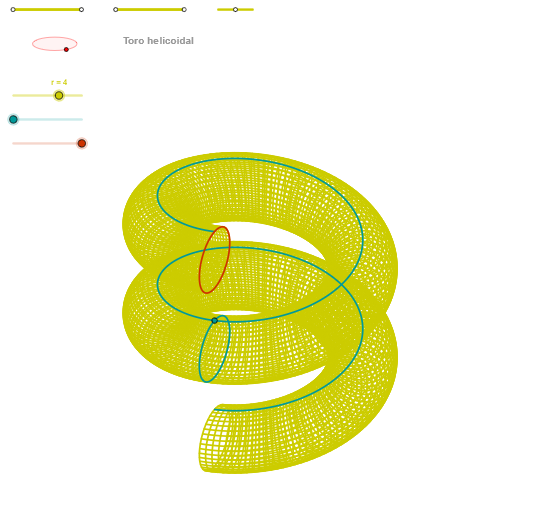
This example demonstrates the geometric construction of a helicoidal torus. It involves the properties of circles and parametric equations. Using GeoGebra commands such as Segment, Point, Circle, Intersect, etc., it dynamically shows the changes in the torus as it spirals upwards. Suitable for high school mathematics education, particularly in coordinate geometry and parametric equations.
GeoGebra Commands & Parameters
Segment(Q3, Q4) → p2Point(p2) → P3Segment(P3, Q4) → p4Point(p4) → P4Segment(Q1, Q2) → p1Point(p1) → P1Segment(P1, Q2) → p3Point(p3) → P2OrthogonalLine(C, xAxis) → zz2Circle(C, 0.62) → zz0Intersect(zz0, zz2, 1) → ZZ4Intersect(zz0, zz2, 2) → ZZ3Ellipse(ZZ3, ZZ4, 0.65) → zElipse2Point(zElipse2) → ZIntersect(zElipse2, zz2) → ZZ7, ZZ8Angle(ZZ8, C, Z) → zAngIncOrthogonalLine(C, yAxis) → zz1Intersect(zz0, zz1, 2) → ZZ2Intersect(zz0, zz1, 1) → ZZ1Ellipse(ZZ1, ZZ2, 0.65) → zElipse1Point(zElipse1) → XYIntersect(zElipse1, zz1) → ZZ5, ZZ6Angle(ZZ6, C, XY) → zAngRotSegment(Q5, Q6) → p5Point(p5) → P5CurveCartesian(((r / 4 * (3 + sin(v))) * sin(zAngRot)), (r / 4 * ((((-(3 + sin(v))) * cos(zAngRot)) * sin(zAngInc)) + ((3.14159 + cos(v)) * cos(zAngInc)))) - 3, v, v1, v2) → curva1Segment(ZZ5, ZZ6) → zz4Segment(ZZ7, ZZ8) → zz3Intersect(zElipse2, zElipse1, 1) → zPunto1Intersect(zElipse2, zElipse1, 4) → zPunto2Segment(zPunto1, zPunto2) → zSeg2CurveCartesian((r / 4 * ((((3 + sin(α)) * cos(u)) * sin(zAngRot)) + (((3 + sin(α)) * sin(u)) * cos(zAngRot)))), (r / 4 * (((((-(3 + sin(α))) * cos(u)) * cos(zAngRot)) * sin(zAngInc)) + ((((3 + sin(α)) * sin(u)) * sin(zAngRot)) * sin(zAngInc)) + ((u / 2 + cos(α)) * cos(zAngInc)))) - 3, u, u1, u2) → curva2CurveCartesian((r / 4 * ((((3 + sin(v)) * cos((2 * β))) * sin(zAngRot)) + (((3 + sin(v)) * sin((2 * β))) * cos(zAngRot)))), (r / 4 * (((((-(3 + sin(v))) * cos((2 * β))) * cos(zAngRot)) * sin(zAngInc)) + ((((3 + sin(v)) * sin((2 * β))) * sin(zAngRot)) * sin(zAngInc)) + ((β + cos(v)) * cos(zAngInc)))) - 3, v, v1, v2) → a1Sequence(CurveCartesian[(r / 4 * ((((3 + sin(v)) * cos(u)) * sin(zAngRot)) + (((3 + sin(v)) * sin(u)) * cos(zAngRot)))), (r / 4 * (((((-(3 + sin(v))) * cos(u)) * cos(zAngRot)) * sin(zAngInc)) + ((((3 + sin(v)) * sin(u)) * sin(zAngRot)) * sin(zAngInc)) + ((u / 2 + cos(v)) * cos(zAngInc)))) - 3, v, v1, v2], u, u1, u2, paso) → list2Sequence(CurveCartesian[(r / 4 * ((((3 + sin(v)) * cos(u)) * sin(zAngRot)) + (((3 + sin(v)) * sin(u)) * cos(zAngRot)))), (r / 4 * (((((-(3 + sin(v))) * cos(u)) * cos(zAngRot)) * sin(zAngInc)) + ((((3 + sin(v)) * sin(u)) * sin(zAngRot)) * sin(zAngInc)) + ((u / 2 + cos(v)) * cos(zAngInc)))) - 3, u, u1, u2], v, v1, v2, (3 * paso)) → list1
AI Drawing Prompt Reference
Draw a helicoidal torus surface rising spirally upward in three-dimensional space. Start with a base circle and construct two orthogonal lines through its center perpendicular to the x-axis and y-axis respectively. Create two elliptical cross-sections on the base circle, lying in perpendicular planes and intersecting the orthogonal lines. Use parametric equations to draw spiral curves that ascend along the central axis, with parameters controlling angular rotation and radius variation, creating a ribbon-like band that winds upward in a helical pattern. The surface features elliptical cross-sections with continuously changing angles as it spirals around the central axis.
The prompt above was compiled from the original drawing commands and is for reference only.