
Graphing Sequences and Series
Loading the math board and drawing, please wait…
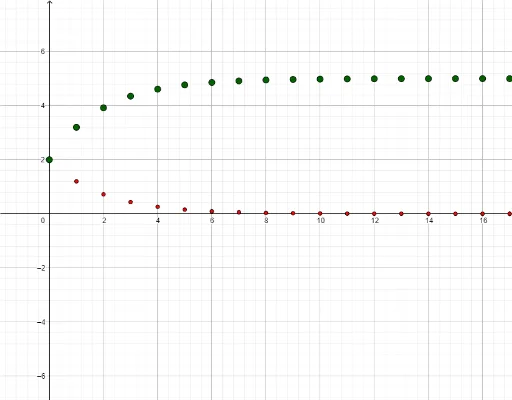
① This GeoGebra example dynamically visualizes sequences and their partial sums, turning abstract sequence terms and series summation into intuitive geometric representations such as point plots and area accumulation. ② Core mathematical concepts include sequences, series, natural numbers, the relationship between circle area and parallelogram area, and the correspondence between sequence terms and geometric shapes. ③ Construction highlights: The Sequence command is used to generate sequence terms (objects N, l1, l2, l3, l4, l5), and geometric objects like points, segments, or area figures are constructed to illustrate recurrence and summation, possibly comparing circle and parallelogram areas to visualize convergence or divergence. ④ Suitable for high school to early college students, this example aids in understanding sequence limits, series summation, and geometric intuition, and serves as a classroom demonstration or self-study exploration tool.
GeoGebra Commands & Parameters
Sequence(n, n, 0, N) → l1Sequence((2 * (3 / 5)^(n)), n, 0, N) → l2Sequence(Sum[(2 * (3 / 5)^(n)), n, 0, m], m, 0, N) → l4
AI Drawing Prompt Reference
Create a dynamic visualization of a sequence and its partial sums. Plot points on a coordinate grid where the x-axis represents natural numbers and the y-axis shows sequence values, with each point at an integer x-coordinate and y-value following a geometric decay. Below or alongside, show the cumulative sum as stacked rectangular areas or a step-like region, growing as more terms are added. Include a slider to adjust the maximum term index. Optionally, display a circle and a parallelogram with equal areas to illustrate the connection between series summation and geometric area. Emphasize the correspondence between individual terms and accumulated area, and the trend toward a limit.
The prompt above was compiled from the original drawing commands and is for reference only.