
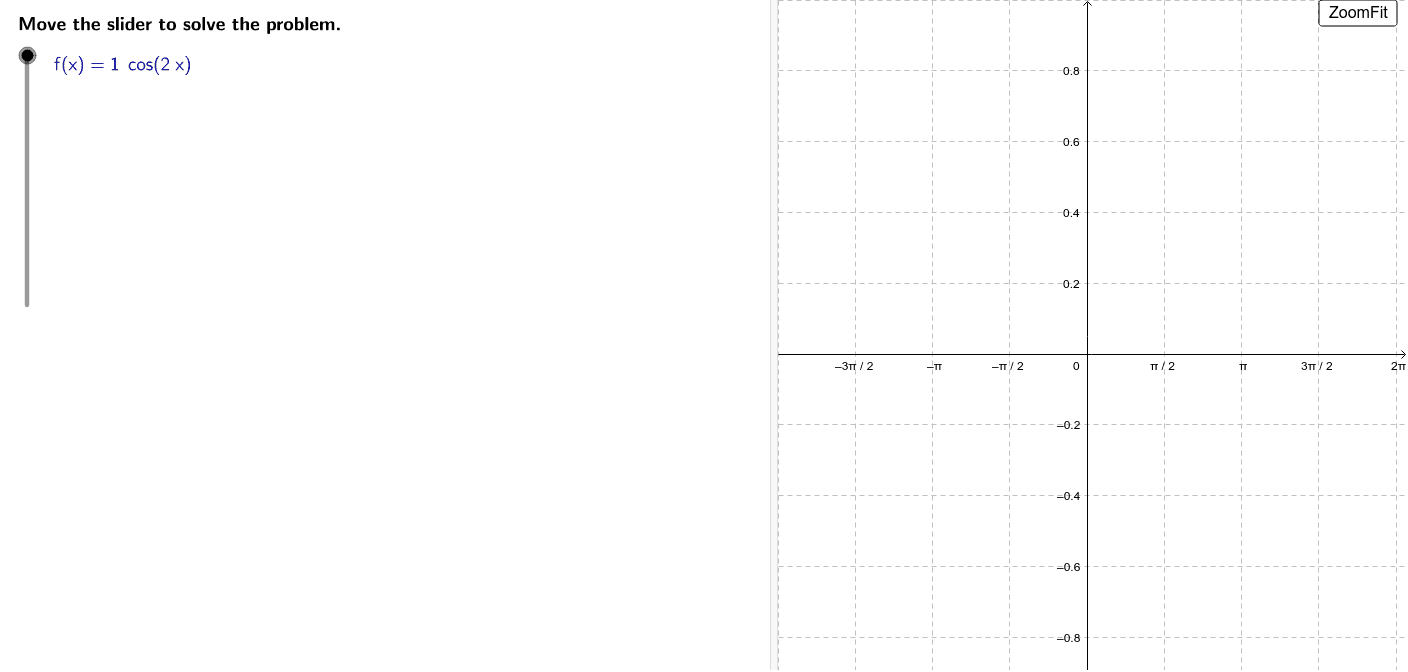
Graphing Multiple Periods of f(x)=cos 2x
Loading the math board and drawing, please wait…
In collections
UCSS Secondary Math III Unit 4A Lesson 1
This example demonstrates the graph of the cosine function f(x)=cos 2x over several periods, illustrating its period, amplitude, and symmetry. Core mathematical concepts include trigonometric periodicity, frequency scaling, and transformations of function graphs. Construction highlights: LaTeX for formula rendering, Corner for text placement, If and Mirror for conditional drawing and reflection, stepMax/stepper/steps/counter for animation stepping, button1 to trigger Randomize and ZoomFit, and text objects (text0, text1, etc.) for step‑by‑step annotations. Suitable for high‑school trigonometry lessons, college‑prep review, and interactive GeoGebra courseware development.
GeoGebra Commands & Parameters
LaTeX(steps) → counterLaTeX("\text{Move the slider to solve the problem.}") → text0Corner(1) → ACorner(3) → BIf(choose ≟ 1, Simplify[(a * sin((b * x)))], Simplify[(a * cos((b * x)))]) → fLaTeX((("\textcolor{#000099}{f(x)=" * f) * "}")) → ProblemLaTeX("\text{Graph several periods of }\textcolor{#000099}{f(x)}.") → text1If(choose ≟ 1, ((-π)) / ((2 * b)), 0) → leftIf(choose ≟ 1, π / ((2 * b)), π / b) → rightIf(choose ≟ 1, "-", "") → posnegIf(choose ≟ 1, LaTeX[(("-\frac{\pi}{" * Simplify[(2 * b)]) * "}")], "0") → leftTextIf(choose ≟ 1, LaTeX[(("\frac{\pi}{" * Simplify[(2 * b)]) * "}")], LaTeX[(("\frac{\pi}{" * Simplify[b]) * "}")]) → rightTextLaTeX("\text{Solve for the inverse function }\textcolor{#006633}{g(x)}\text{ algebraically.}") → text11LaTeX((("\textcolor{#000099}{f(x)=" * f) * "}")) → text14LaTeX("\text{Switch }\textcolor{#000099}{x}\text{ and }\textcolor{#000099}{f(x)}.") → text15If(choose ≟ 1, "sin", "cos") → functextLaTeX((("\text{Take the inverse " * functext) * " of both sides.}")) → text21LaTeX("\text{Simplify and use symmetry of equality.}") → text23If(b ≠ 1, LaTeX[Simplify[1 / b]], "") → invCoeffMirror(h, y = x) → InverseLaTeX((((((("\textcolor{#006633}{g(x)=\frac{" * functext) * "^{-1}\left(\frac{x}{") * a) * "}\right)}{") * b) * "}}")) → text26LaTeX((((((("\textcolor{#006633}{" * b) * "g(x)=") * functext) * "^{-1}\left(\frac{x}{") * a) * "}\right)}")) → text24LaTeX((((((((((("\textcolor{#006633}{" * functext) * "^{-1}\left(\frac{x}{") * a) * "}\right)=") * functext) * "^{-1}\left(") * functext) * "(") * b) * "g(x))\right)}")) → text22LaTeX((((("\textcolor{#006633}{\frac{x}{" * a) * "}=") * functext) * "(g(x))}")) → text20LaTeX("\text{Rename }\textcolor{#000099}{f(x)}\text{ as }\textcolor{#006633}{g(x)}.") → text17LaTeX((((((("\textcolor{#006633}{x=" * a) * "") * functext) * "(") * b) * "g(x))}")) → text18LaTeX((((((("\textcolor{#006633}{g(x)=" * invCoeff) * "") * functext) * "^{-1}\left(\frac{x}{") * a) * "}\right)}")) → invlabelLaTeX((("\text{Divide both sides by }\textcolor{#006633}{" * b) * "}.")) → text25LaTeX((("\textcolor{#000099}{f(x)=" * f) * "}")) → restrictlabelLaTeX((((((("\textcolor{#000099}{x=" * a) * " ") * functext) * "(") * b) * "f(x))}")) → text16If(choose ≟ 1, "sine", "cosine") → nameIf(choose ≟ 1, (((-3) * a / 4), asin((((-3) * a / 4)) / a) / b), (((-3) * a / 4), acos((((-3) * a / 4)) / a) / b)) → CLaTeX((("\text{The trigonometric function }\textcolor{#000099}{f(x) = " * f) * "}\text{ is not fully invertible because of its }\cr\text{periodic nature. Viewing several periods of the function is the first step toward }\cr\text{identifying a restricted domain on which the function is invertible.}")) → text2LaTeX("\text{Restrict the domain until there is a one-to-one correspondence. }") → text3LaTeX("\text{Determine the range of }\textcolor{#000099}{f(x)}\text{ within the restricted domain.}") → text8LaTeX((((((((("\text{The inverse function of }\textcolor{#000099}{f(x)=" * f) * "}\text{ is }\textcolor{#006633}{g(x)=") * invCoeff) * "") * functext) * "^{-1}\left(\frac{x}{") * a) * "}\right)}.")) → text27LaTeX("\text{Determine the domain and range of the inverse function }\textcolor{#006633}{g(x)}.") → text28LaTeX("\text{The domain and range of an inverse function are the range and (restricted) }\cr\text{domain of the original function.}") → text29LaTeX((((((((((((((((((((((((("\text{For the original function } \textcolor{#000099}{f(x) = " * f) * "} \text{, the restricted domain is } \textcolor{#000099}{\left[") * leftText) * ",") * rightText) * "\right]} \cr\text{and the range is }\textcolor{#000099}{[-") * a) * ",") * a) * "]} \text{. }\cr\text{Therefore, for the inverse function }\textcolor{#006633}{g(x)=") * invCoeff) * "") * functext) * "^{-1}\left(\frac{x}{") * a) * "}\right)} \text{, the domain is } \cr \textcolor{#006633}{[–") * a) * ", ") * a) * "]} \text{ and the range is } \textcolor{#006633}{\left[") * leftText) * ",") * rightText) * "\right]}.")) → text30LaTeX("\text{Use the buttons below to return to the original problem or}\cr\text{randomly generate a similar practice problem.}") → RandomizationTextLaTeX("\text{Look at the graph of }\textcolor{#000099}{f(x)}\text{ to find the widest possible }\textcolor{#000099}{x}\text{-interval containing }\cr\textcolor{#000099}{x = 0}\text{ for which no }\textcolor{#000099}{y}\text{-value is repeated.}") → text4LaTeX((((((("\text{For the function }\textcolor{#000099}{f(x) = " * f) * "}\text{, this restricted domain is }\textcolor{#CC0000}{\left[") * leftText) * ",") * rightText) * "\right]}.")) → text5LaTeX((((("\text{Notice that multiplying the " * name) * " function by }\textcolor{#000099}{") * a) * "}\text{ does not affect the}\cr\text{restricted domain.}")) → text6LaTeX("\text{Adjust the window properties to display the graph only for }\textcolor{#000099}{x}\text{-values in the }\cr\text{restricted domain. Make sure you do not change the }\textcolor{#000099}{y}\text{-axis window settings.}") → text7LaTeX("\text{Look at the graph of }\textcolor{#000099}{f(x)}\text{ on its restricted domain, and identify the range of }\cr\textcolor{#000099}{y}\text{-values }\text{that are visible for the function.}") → text9LaTeX((((((((((((((("\text{For the function }\textcolor{#000099}{f(x) = " * f) * "}\text{ on the restricted domain }\textcolor{#000099}{\left[") * leftText) * ",") * rightText) * "\right]}\text{, }\cr\textcolor{#000099}{y}\text{-values on the visible part of the function range from }\textcolor{#000099}{–") * a) * "}\text{ to }\textcolor{#000099}{") * a) * "}\text{.}\cr\text{Therefore, the range of }\textcolor{#000099}{f(x)}\text{ within the restricted domain is }\textcolor{#000099}{\left[–") * a) * ", ") * a) * "\right]}.")) → text10LaTeX((("\text{Divide both sides by }\textcolor{#006633}{" * a) * "}.")) → text19LaTeX("\text{Original function }\textcolor{#000099}{f(x)}") → text13LaTeX("\text{Recall that you can find the inverse of a function }\textcolor{#000099}{f(x)}\text{ by switching the domain }\cr\text{and function variables, renaming the function as }\textcolor{#006633}{g(x)}\text{, and then solving for }\textcolor{#006633}{g(x)}.") → text12
AI Drawing Prompt Reference
Draw the graph of f(x)=cos 2x over multiple periods to illustrate its period, amplitude, and symmetry. The graph should show complete cycles of the cosine function, with annotations for the function formula, period length, and amplitude. Highlight key points such as peaks and troughs. Use clear lines and appropriate axes to make the graph easy to understand.
The prompt above was compiled from the original drawing commands and is for reference only.