
Graphing and Analyzing the Sine Function f(x) = 4 sin x
Loading the math board and drawing, please wait…
In collections
UCSS Secondary Math III Unit 4A Lesson 1
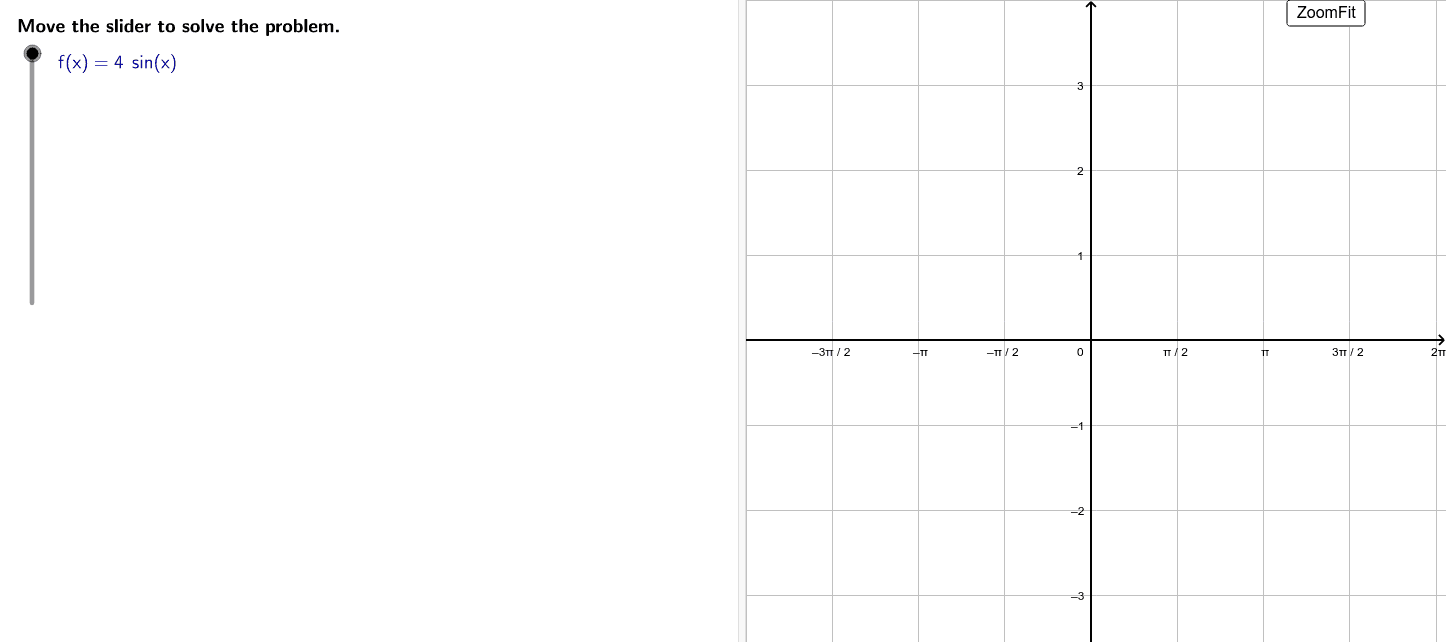
This GeoGebra example demonstrates the graphical representation and property analysis of the trigonometric function f(x) = 4 sin x. The core mathematical concepts involved include sine waves, amplitude scaling, periodicity, and trigonometric function transformations. To construct this interactive visualization, LaTeX is used for formula rendering, while commands like Corner, If, and Mirror handle the logical layout. Key objects such as stepper, counter, and steps manage the step-by-step problem-solving flow, and ZoomFit dynamically adjusts the grid view. Interactive elements like buttons, dynamic texts, and sliders allow students to explore the function's behavior in real-time. It is highly suitable for high school level mathematics (specifically Math III or precalculus) to teach and learn trigonometric graphing.
GeoGebra Commands & Parameters
LaTeX(steps) → counterLaTeX("\text{Move the slider to solve the problem.}") → text0Corner(1) → ACorner(3) → BIf(choose ≟ 1, Simplify[(a * sin((b * x)))], Simplify[(a * cos((b * x)))]) → fLaTeX((("\textcolor{#000099}{f(x)=" * f) * "}")) → ProblemLaTeX("\text{Graph several periods of }\textcolor{#000099}{f(x)}.") → text1If(choose ≟ 1, ((-π)) / ((2 * b)), 0) → leftIf(choose ≟ 1, π / ((2 * b)), π / b) → rightIf(choose ≟ 1, "-", "") → posnegIf(choose ≟ 1, LaTeX[(("-\frac{\pi}{" * Simplify[(2 * b)]) * "}")], "0") → leftTextIf(choose ≟ 1, LaTeX[(("\frac{\pi}{" * Simplify[(2 * b)]) * "}")], LaTeX[(("\frac{\pi}{" * Simplify[b]) * "}")]) → rightTextLaTeX("\text{Solve for the inverse function }\textcolor{#006633}{g(x)}\text{ algebraically.}") → text11LaTeX((("\textcolor{#000099}{f(x)=" * f) * "}")) → text14LaTeX("\text{Switch }\textcolor{#000099}{x}\text{ and }\textcolor{#000099}{f(x)}.") → text15If(choose ≟ 1, "sin", "cos") → functextLaTeX((("\text{Take the inverse " * functext) * " of both sides.}")) → text21LaTeX("\text{Simplify and use symmetry of equality.}") → text23If(b ≠ 1, LaTeX[Simplify[1 / b]], "") → invCoeffMirror(h, y = x) → InverseLaTeX((((((("\textcolor{#006633}{g(x)=\frac{" * functext) * "^{-1}\left(\frac{x}{") * a) * "}\right)}{") * b) * "}}")) → text26LaTeX((((((("\textcolor{#006633}{" * b) * "g(x)=") * functext) * "^{-1}\left(\frac{x}{") * a) * "}\right)}")) → text24LaTeX((((((((((("\textcolor{#006633}{" * functext) * "^{-1}\left(\frac{x}{") * a) * "}\right)=") * functext) * "^{-1}\left(") * functext) * "(") * b) * "g(x))\right)}")) → text22LaTeX((((("\textcolor{#006633}{\frac{x}{" * a) * "}=") * functext) * "(g(x))}")) → text20LaTeX("\text{Rename }\textcolor{#000099}{f(x)}\text{ as }\textcolor{#006633}{g(x)}.") → text17LaTeX((((((("\textcolor{#006633}{x=" * a) * "") * functext) * "(") * b) * "g(x))}")) → text18LaTeX((((((("\textcolor{#006633}{g(x)=" * invCoeff) * "") * functext) * "^{-1}\left(\frac{x}{") * a) * "}\right)}")) → invlabelLaTeX((("\text{Divide both sides by }\textcolor{#006633}{" * b) * "}.")) → text25LaTeX((("\textcolor{#000099}{f(x)=" * f) * "}")) → restrictlabelLaTeX((((((("\textcolor{#000099}{x=" * a) * " ") * functext) * "(") * b) * "f(x))}")) → text16If(choose ≟ 1, "sine", "cosine") → nameIf(choose ≟ 1, (((-3) * a / 4), asin((((-3) * a / 4)) / a) / b), (((-3) * a / 4), acos((((-3) * a / 4)) / a) / b)) → CLaTeX("\text{Use the buttons below to return to the original problem or}\cr\text{randomly generate a similar practice problem.}") → RandomizationTextLaTeX("\text{Determine the range of }\textcolor{#000099}{f(x)}\text{ within the restricted domain.}") → text8LaTeX((((((((("\text{The inverse function of }\textcolor{#000099}{f(x)=" * f) * "}\text{ is }\textcolor{#006633}{g(x)=") * invCoeff) * "") * functext) * "^{-1}\left(\frac{x}{") * a) * "}\right)}.")) → text27LaTeX("\text{The domain and range of an inverse function are the range and (restricted) }\cr\text{domain of the original function.}") → text29LaTeX((("\text{The trigonometric function }\textcolor{#000099}{f(x) = " * f) * "}\text{ is not fully invertible because}\cr\text{of its periodic nature. Viewing several periods of the function is the first step }\cr\text{toward identifying a restricted domain on which the function is invertible.}")) → text2LaTeX((((("\text{Notice that multiplying the " * name) * " function by }\textcolor{#000099}{") * a) * "}\text{ does not affect the}\cr\text{restricted domain.}")) → text6LaTeX((((((("\text{For the function }\textcolor{#000099}{f(x) = " * f) * "}\text{, this restricted domain is }\textcolor{#CC0000}{\left[") * leftText) * ",") * rightText) * "\right]}.")) → text5LaTeX("\text{Adjust the window properties to display the graph only for }\textcolor{#000099}{x}\text{-values}\cr\text{in the restricted domain. Make sure you do not change the }\textcolor{#000099}{y}\text{-axis}\cr\text{window settings.}") → text7LaTeX("\text{Look at the graph of }\textcolor{#000099}{f(x)}\text{ on its restricted domain, and identify the range}\cr\text{of }\textcolor{#000099}{y}\text{-values that are visible for the function.}") → text9LaTeX("\text{Original function }\textcolor{#000099}{f(x)}") → text13LaTeX((("\text{Divide both sides by }\textcolor{#006633}{" * a) * "}.")) → text19LaTeX("\text{Determine the domain and range of the inverse }\text{function }\textcolor{#006633}{g(x)}.") → text28LaTeX("\text{Restrict the domain until there is a one-to-one correspondence. }") → text3LaTeX("\text{Look at the graph of }\textcolor{#000099}{f(x)}\text{ to find the widest possible }\textcolor{#000099}{x}\text{-interval containing }\cr\textcolor{#000099}{x = 0}\text{ for which no }\textcolor{#000099}{y}\text{-value is repeated.}") → text4LaTeX((((((((((((((("\text{For the function }\textcolor{#000099}{f(x) = " * f) * "}\text{ on the restricted domain }\textcolor{#000099}{\left[") * leftText) * ",") * rightText) * "\right]}\text{, }\cr\textcolor{#000099}{y}\text{-values on the visible part of the function range from }\textcolor{#000099}{–") * a) * "}\text{ to }\textcolor{#000099}{") * a) * "}\text{.}\cr\text{Therefore, the range of }\textcolor{#000099}{f(x)}\text{ within the restricted domain is }\textcolor{#000099}{\left[–") * a) * ", ") * a) * "\right]}.")) → text10LaTeX((((((((((((((((((((((((("\text{For the original function }\textcolor{#000099}{f(x) = " * f) * "}\text{, the restricted domain is }\cr\textcolor{#000099}{\left[") * leftText) * ",") * rightText) * "\right]}\text{ and the range is }\textcolor{#000099}{[-") * a) * ",") * a) * "]}\text{.}\cr\text{Therefore, for the inverse function }\textcolor{#006633}{g(x)=") * invCoeff) * "") * functext) * "^{-1}\left(\frac{x}{") * a) * "}\right)}\text{, }\cr\text{the domain is }\textcolor{#006633}{[–") * a) * ", ") * a) * "]}\text{ and the range is }\textcolor{#006633}{\left[") * leftText) * ",") * rightText) * "\right]}.")) → text30LaTeX("\text{Recall that you can find the inverse of a function }\textcolor{#000099}{f(x)}\text{ by switching the domain}\cr\text{and function variables, renaming the function as }\textcolor{#006633}{g(x)}\text{, and then solving for }\textcolor{#006633}{g(x)}.") → text12