
Graphical and Numerical CAS Solution of a System with Implicit Functions (1)
Loading the math board and drawing, please wait…
In collections
intersection: surface-surface, curve-curve
intersection: surface-surface, curve-curve
intersection: surface-surface, curve-curve
intersection: surface-surface, curve-curve
Solution of Systems of nonlinear Equations
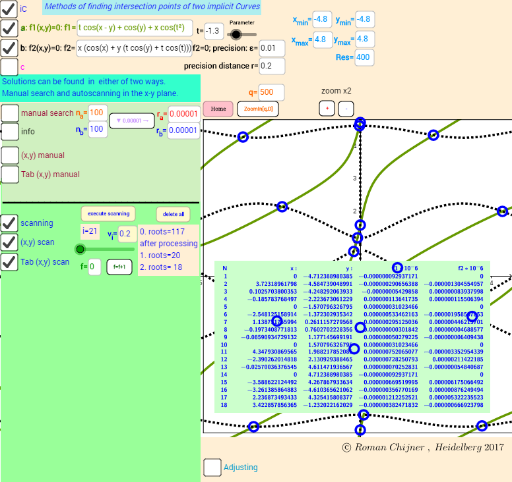
This example demonstrates solving a system of two equations with implicit functions using graphical and numerical methods with CAS. Key mathematical concepts include implicit functions, intersections, and functions. GeoGebra commands used include ImplicitCurve, Intersect, PolyLine, etc. Suitable for high school math education and learning.
GeoGebra Commands & Parameters
ImplicitCurve(f1(x, y)) → aIntersect(Circle[D, r_a], OrthogonalLine[D, Segment[D, ClosestPoint[a, D]]], 2) → Z2_aIntersect(Circle[D, r_a], OrthogonalLine[D, Segment[D, ClosestPoint[a, D]]], 1) → Z1_aPolyLine(Zip[ClosestPoint[a, B], B, Z1_a + ((Z2_a - Z1_a) / n_a * Sequence[i, i, 0, n_a])]) → polZaImplicitCurve(f2(x, y)) → bIntersect(Circle[D, r_b], OrthogonalLine[D, Segment[D, ClosestPoint[b, D]]], 1) → Z1_bIntersect(Circle[D, r_b], OrthogonalLine[D, Segment[D, ClosestPoint[b, D]]], 2) → Z2_bPolyLine(Zip[ClosestPoint[b, B], B, Z1_b + ((Z2_b - Z1_b) / n_b * Sequence[i, i, 0, n_b])]) → polZbElement({Intersect[polZa, polZb]}, 1) → PZTextfield(Nn) → InputBox4Textfield(e) → InputBox5Textfield(x_{min}) → InputBox6Textfield(x_{max}) → InputBox7Textfield(y_{min}) → InputBox8Textfield(y_{max}) → InputBox9Polygon((x_{min}, y_{min}), (x_{max}, y_{min}), (x_{max}, y_{max}), (x_{min}, y_{max})) → poly1, g1_s, g2_s, g3_s, s4_sLength(lr1) → llr1Length(lf2) → llf2Textfield(r) → InputBox16Element(lr1, i_{manual}) → C_tLength(lf1) → llf1Textfield(n_a) → InputBox21Textfield(n_b) → InputBox22Textfield(r_a) → InputBox23Textfield(q) → InputBox24PolyLine(Z1_a + ((Z2_a - Z1_a) / n_a * Sequence[i, i, 0, n_a])) → poly2_aaPolyLine(Z1_b + ((Z2_b - Z1_b) / n_b * Sequence[i, i, 0, n_b])) → poly2_bbPoint(poly2_aa, e1) → R_aPoint(poly2_bb, e2) → R_bClosestPoint(a, R_a) → R'_aClosestPoint(b, R_b) → R'_bLength(R'_a - R'_b) → dmaxmins2If(Defined[PZ], If[fza2 < fzb2, (f1za2, f2za2), (f1zb2, f2zb2)], (NaN, NaN)) → errorz2If(Defined[PZ], If[fza2 < fzb2, R'_a, R'_b], (NaN, NaN)) → Pz2If(ca, PZ, Pz2) → PZ0If(ca, f11, x(errorz2)) → f110If(ca, f22, y(errorz2)) → f220Element(listxyres1, f) → B_tTextfield(r_b) → InputBox13Element(roots0, f) → ATextfield(f1) → InputBox1Textfield(f2) → InputBox3Corner(1) → Corner1Corner(2) → Corner2Corner(3) → Corner3ImplicitCurve(f01(x, y)) → cTextfield(α) → InputBox11TableText({Join[{{"N"}, Sequence[i, i, 1, llr1]}], Join[{{""}, Sequence["→", i, 1, i_{manual}]}], Join[{{"x:"}, x(lr1)}], Join[{{"y:"}, y(lr1)}], Join[{{"f1* 10^-6"}, lf1}], Join[{{"f2* 10^-6"}, lf2}]}, "vr") → text8Textfield(i_{manual}) → Eingabefeld1Textfield(f) → Eingabefeld2Length(lr2) → llr2If(Length[listxyres1] ≟ 0 ∨ (i > m1), E, Element[listxyres1, i]) → BTableText({Join[{{"N"}, Sequence[i, i, 1, Length[roots0]]}], Join[{{""}, Sequence["→", i, 1, f]}], Join[{{" x:"}, x(roots0)}], Join[{{" y:"}, y(roots0)}], Join[{{"f1*10^-6"}, lf1_{Pr}2}], Join[{{"f2* 10^-6"}, lf2_{Pr}2}]}, "vr") → Text2Textfield(v_i) → InputBox2Textfield(t) → InputBox10