
Graph Isomorphism 1: Exploring Geometric and Functional Relationships
Loading the math board and drawing, please wait…
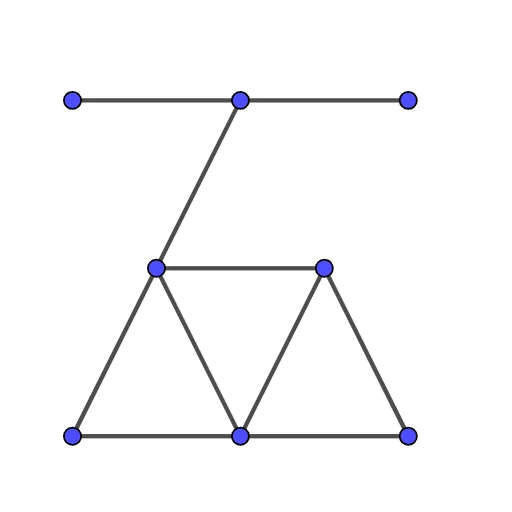
This example demonstrates graph isomorphism through GeoGebra, highlighting the relationship between geometric shapes and functions. Key mathematical concepts include graph isomorphism in graph theory, geometric transformations, and function translations and scaling. Construction involves using objects like Segment, F, G, H to create shapes and verify function relationships. Suitable for high school students or college students learning about combining graph theory with geometry, aiding in understanding abstract concepts in practical applications.
GeoGebra Commands & Parameters
Segment(A, B) → fSegment(C, B) → gSegment(E, D) → iSegment(E, B) → lSegment(E, C) → hSegment(B, D) → jSegment(D, A) → kSegment(D, G) → mSegment(F, G) → nSegment(G, H) → p
AI Drawing Prompt Reference
Draw a graph isomorphism demonstration consisting of two sets of geometric figures, each composed of vertices connected by line segments. The first set contains five vertices connected in a specific pattern forming one connected structure, while the second set contains three vertices arranged to share the same topological relationship as the first. Place the two graphs side by side to visually illustrate that although they appear different in shape, they have identical structural relationships, demonstrating the concept of isomorphism in graph theory.
The prompt above was compiled from the original drawing commands and is for reference only.