
Planar Graph 4
Loading the math board and drawing, please wait…
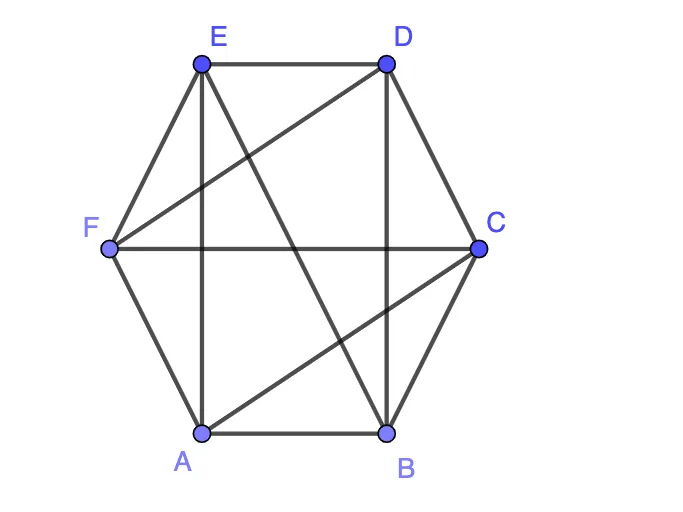
This example demonstrates the structure and properties of a planar graph, visually representing vertices, edges, and their connections. Core mathematical concepts include graph theory's planarity, vertex degrees, and Euler's formula. Construction highlights involve using the Segment command to draw basic graph structures with points like C, D, E, A, B, and objects f, g, h, i, F, j, k, l, m, n, p, q, r. Suitable for high school and above students studying graph theory, combinatorics, or discrete mathematics, as well as competitive math tutoring and visual learning.
GeoGebra Commands & Parameters
Segment(A, B) → fSegment(B, C) → gSegment(C, D) → hSegment(D, E) → iSegment(E, F) → jSegment(F, A) → kSegment(A, C) → lSegment(F, D) → mSegment(E, B) → nSegment(E, A) → pSegment(D, B) → qSegment(F, C) → r
AI Drawing Prompt Reference
Draw a planar graph with six vertices arranged as a hexagon. Connect adjacent vertices to form the hexagon's six sides, then add six diagonals connecting every pair of non-adjacent vertices, so that all pairs of vertices are joined by straight line segments. Ensure no edges cross, keeping the layout planar and symmetric, with vertices clearly marked.
The prompt above was compiled from the original drawing commands and is for reference only.