
Gradients of Parallel and Perpendicular Lines Quiz
Loading the math board and drawing, please wait…
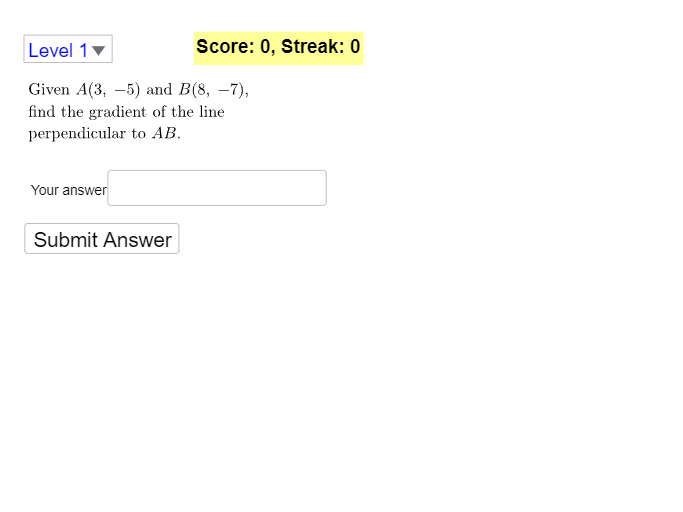
This example demonstrates the relationship between gradients of parallel and perpendicular lines. It involves core math concepts: equal gradients for parallel lines, product of gradients being -1 for perpendicular lines. Constructed using GeoGebra commands like Sample, SelectedIndex, Line, Intersect, OrthogonalLine, Textfield, If. Suitable for high school mathematics teaching, helping students understand and apply properties of line slopes.
GeoGebra Commands & Parameters
Sample(Sequence[-10, 10], 8) → S, {3, -5, 8, -7, 10, 5, -2, -8}SelectedIndex(Level) → LLine(A, B) → l_{1}Line(C, l_{1}) → l_{2}Intersect(l_{2}, eq1) → DOrthogonalLine(C, l_{1}) → l_{3}Intersect(l_{3}, eq1) → ESample(Sequence[-10, 10], 8) → S_{1}, {9, 0, -8, 10, -7, -2, -4, 1}Intersect(l_{1}, eq1) → FTextfield(StdAns) → InputBox1If(L ≟ 5, Random[1, 4], L) → Qn
AI Drawing Prompt Reference
Draw a coordinate-plane setup showing the slope relationships of parallel and perpendicular lines. First create a base line. Then construct a second line that is parallel to the base line so the two parallel lines share the same gradient. Next construct an orthogonal (perpendicular) line to the base line and mark the intersection point between this perpendicular line and the base line to emphasize the perpendicular gradient relationship. Include a text input area in the figure for a slope-based answer, with the displayed answer depending on a given level through simple internal choice logic.
The prompt above was compiled from the original drawing commands and is for reference only.