
Geometric Transformations: Polygon Rotation and Dilation
Loading the math board and drawing, please wait…
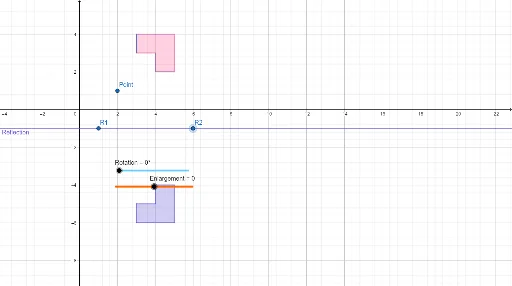
This example demonstrates the transformation of a polygon through rotation and dilation. Key mathematical concepts include geometric transformations, similarity transformations, and coordinate geometry. Construction involves using GeoGebra commands such as Rotate, Dilate, Polygon, and Line. Suitable for middle or high school mathematics education to understand the principles and operations of geometric transformations.
GeoGebra Commands & Parameters
Polygon(A, B, C, D, E, F) → poly1, a, b, c, d, e, fRotate(A, (-Rotation_1), Point) → A'Rotate(B, (-Rotation_1), Point) → B'Rotate(C, (-Rotation_1), Point) → C'Rotate(D, (-Rotation_1), Point) → D'Rotate(E, (-Rotation_1), Point) → E'Rotate(F, (-Rotation_1), Point) → F'Rotate(A, (-Rotation), Point) → A'_1Rotate(B, (-Rotation), Point) → B'_1Rotate(C, (-Rotation), Point) → C'_1Rotate(D, (-Rotation), Point) → D'_1Rotate(E, (-Rotation), Point) → E'_1Rotate(F, (-Rotation), Point) → F'_1Polygon(A'_1, B'_1, C'_1, D'_1, E'_1, F'_1) → poly1', a'_1, b'_1, c'_1, d'_1, e'_1, f'_1Dilate(A, Enlargement, Point) → A'_2Dilate(B, Enlargement, Point) → B'_2Dilate(C, Enlargement, Point) → C'_2Dilate(D, Enlargement, Point) → D'_2Dilate(E, Enlargement, Point) → E'_2Dilate(F, Enlargement, Point) → F'_2Polygon(A'_2, B'_2, C'_2, D'_2, E'_2, F'_2) → poly1'_1, a'_2, b'_2, c'_2, d'_2, e'_2, f'_2Line(R1, R2) → ReflectionMirror(A, Reflection) → A'_3Mirror(B, Reflection) → B'_3Mirror(C, Reflection) → C'_3Mirror(D, Reflection) → D'_3Mirror(E, Reflection) → E'_3Mirror(F, Reflection) → F'_3Polygon(A'_3, B'_3, C'_3, D'_3, E'_3, F'_3) → poly1'_2, a'_3, b'_3, c'_3, d'_3, e'_3, f'_3
AI Drawing Prompt Reference
Draw a hexagon. First, create a hexagon. Then, rotate it by a certain angle. Next, dilate it. Finally, draw a symmetric figure to the dilated hexagon. Ensure the figure is clear and proportions are appropriate.
The prompt above was compiled from the original drawing commands and is for reference only.