
Geometric Transformations and Optimization Animation
Loading the math board and drawing, please wait…
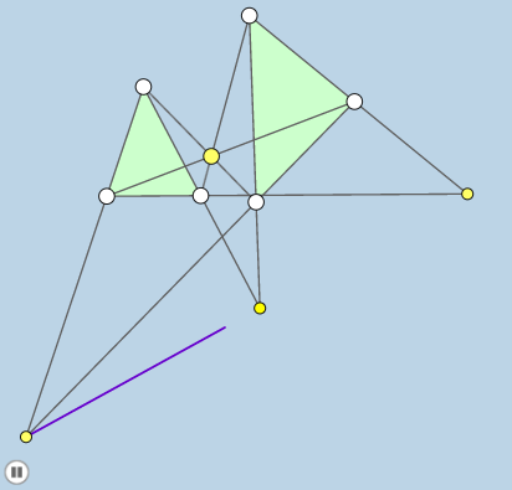
This example demonstrates geometric transformations involving triangles and circles through animation, integrating function graphs to analyze angles and optimization problems. Core concepts include geometric transformations (scaling, rotation), coordinate geometry, function optimization, and problem-solving. Construction uses commands like Line, Point, Circle, Dilate, Segment, Intersect, Polygon, with key steps involving dilation for transformations and intersection for finding points. Suitable for high school and above, focusing on geometric transformations, function optimization, and coordinate geometry applications.
GeoGebra Commands & Parameters
Line(A_1, A') → fLine(A_1, C') → gLine(A_1, B') → hPoint(g) → CPoint(g) → C'_1Point(f) → A'_1Point(f) → APoint(h) → BPoint(h) → B'_1Circle(A'_1, 1) → rCircle(A, 1) → tDilate(A_1, If[0 < a ≤ 1, 1 - a, 0], A) → NDilate(A_1, If[0 < a ≤ 1, 1 - a, 0], A') → OSegment(A_1, N) → bSegment(A_1, O) → i_1Dilate(A_1, If[1 < a ≤ 2, 2 - a, 0], B') → PDilate(A_1, If[1 < a ≤ 2, 2 - a, 0], B) → QSegment(A_1, P) → l_1Segment(A_1, Q) → m_1Dilate(A_1, If[2 < a ≤ 3, 3 - a, 0], C') → HDilate(A_1, If[2 < a ≤ 3, 3 - a, 0], C) → ISegment(A_1, H) → cSegment(A_1, I) → dLine(A', B') → jLine(B, A) → kIntersect(j, k) → DLine(C', B') → lLine(B, C) → mIntersect(l, m) → ELine(C', A') → nLine(A, C) → pIntersect(n, p) → FPolygon(A, C, B) → poly1, b_1, a_1, c_1Polygon(A', B', C') → poly3, c', a', b'Dilate(B, If[5 < a ≤ 6, 6 - a, 0], D) → B'_2Segment(B, B'_2) → iDilate(A', If[5 < a ≤ 6, 6 - a, 0], D) → A''Segment(A', A'') → qDilate(B, If[6 < a ≤ 7, 7 - a, 0], E) → B'_3Dilate(C', If[6 < a ≤ 7, 7 - a, 0], E) → C''Segment(B, B'_3) → sSegment(C', C'') → eDilate(A, If[7 < a ≤ 8, 8 - a, 0], F) → A'_2Dilate(C', If[7 < a ≤ 8, 8 - a, 0], F) → C''_1Segment(C', C''_1) → f_1Segment(A, A'_2) → g_1Dilate(D, If[10 < a ≤ 11, 11 - a, 0], E) → D'Dilate(E, If[11 < a ≤ 12, 12 - a, 0], F) → E'Segment(D, D') → h_1Segment(E, E') → j_1