
Geometric Properties of Quadrilaterals
Loading the math board and drawing, please wait…
In collections
Mathematics Form 1
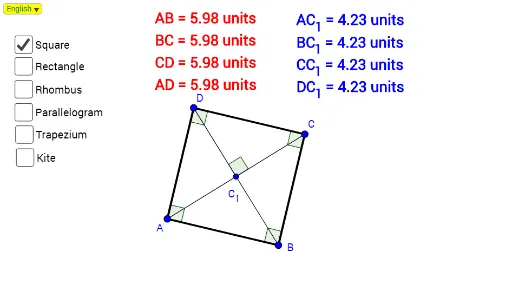
This example demonstrates the geometric properties and relationships of various quadrilaterals (kites, parallelograms, rectangles, squares, trapezoids). It covers core concepts like diagonals, angle sums, side relationships, symmetry, and area calculations. The construction uses commands such as Segment, Rotate, Distance, Angle, OrthogonalLine, Point, Line, Intersect, Circle, LineBisector, and Ray. Ideal for high school mathematics instruction or exploration by geometry enthusiasts.
GeoGebra Commands & Parameters
Segment(A, B) → aRotate(A, (-(90°)), B) → CRotate(B, 90°, A) → DSegment(D, A) → bSegment(D, C) → cSegment(C, B) → dDistance(A, B) → ABAngle(B, A, D) → αAngle(A, D, C) → βAngle(D, C, B) → γAngle(C, B, A) → δSegment(E, F) → fOrthogonalLine(E, f) → gOrthogonalLine(F, f) → hPoint(g) → GLine(G, f) → iIntersect(h, i) → HSegment(E, G) → jSegment(G, H) → kSegment(H, F) → lAngle(F, E, G) → εAngle(E, G, H) → ζAngle(G, H, F) → ηAngle(H, F, E) → θDistance(E, F) → EFDistance(E, G) → EGCircle(I, J) → pSegment(I, J) → nPoint(p) → KSegment(I, K) → qLine(K, n) → rLine(J, q) → sIntersect(r, s) → LSegment(K, L) → tSegment(J, L) → a_1Distance(I, J) → IJDistance(I, K) → IKLine(M, q) → b_1Line(M, t) → c_1Segment(N, O) → d_1Segment(N, P) → e_1Line(P, d_1) → f_1Line(O, e_1) → g_1Intersect(f_1, g_1) → QSegment(P, Q) → h_1Segment(Q, O) → i_1Distance(N, O) → NODistance(N, P) → NPLine(R, e_1) → j_1Line(R, h_1) → k_1Segment(S, T) → l_1Line(U, l_1) → m_1Point(m_1) → VSegment(U, S) → n_1Segment(V, T) → p_1Segment(U, V) → q_1Segment(A_2, A_4) → r_1LineBisector(A_4, A_2) → s_1Intersect(s_1, r_1) → WPoint(s_1) → ZRay(W, Z) → d_2Point(s_1) → B_1Ray(W, B_1) → e_2Point(e_2) → A_3Point(d_2) → A_1Segment(A_4, A_3) → t_1Segment(A_3, A_2) → a_2Segment(A_2, A_1) → b_2Segment(A_1, A_4) → c_2Distance(A_1, A_2) → A1A2Distance(A_1, A_4) → A1A4Distance(A_2, A_3) → A2A3Distance(A_4, A_3) → A3A4Segment(A, C) → f_2Segment(D, B) → g_2Intersect(f_2, g_2) → C_1Angle(C, C_1, D) → ιDistance(A, C_1) → AC01Distance(C, C_1) → CC01Distance(D, C_1) → DC01Distance(B, C_1) → BC01Segment(E, H) → h_2Segment(G, F) → i_2Intersect(h_2, i_2) → D_1Distance(E, D_1) → ED01Distance(F, D_1) → FD01Distance(G, D_1) → GD01Distance(H, D_1) → HD01Segment(I, L) → j_2Segment(J, K) → k_2Intersect(j_2, k_2) → E_1Angle(L, E_1, K) → κDistance(I, E_1) → IE01Distance(J, E_1) → JE01Distance(K, E_1) → KE01Distance(L, E_1) → LE01Segment(N, Q) → l_2Segment(O, P) → m_2Intersect(l_2, m_2) → F_1Distance(N, F_1) → NF01Distance(O, F_1) → OF01Distance(P, F_1) → PF01Distance(Q, F_1) → QF01Segment(A_3, A_1) → n_2Angle(r_1, n_2) → λIntersect(r_1, n_2) → G_1Distance(A_1, G_1) → A02G01Distance(A_4, G_1) → A04G01SelectedIndex(Bahasa) → nnIf(nn ≟ 1, "units", "unit") → UTex