
Geometric Proof of Pythagorean Theorem by Steve Phelps (2)
Loading the math board and drawing, please wait…
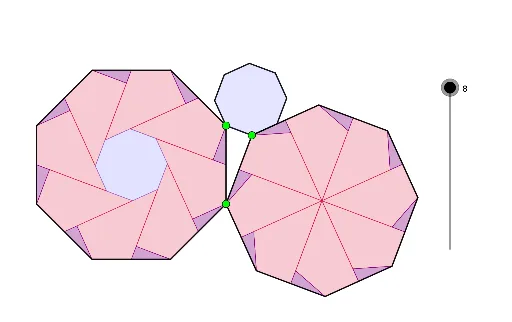
This example demonstrates the Pythagorean Theorem using regular polygons and semicircles. It involves core math concepts like polygons, circles, the Pythagorean Theorem, functions, linear regression, and more. Constructed with GeoGebra commands such as Point, Semicircle, Polygon, Centroid, Mirror, OrthogonalLine, Line, Intersect, Sequence, and Midpoint. Suitable for high school mathematics teaching and geometric construction learning.
GeoGebra Commands & Parameters
Point(yAxis) → APoint(yAxis) → BSemicircle(A, B) → cPoint(c) → CPolygon(A, C, n) → poly1, f, G, J, M, P, S, g, h, q, t, d, g_1, j_1, DPolygon(C, B, n) → poly2, i, H, K, N, Q, T, j, k, r, a, e, h_1, k_1, EPolygon(B, A, n) → poly3, l, I, L, O, R, U, m, p, s, b, f_1, i_1, l_1, FCentroid(poly3) → VCentroid(poly2) → WCentroid(poly1) → ZMirror(A, i) → A'OrthogonalLine(W, i) → m_1Line(B, A') → n_1Intersect(m_1, n_1) → A_1Sequence(Rotate[A_1, ((w * 2) * π / n), W], w, 0, 7) → l1Intersect(m_1, i) → B_1Sequence(Rotate[B_1, ((w * 2) * π / n), W], w, 1, 8) → l2Sequence(Rotate[B, ((w * 2) * π / n), W], w, 0, 7) → l3Sequence(Polygon[W, l1(w), l3(w), l2(w)], w, 1, n) → l4Sequence(Rotate[Mirror[l4(1), Segment[B, C]], ((w * 2) * π / n), V], w, 1, n) → l5Sequence(Rotate[Mirror[W, Segment[B, C]], ((w * 2) * π / n), V], w, 1, n) → l6Sequence(Rotate[Mirror[A_1, Segment[B, C]], ((w * 2) * π / n), V], w, 1, n) → l7Midpoint(l) → C_1Sequence(Rotate[Mirror[B_1, C_1], ((w * 2) * π / n), V], w, 1, n) → l8Polygon(l6) → poly4Polygon(C_1, l8(n), A) → t1, a_1, c_1, p_1Sequence(Rotate[t1, ((w * 2) * π / n), V], w, 1, n) → l9Sequence(Polygon[Rotate[A_1, ((w * 2) * π / n), W], Rotate[B_1, ((w * 2) * π / n), W], Rotate[B, ((w * 2) * π / n), W]], w, 1, n) → l10Polygon(A, C, n) → poly5, q_1, E_1, F_1, G_1, H_1, I_1, r_1, s_1, t_1, b_1, d_1, e_1, f_2, D_1
AI Drawing Prompt Reference
Draw a geometric proof of the Pythagorean theorem. Include three semicircles and a square, with the diameters of the semicircles being the sides of the square. Connect each vertex of the square to the corresponding semicircle, forming three triangles. The diagonals of the square intersect the lines connecting the centers of the semicircles at a single point, demonstrating the Pythagorean theorem.
The prompt above was compiled from the original drawing commands and is for reference only.