
Geometric Proof of Pythagorean Theorem by cemccourseware
Loading the math board and drawing, please wait…
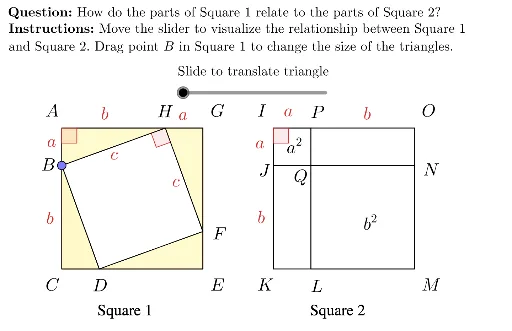
This example demonstrates a geometric proof of the Pythagorean Theorem, illustrating the relationship between the sides of a right triangle through specific constructions. Core mathematical concepts include right triangles, Pythagorean Theorem, geometric construction, and area calculations. It utilizes GeoGebra commands/objects like Point, Polygon, Translate, Angle, and LaTeX in its construction, making it suitable for high school mathematics education or for enthusiasts to delve deeper into the geometric essence of the theorem.
GeoGebra Commands & Parameters
Point(Segment[A, B]) → EPolygon(A, B, 4) → square1, f, g, h, i, C, DTranslate(E, Vector[((2 * f) + spacer - Segment[B, E], 0)]) → E'Translate(D, Vector[E' - D]) → D'Translate(square1, (f + spacer, 0)) → square2Polygon(A, F, E) → t1, e, a, f_1Polygon(F, D, G) → t2, g_1, f_2, dPolygon(G, H, C) → t3, c, g_2, h_1Polygon(E, B, H) → t4, h_2, e_1, bTranslate(A, Vector[((2 * f) + spacer - Segment[B, E], 0)]) → A'Translate(F, Vector[((2 * f) + spacer - Segment[B, E], 0)]) → F'Polygon(A', F', E') → t1', e', a', f'Translate(G, Vector[F' - G]) → G'Translate(H, Vector[F' - G]) → H'Translate(C, Vector[F' - G]) → C'Polygon(G', H', C') → t3', c', g', h'Translate(E, (f + spacer, 0)) → E'_1Translate(B, (f + spacer, 0)) → B'Translate(H, (f + spacer, 0)) → H'_1Polygon(E'_1, B', H'_1) → t4', h'_1, e'_1, b'Translate(G, Vector[E' - D]) → G'_1Translate(F, Vector[D' - D]) → F'_1Polygon(F'_1, D', G'_1) → t2', g'_1, f'_1, d'Translate(A, Vector[(n * Vector[((2 * f) + spacer - Segment[B, E], 0)])]) → A'_1Translate(F, Vector[(n * Vector[((2 * f) + spacer - Segment[B, E], 0)])]) → F'_2Translate(E, Vector[(n * Vector[((2 * f) + spacer - Segment[B, E], 0)])]) → E'_2Polygon(A'_1, F'_2, E'_2) → t1'', e'_2, a'_1, f'_2Translate(F, Vector[(n * Vector[G, G'_1])]) → F'_3Translate(D, Vector[(n * Vector[G, G'_1])]) → D'_1Translate(G, Vector[(n * Vector[G, G'_1])]) → G'_2Polygon(F'_3, D'_1, G'_2) → t2'', g'_2, f'_3, d'_1Translate(G, Vector[(n * Vector[G, F'])]) → G'_3Translate(H, Vector[(n * Vector[G, F'])]) → H'_2Translate(C, Vector[(n * Vector[G, F'])]) → C'_1Polygon(G'_3, H'_2, C'_1) → t3'', c'_1, g'_3, h'_2Translate(E, Vector[(n * Vector[B, B'])]) → E'_3Translate(B, Vector[(n * Vector[B, B'])]) → B'_1Translate(H, Vector[(n * Vector[B, B'])]) → H'_3Polygon(E'_3, B'_1, H'_3) → t4'', h'_3, e'_3, b'_1Polygon(E', A', 4) → aSquared, j, k, l, m, I, JPolygon(D', G'_1, 4) → bSquared, p, q, r, s, K, LPoint(i) → MPoint(h) → NPolygon(E, F, G, H) → q1, t, i_1, j_1, k_1Angle(B, A, D) → αAngle(B', I, G') → βAngle(E, F, G) → γLaTeX("\text{\textbf{Question: }How do the parts of Square 1 relate to the parts of Square 2?}") → instruction1LaTeX("\text{\textbf{Instructions: }Move the slider to visualize the relationship between Square 1\\and Square 2. Drag point \(B\) in Square 1 to change the size of the triangles.}") → instruction2
AI Drawing Prompt Reference
Create a right triangle with its three sides. On each side construct a square, aligning the square’s side with the triangle’s side. Use translations and rotations to reposition the squares, forming two smaller squares on the legs and a larger square on the hypotenuse. Draw connecting lines and auxiliary shapes to illustrate how the areas of the two smaller squares together equal the area of the larger square, providing a visual geometric proof of the Pythagorean theorem. Ensure the construction clearly shows the relationship between the squares and the triangle, highlighting the proof’s logic.
The prompt above was compiled from the original drawing commands and is for reference only.