
Geometric Proof Of Multiplication Rule
Loading the math board and drawing, please wait…
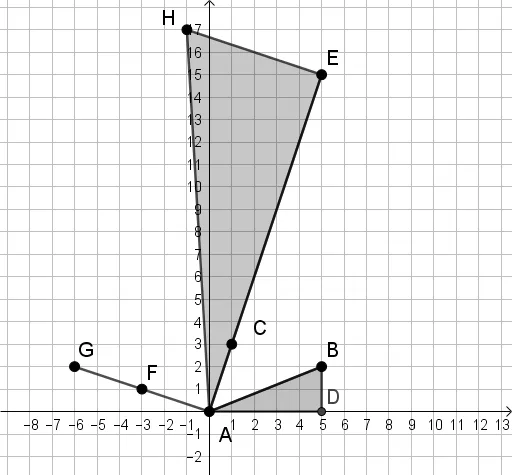
This example dynamically demonstrates the geometric multiplication rule, revealing the intrinsic connection between geometric transformations and multiplication operations. It involves core mathematical concepts such as multiplication, rhombus, differential calculus, complex numbers, exponent, and Pythagorean theorem. The construction utilizes GeoGebra commands like Segment, Dilate, Rotate, Vector, Translate, and Polygon. Suitable for high school and above mathematics learners to understand the application of geometric transformations in proving the multiplication rule.
GeoGebra Commands & Parameters
Segment(A, B) → fSegment(A, C) → gDilate(C, a, A) → ESegment(C, E) → hRotate(C, 90°, A) → FDilate(F, b, A) → GVector(A, G) → uTranslate(E, u) → HPolygon(A, D, B) → t1, b_1, a_1, dPolygon(A, E, H) → t2, h_1, a_2, eSegment(A, G) → i
AI Drawing Prompt Reference
Draw a dynamic geometric illustration showing the multiplication rule, featuring a rhombus and two related polygons, demonstrating the connection between geometric transformations and multiplication. Start with a line segment, create a rhombus based on it, then scale and rotate one vertex of the rhombus to generate two new polygons, and finally connect key points to show vector relationships and geometric transformation effects.
The prompt above was compiled from the original drawing commands and is for reference only.