
Geometric Patterns - Isis Project: Construction & Puzzles
Loading the math board and drawing, please wait…
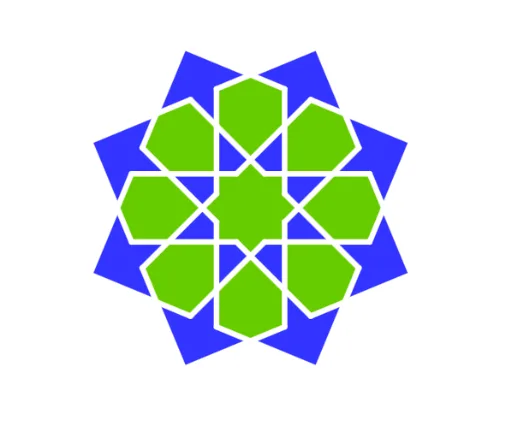
① This example demonstrates the creation of intricate geometric patterns through a sequence of construction commands, accompanied by puzzle-style exploration, showcasing the visual beauty of geometric transformations and constructions. ② Core mathematical concepts include geometric transformations (translation, similar triangles), tangent function, median lines, orthogonal lines, and combinations of polygons and circles, integrating coordinate geometry and trigonometry. ③ Construction highlights: Based on the construction summary, GeoGebra commands such as Intersect, Point, Circle, OrthogonalLine, Segment, Line, and Polygon are used, creating numerous objects (A, B, C, D, E, F, G, H, I, J, K, L, M, N, O, P, Q, R, S) and auxiliary lines (c, d, e, f, g, h, i, j, k, l, m, n, p, q, r, s, t, a, b, f_1, g_1), building symmetric and regular patterns via intersections and orthogonal relationships. ④ Suitable for upper secondary to early university geometry courses, as well as mathematical art design or geometric puzzle challenges, helping learners understand construction logic and transformation properties.
GeoGebra Commands & Parameters
Intersect(xAxis, yAxis) → APoint(xAxis) → BCircle(A, B) → cCircle(B, Segment[A, B]) → dIntersect(c, xAxis, 2) → CCircle(C, Segment[A, B]) → eOrthogonalLine(A, xAxis) → fIntersect(c, f, 1) → DIntersect(c, f, 2) → ECircle(D, Segment[A, B]) → gCircle(E, Segment[A, B]) → hIntersect(e, h, 1) → FIntersect(d, g, 1) → GIntersect(d, h, 2) → HIntersect(e, g, 2) → ISegment(I, H) → iSegment(F, G) → jSegment(F, H) → kSegment(H, G) → lSegment(G, I) → mSegment(I, F) → nIntersect(c, j, 1) → JIntersect(c, i, 2) → KIntersect(c, j, 2) → LIntersect(c, i, 1) → MLine(J, K) → pLine(M, L) → qLine(L, K) → rLine(J, M) → sSegment(D, C) → tSegment(C, E) → aSegment(E, B) → bSegment(B, D) → f_1Intersect(h, r, 1) → NIntersect(d, p, 1) → OIntersect(e, a, 1) → PIntersect(h, a, 1) → QIntersect(g, t, 1) → RIntersect(d, q, 1) → SLine(P, A) → g_1Line(O, A) → h_1Line(N, A) → i_1Intersect(g, f_1, 1) → TLine(T, A) → j_1Intersect(e, h_1, 2) → UIntersect(g_1, m) → VCircle(V, Segment[V, D]) → c_1Intersect(c_1, g_1, 1) → WCircle(A, Segment[A, W]) → d_1Intersect(d_1, g_1, 1) → ZIntersect(d_1, h_1, 1) → A_1Intersect(d_1, i_1, 1) → B_1Line(A, B) → k_1Intersect(d_1, j_1, 1) → C_1Intersect(d_1, h_1, 2) → D_1Intersect(d_1, i_1, 2) → E_1Intersect(d_1, j_1, 2) → F_1Line(Z, D_1) → l_1Line(W, A_1) → m_1Line(F_1, B_1) → n_1Line(C_1, E_1) → p_1Line(F_1, W) → q_1Line(C_1, Z) → r_1Line(A_1, E_1) → s_1Line(D_1, B_1) → t_1Line(B, K) → a_1Line(K, E) → b_1Line(E, J) → e_1Line(J, C) → f_2Line(C, M) → g_2Line(M, D) → h_2Line(D, L) → i_2Line(L, B) → j_2Intersect(l_1, h_2) → G_1Intersect(j_2, h_2) → H_1Segment(G_1, H_1) → k_2Intersect(i_1, f_2) → I_1Intersect(h_2, t_1) → J_1Segment(J_1, I_1) → l_2Intersect(h_1, g_2) → K_1Intersect(j_1, a_1) → L_1Intersect(i_2, q_1) → M_1Segment(M_1, L_1) → m_2Intersect(m_1, i_2) → N_1Segment(N_1, K_1) → n_2Intersect(i_1, b_1) → O_1Intersect(p_1, j_2) → P_1Segment(O_1, P_1) → p_2Intersect(r_1, j_2) → Q_1Segment(Q_1, H_1) → q_2Intersect(s_1, b_1) → R_1Segment(R_1, O_1) → r_2Intersect(m_1, b_1) → S_1Intersect(g_1, b_1) → T_1Segment(T_1, S_1) → s_2Intersect(l_1, e_1) → U_1Intersect(h_1, e_1) → V_1Segment(V_1, U_1) → t_2Intersect(r_1, e_1) → W_1Intersect(j_1, e_1) → Z_1Segment(W_1, Z_1) → a_2Intersect(n_1, a_1) → A_2Segment(A_2, L_1) → b_2Intersect(t_1, a_1) → B_2Segment(B_2, V_1) → c_2Intersect(n_1, f_2) → C_2Intersect(f_2, q_1) → D_2Segment(T_1, D_2) → d_2Segment(C_2, I_1) → e_2Intersect(s_1, g_2) → E_2Segment(K_1, E_2) → f_3Intersect(p_1, g_2) → F_2Segment(Z_1, F_2) → g_3Intersect(h_1, p_1) → G_2Intersect(g_1, p_1) → H_2Segment(F_2, G_2) → h_3Segment(H_2, P_1) → i_3Intersect(s_1, g_1) → I_2Intersect(h_1, r_1) → J_2Segment(C_2, I_2) → j_3Segment(J_2, A_2) → k_3Intersect(m_1, r_1) → K_2Intersect(j_1, m_1) → L_2Segment(S_1, K_2) → l_3Segment(L_2, N_1) → m_3Intersect(j_1, l_1) → M_2Intersect(i_1, l_1) → N_2Segment(U_1, M_2) → n_3Segment(N_2, G_1) → p_3Segment(W_1, J_2) → q_3Segment(D_2, N_2) → r_3Segment(K_2, Q_1) → s_3Segment(M_1, G_2) → t_3Segment(R_1, I_2) → a_3Segment(B_2, L_2) → b_3Segment(J_1, H_2) → c_3Segment(E_2, M_2) → d_3Polygon(E, S_1, A_1, R_1, K, V_1) → pol1, e_3, s_4, a_4, r_4, k_4, v_1Polygon(K, O_1, B, A_2, B_1, B_2) → pol2, k_5, o_1, b_4, a_5, b_5, b_6Polygon(B, P_1, C_1, Q_1, L, L_1) → pol3, b_7, p_4, c_4, q_4, l_4, l_5Polygon(D, H_1, L, M_1, W, N_1) → pol4, d_4, h_4, l_6, m_4, w, n_4Polygon(D, K_1, M, J_1, D_1, G_1) → pol5, d_5, k_6, m_5, j_4, d_6, g_4Polygon(M, E_2, E_1, F_2, C, I_1) → pol6, m_6, e_4, e_5, f_4, c_5, i_4Polygon(J, Z_1, C, C_2, F_1, D_2) → pol7, j_5, z_1, c_6, c_7, f_5, d_7Polygon(J, T_1, E, U_1, Z, W_1) → pol8, j_6, t_4, e_6, u_1, z_2, w_1Intersect(j_3, n_3) → O_2Intersect(q_3, a_3) → P_2Intersect(k_3, l_3) → Q_2Intersect(s_3, b_3) → R_2Intersect(i_3, m_3) → S_2Intersect(t_3, c_3) → T_2Intersect(h_3, p_3) → U_2Intersect(r_3, d_3) → V_2Polygon(Z, U_1, E, S_1, A_1, P_2) → pol9, z_3, u_2, e_7, s_5, a_6, p_5Polygon(F_1, O_2, Z, W_1, J, D_2) → pol10, f_6, o_2, z_4, w_2, j_7, d_8Polygon(C_2, F_1, V_2, E_1, F_2, C) → pol11, c_8, f_7, v_2, e_8, f_8, c_9Polygon(E_1, U_2, D_1, J_1, M, E_2) → pol12, e_9, u_3, d_9, j_8, m_7, e_{10}Polygon(T_2, D_1, G_1, D, N_1, W) → pol13, t_5, d_{10}, g_5, d_{11}, n_5, w_3Polygon(S_2, C_1, Q_1, L, M_1, W) → pol14, s_6, c_{10}, q_5, l_7, m_8, w_4Polygon(R_2, C_1, P_1, B, A_2, B_1) → pol15, r_5, c_{11}, p_6, b_8, a_7, b_9Polygon(A_1, R_1, K, B_2, B_1, Q_2) → pol16, a_8, r_6, k_7, b_{10}, b_{11}, q_6Polygon(O_2, I_2, P_2, Z) → q1, o_3, i_5, p_7, z_5Polygon(F_1, V_2, M_2, O_2) → q2, f_9, v_3, m_9, o_4Polygon(V_2, N_2, U_2, E_1) → q3, v_4, n_6, u_4, e_{11}Polygon(T_2, D_1, U_2, G_2) → q4, t_6, d_{12}, u_5, g_6Polygon(T_2, W, S_2, H_2) → q5, t_7, w_5, s_7, h_5Polygon(R_2, L_2, S_2, C_1) → q6, r_7, l_8, s_8, c_{12}Polygon(R_2, B_1, Q_2, K_2) → q7, r_8, b_{12}, q_7, k_8Polygon(P_2, A_1, Q_2, J_2) → q8, p_8, a_9, q_8, j_9Polygon(M_2, O_2, H_2, T_2, G_2, U_2, N_2, V_2, I_2, P_2, J_2, Q_2, K_2, R_2, L_2, S_2) → pol17, m_{10}, s_9, h_6, t_8, g_7, u_6, n_7, v_5, o_5, i_6, p_9, j_{10}, q_9, k_9, r_9, l_9