
Geometric Mean Demonstration by davidcorcoran
Loading the math board and drawing, please wait…
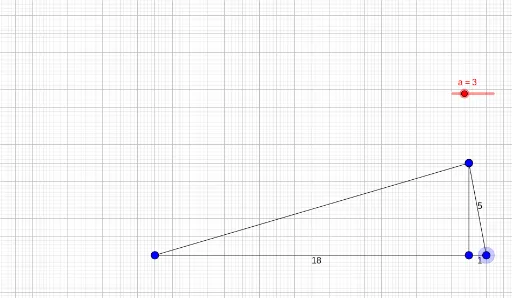
This example dynamically demonstrates how to calculate the geometric mean by constructing segments and angles. It involves core mathematical concepts such as the definition of the geometric mean, segment length calculation, angle measurement, and potential optimization problems. The construction uses GeoGebra commands/objects like Segment, Angle, and various labeled objects (a, b, c, ..., α, β, A_1, B_2, etc.). Suitable for high school mathematics education to understand the practical application and construction method of the geometric mean.
GeoGebra Commands & Parameters
Segment(A, B) → fSegment(B, C) → gSegment(B, D) → hSegment(A, E) → iSegment(E, D) → jSegment(E, D) → kSegment(E, D) → lAngle(A, B, D) → αSegment(E, C) → mAngle(C, E, A) → βSegment(A_1, B_1) → f_1Segment(B_1, C_1) → g_1Segment(B_1, D_1) → h_1Segment(A_1, E_1) → i_1Segment(E_1, D_1) → j_1Segment(E_1, D_1) → k_1Segment(E_1, D_1) → l_1Angle(A_1, B_1, D_1) → α_1Segment(E_1, C_1) → m_1Angle(C_1, E_1, A_1) → β_1Angle(A_1, B_1, D_1) → γAngle(A_1, E_1, C_1) → δSegment(A_2, B_2) → f_2Segment(B_2, C_2) → g_2Segment(B_2, D_2) → h_2Segment(A_2, E_2) → i_2Segment(E_2, D_2) → j_2Segment(E_2, D_2) → k_2Segment(E_2, D_2) → l_2Angle(A_2, B_2, D_2) → α_2Segment(E_2, C_2) → m_2Angle(C_2, E_2, A_2) → β_2