
Geometric Interpretation of Complex Arithmetic
Loading the math board and drawing, please wait…
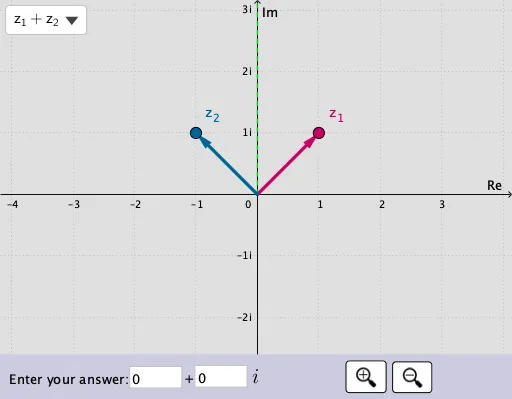
This example demonstrates the geometric interpretation of complex arithmetic. It involves core concepts such as addition, subtraction, rotation, and translation of complex numbers. Using GeoGebra commands like If, Textfield, Segment, Vector, etc., it provides a visual understanding of complex numbers. Suitable for high school mathematics education and learning.
GeoGebra Commands & Parameters
If(form ≟ true, ((const1 * x(Apolar)) + (const2 * x(Bpolar)), (const1 * y(Apolar)) + (const2 * y(Bpolar))), ((const1 * a) + (const2 * c), (const1 * b) + (const2 * d))) → Z5If(form ≟ true, (((x(Apolar) * x(Bpolar)) + (y(Apolar) * y(Bpolar))) / (x(Bpolar)^(2) + y(Bpolar)^(2)), ((y(Apolar) * x(Bpolar)) - (x(Apolar) * y(Bpolar))) / (x(Bpolar)^(2) + y(Bpolar)^(2))), (((a * c) + (b * d)) / (c^(2) + d^(2)), ((b * c) - (a * d)) / (c^(2) + d^(2)))) → Z4If(form ≟ true, ((x(Apolar) * x(Bpolar)) - (y(Apolar) * y(Bpolar)), (y(Apolar) * x(Bpolar)) + (x(Apolar) * y(Bpolar))), ((a * c) - (b * d), (b * c) + (a * d))) → Z3If(form ≟ true, (x(Apolar) - x(Bpolar), y(Apolar) - y(Bpolar)), (a - c, b - d)) → Z2Textfield(xA) → InputBox1Textfield(yA) → InputBox2Textfield(xB) → InputBox3Textfield(yB) → InputBox4Segment((0, 0), A) → rASegment((0, 0), B) → rBIf(form ≟ true, (x(Apolar) + x(Bpolar), y(Apolar) + y(Bpolar)), (a + c, b + d)) → Z1Segment((0, 0), Z1) → rZ1Segment((0, 0), Z2) → rZ2Segment((0, 0), Z3) → rZ3Segment((0, 0), Z4) → rZ4Vector((0, 0), A) → uAVector((0, 0), B) → uBVector((0, 0), Z1) → uZ1Vector((0, 0), Z2) → uZ2Vector((0, 0), Z3) → uZ3Vector((0, 0), Z4) → uZ4SelectedIndex(operation) → indexopAngle((1000, 0), (0, 0), Element[points, indexop]) → εAngle(Element[points, indexop], (0, 0), (1000, 0)) → ζSegment(B', Z1) → fSegment(A', Z1) → gVector((0, 0), A') → uA'Vector((0, 0), B') → uB'Mirror(uB', (0, 0)) → uB''Segment(A', Z2) → hSegment(Z2, Bminus) → iTextfield(guessx) → InputBox5Textfield(guessy) → InputBox6Ray((0, 0), Element[points, indexop]) → RayzVector((0, 0), Z5) → uZ5Vector((0, 0), A'') → uA''Vector((0, 0), B'') → uB3Vector((0, 0), A) → uVector((0, 0), B) → vTextfield(const1) → InputBox7Textfield(const2) → InputBox8Segment(Z5, A'') → jSegment(Z5, B'') → kAngle((1000, 0), (0, 0), Apolar) → αAngle(Apolar, (0, 0), (1000, 0)) → βAngle((1000, 0), (0, 0), Bpolar) → γAngle(Bpolar, (0, 0), (1000, 0)) → δIf(form ≟ true, (x(Apolar) + x(Bpolar), y(Apolar) + y(Bpolar)), (a + c, b + d)) → ZZVector((0, 0), Apolar) → upolarVector((0, 0), Bpolar) → vpolarVector((0, 0), Apolar') → wVector((0, 0), Bpolar') → eVector((0, 0), Apolar) → lVector((0, 0), Bpolar) → mVector((0, 0), Bpolarminus) → nTextfield(theta1) → InputBox9Textfield(theta2) → InputBox11Textfield(mod1) → InputBox10Textfield(mod2) → InputBox12Line(C, xAxis) → pLine(D, p) → qSegment((0, 0), Z5) → rZ5Segment(Bpolar', Z5) → rSegment(Apolar', Z5) → sTableText({{LaTeX[A, true, true]}, {LaTeX[B, true, true]}}) → CartesianPointsTableText({{LaTeX[Apolar, true, true]}, {LaTeX[Bpolar, true, true]}}) → PolarPoints