
Geometric Exploration of Set Intersection and Union (A∩B, A∪B)
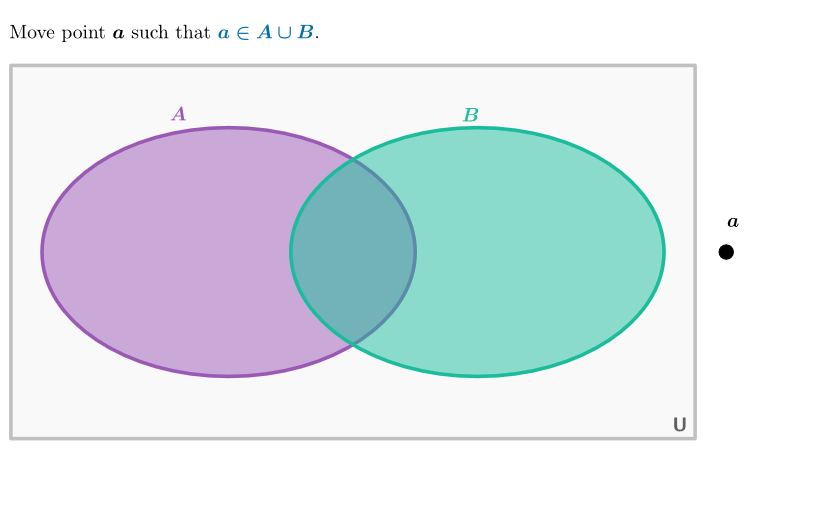
Loading the math board and drawing, please wait…
In collections
Sets
This GeoGebra example demonstrates how set intersection and union can be visualized by testing whether a point lies inside one or more geometric regions. The key math ideas are set theory concepts—intersection (A∩B), union (A∪B), subset membership, and the role of the universal set—linked to geometric regions. Construction focuses on: Point and Random to create a test point (possibly randomized or controlled), Polygon to define the regions representing sets, and IsInRegion to decide membership in A, B, and their intersection/union conditions; Element is used to reference geometric objects in the logic. The included objects (e.g., inA, inB, inAB, outABinUni, universe, validate, btnCheck, textFeedback, correct flags) support interactive checking and immediate feedback. Suitable for middle and high school students, as well as for classroom activities that connect formal set operations with geometric interpretation.
GeoGebra Commands & Parameters
Point(xAxis) → BRandom(1, 12) → caseNumPolygon({(-3.5, -3), (7.5, -3), (7.5, 3), (-3.5, 3)}) → universeIsInRegion(P, a) → inAIsInRegion(P, b) → inBIsInRegion(P, universe) → inUElement(allCorrect, caseNum) → correct
AI Drawing Prompt Reference
Create a coordinate system with four points, then draw a polygon covering from (-3.5, -3) to (7.5, 3) as the universal set. Randomly generate a point P and check if it is in set A and set B, recording the results. Then determine if P is in set A, set B, the intersection of A and B, or the union of A and B.
The prompt above was compiled from the original drawing commands and is for reference only.