
Geometric Demonstration of Trigonometric Factorization Addition Identities
Loading the math board and drawing, please wait…
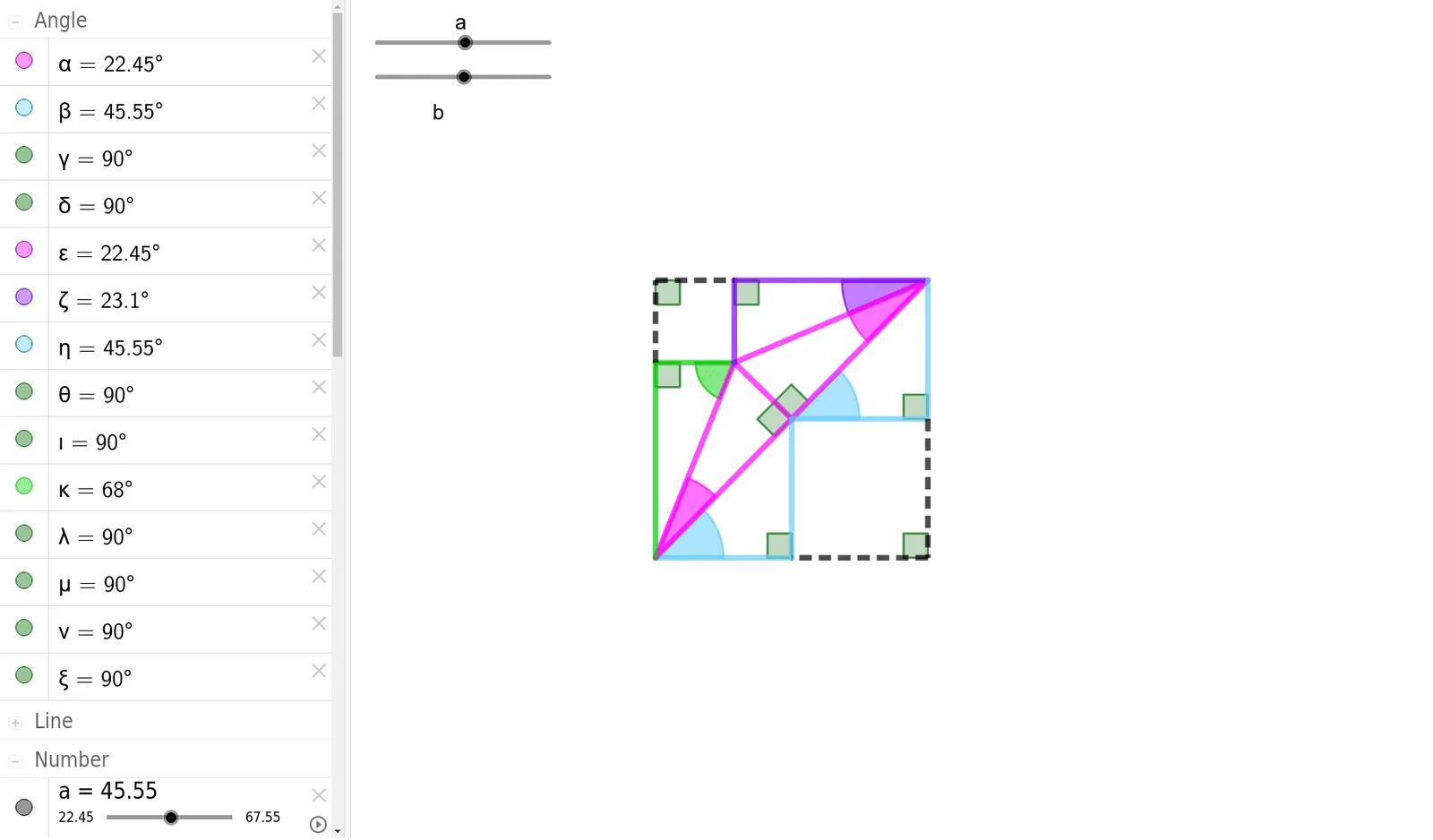
This GeoGebra example dynamically illustrates the geometric meaning of trigonometric factorization addition identities, such as sinα + sinβ = 2sin((α+β)/2)cos((α-β)/2). The core mathematical concepts involve trigonometric identities, angle rotation, vector translation, and geometric transformations. The construction uses commands like Rotate, Angle, Line, Segment, Intersect, Vector, and Translate to create angles, auxiliary lines, and translated points (e.g., A', D', etc.), revealing how the sum of trigonometric functions corresponds to products of half-angle functions. This is suitable for high school or early college students learning trigonometry, and for teachers demonstrating the visual derivation of algebraic identities. It enhances conceptual understanding by connecting algebra with geometry.
GeoGebra Commands & Parameters
Rotate(B, a°, A) → B'Angle(B, A, B') → βLine(A, B') → fSegment(A, B) → gLine(B, C) → hIntersect(h, f) → DRotate(A, (-(90°)), D) → A'Angle(A', D, A) → γLine(A', D) → iLine(A, E) → jRotate(D, b°, A) → D'Angle(D, A, D') → αLine(A, D') → kIntersect(i, k) → FLine(F, G) → lIntersect(j, l) → HSegment(A, D) → mSegment(D, F) → nSegment(F, A) → pSegment(A, H) → qSegment(H, F) → rSegment(D, B) → cRotate(D, 90°, F) → D'_1Angle(D, B, A) → ιAngle(H, F, A) → κVector(A, D) → uTranslate(D, u) → D'_2Vector(D, D'_2) → vSegment(D, D'_2) → tSegment(F, D'_2) → dSegment(F, I) → eSegment(I, D'_2) → g_1Line(D'_2, I) → h_1Intersect(j, h_1) → JSegment(A, J) → i_1Segment(J, D'_2) → j_1Angle(D'_2, D, F) → δAngle(F, D'_2, D) → εAngle(I, D'_2, F) → ζIntersect(f_1, k_1) → KSegment(D, K) → l_1Segment(K, D'_2) → m_1Angle(K, D, D'_2) → ηAngle(D'_2, K, D) → θAngle(F, I, D'_2) → λAngle(H, J, I) → μAngle(A, H, F) → νLine(A, B) → n_1Intersect(k_1, n_1) → LSegment(K, L) → p_1Segment(L, B) → q_1Segment(H, J) → r_1Segment(J, I) → s_1Angle(K, L, B) → ξ
AI Drawing Prompt Reference
Draw a geometric figure demonstrating trigonometric sum-to-product identities. Start with a segment, rotate another segment from one endpoint to form two angles, and construct auxiliary lines intersecting at a point. Around this intersection, rotate and construct perpendiculars to form multiple triangles and quadrilaterals. Use translations and rotations to create symmetric or parallel segments, and label various angles. The final figure includes several triangles, quadrilaterals, parallel and perpendicular lines, and labeled angles, visually showing how sums of sine and cosine relate to products of half-angles.
The prompt above was compiled from the original drawing commands and is for reference only.