
Geometric Construction with Transformations Linked to Integral Ideas
Loading the math board and drawing, please wait…
In collections
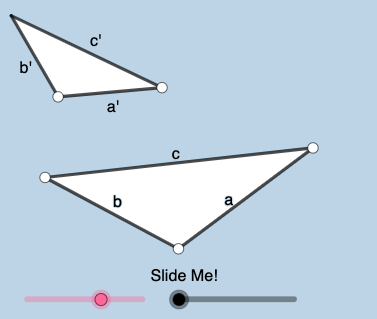
Exploration: Similar Triangles
This example demonstrates how to build a structured geometric configuration—points, segments, lines, circles, and circle arcs—by using multiple geometric operations and transformations, and then use the resulting structure to visualize ideas related to integral expressions (e.g., an interpretation connected to indefinite integrals). Key mathematical concepts include geometric object construction (point/line/circle/arc), angle and orthogonality, vector-based reasoning, intersection of loci, and transformation tools such as rotation, translation, and dilation. Construction highlights from the provided GeoGebra commands: Segment, Rotate, Ray, Point, OrthogonalLine, Circle, Intersect, Line, Polygon, Min, CircleSector, Dilate, Vector, Translate, Angle, and CircleArc. The construction organizes several derived points and labels (e.g., multiple stages like A, B, C and their dependent objects) to enforce geometric constraints; then transformation commands generate comparable configurations, making it easier to observe angle relationships, intersection behavior, and the components that can be tied to calculation or integral-related understanding. Suitable for advanced secondary students and early university learners for geometric construction, coordinate/analytic modeling, and calculus-integral concept visualization.
GeoGebra Commands & Parameters
Segment(A, B) → aRotate(B, (a_{2} * pi / 180), A) → B'Ray(A, B') → fPoint(f) → CSegment(A, C) → bOrthogonalLine(C, b) → rCircle(C, 1) → tIntersect(t, r, 2) → KOrthogonalLine(K, r) → i_1Point(i_1) → WRotate(E, (a_{2} * pi / 180), D) → E'Ray(D, E') → jSegment(D, E) → a'Circle(D, (a' / a * b)) → dIntersect(d, j, 1) → FSegment(D, F) → b'Line(K, b') → k_1Point(k_1) → ULine(K, a') → j_1Point(j_1) → VCircle(B, 1) → sOrthogonalLine(B, a) → qPoint(q) → MIntersect(s, q, 1) → JOrthogonalLine(J, q) → h_1Point(h_1) → PPolygon(A, B, C) → t1, c_{2}, a_1, b_{1}Polygon(D, F, E) → t2, e, d_1, f_1Min({a, a', b, b'}) → gCircle(A, (0.35 * g)) → hIntersect(h, a, 1) → GIntersect(h, b, 1) → HCircleSector(A, G, H) → kLine(A, a') → iDilate(A, If[-1 < l ≤ 0, (-l), 0], D) → A'Vector(A, A') → uTranslate(k, u) → k'Point(i) → IAngle(I, A, B) → αCircleArc(A, G, H) → pDilate(D, If[1 < l ≤ 2, 2 - l, 0], J) → D'Vector(D, D') → vTranslate(D, v) → D'_{1}Translate(E, v) → E'_{1}Segment(D'_{1}, E'_{1}) → a''Line(J, a') → g_1Point(g_1) → LAngle(P, J, L) → βRotate(D'_{1}, If[1 < l ≤ 2, ((l - 1) * β), β], D'_{1}) → NRotate(E'_{1}, If[1 < l ≤ 2, ((-(l - 1)) * β), (-β)], D'_{1}) → OSegment(N, O) → a'''Dilate(D, If[2 < l ≤ 3, 3 - l, 0], K) → D'_{2}Vector(D, D'_{2}) → wTranslate(D, w) → D'_{3}Translate(E, w) → E'_{2}Point(j_1) → QPoint(i_1) → RAngle(W, K, U) → γRotate(D'_{3}, If[2 < l ≤ 3, ((l - 2) * γ), γ], D'_{3}) → SRotate(E'_{2}, If[2 < l ≤ 3, ((l - 2) * γ), γ], D'_{3}) → TTranslate(D, w) → D'_{4}Translate(F, w) → F'Segment(D'_{4}, F') → b''Rotate(D'_{4}, If[2 < l ≤ 3, ((-(l - 2)) * γ), (-γ)], K) → ZRotate(F', If[2 < l ≤ 3, ((-(l - 2)) * γ), (-γ)], K) → F''Segment(Z, F'') → b'''Angle(A, C, B) → δIntersect(t, b, 1) → A_1Rotate(A_1, If[-3 < l ≤ -2, ((l + 3) * δ), δ], C) → B_1CircleSector(C, A_1, B_1) → e_1Dilate(C, If[-1 < l ≤ 0, (-l), 0], F) → C'Vector(C, C') → u_1Translate(e_1, u_1) → p_1Line(C, b') → l_1Point(l_1) → C_1Angle(C_1, C, A) → εSegment(F, E) → m_1Segment(B, C) → cOrthogonalLine(B, c) → r_1Circle(B, 1) → s_1Intersect(s_1, r_1, 1) → D_1Dilate(E, If[3 < l ≤ 4, 4 - l, 0], D_1) → E'_{3}Vector(E, E'_{3}) → v_1Translate(F, v_1) → F'_{1}Translate(E, v_1) → E'_{4}Segment(F'_{1}, E'_{4}) → t_1Line(E, c) → f_2Point(f_2) → E_1Angle(F, E, E_1) → ζRotate(F'_{1}, If[3 < l ≤ 4, ((l - 3) * ζ), ζ], E'_{3}) → F_1Rotate(E'_{4}, If[3 < l ≤ 4, ((l - 3) * ζ), ζ], E'_{3}) → G_1Segment(F_1, G_1) → g_2Angle(B, A, C) → ηRotate(G, If[-3 < l ≤ -2, ((l + 3) * η), η], A) → G'CircleSector(A, G, G') → d_2CircleArc(C, A_1, B_1) → e_2Rotate(p_1, If[-1 < l ≤ 0, ((-(l + 1)) * ε), (-ε)], C') → q_1Rotate(k', If[-1 < l ≤ 0, ((-(l + 1)) * α), (-α)], A') → k''
AI Drawing Prompt Reference
Draw a geometric figure composed of multiple objects including points A, B, C, D, E, F, G, H, I, J, K, L, M, N, O, P. Include line segments a, b, a', b', c, d, e, f', g''. Include rays f, j, i. Include circles t, s, d, h, k, p. Include circular arcs k, p. Include perpendicular lines r, q, h_1, i_1. The construction starts from points A and B, creating segment a, rotating B to B', constructing ray f, point C, segment b, perpendicular line r, circle t, intersection K, perpendicular line i_1, point W. Then construct D, E, E', j, a', d, F, b', k_1, U, j_1, V, s, q, M, J, h_1, P. Organize points A, B, C and D, F, E into polygons. Compute minimum g, construct circle h, intersection points G and H, circular arc k. Construct line i, point I, angle alpha. Construct points D', D'_{1}, E'_{1}, segment a'', line g_1, point L, angle beta. The figure should illustrate geometric transformations linked to integral concepts, showing angle relationships, intersection behaviors, and calculable components.
The prompt above was compiled from the original drawing commands and is for reference only.