
Geometric Construction of Vector Addition by Ramon Pereira da Silva (2)
Loading the math board and drawing, please wait…
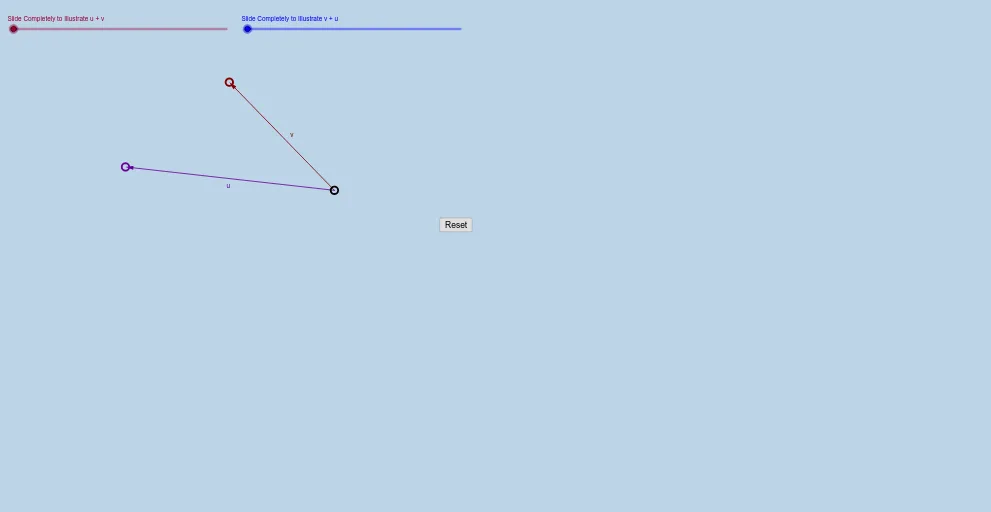
This example visually demonstrates vector addition by constructing equivalent results through geometric transformations, making the relationship between different vector representations clear. It centers on core concepts such as vector addition (head-to-tail and parallelogram interpretations), interpreting vectors as directed segments, and using affine operations—rotation, dilation (scaling), and translation—to generate corresponding vectors and a combined (resultant) vector. The construction is built with GeoGebra commands including Vector to define directed segments, Rotate to change orientation, Dilate to scale magnitudes, Translate to preserve direction while shifting position, and Textfield to label key points/vectors. It relies on a set of base objects (points A, B and vectors v, u, a, C, etc.) and their transformed counterparts (e.g., primed versions like A', C', and indexed variants) to connect the original vectors with the constructed results. Suitable for middle school through early university students, and ideal for teaching vector fundamentals, geometric construction lessons, and interactive explorations linking algebraic operations to geometric meaning.
GeoGebra Commands & Parameters
Vector(A, B) → vVector(A, C) → uRotate(C, If[0 < a ≤ 1, (a * 180°), 180°], A) → C'Dilate(A, If[1 < a < 2, 2 - a, 1], B) → A'Vector(A, A') → bRotate(C, 180°, A) → C'_1Translate(C'_1, b) → DTranslate(C'_1, v) → EVector(A, E) → fTextfield() → InputBox1Dilate(A, If[0 < a ≤ 1, 1 - a, 0], C) → A'_1Vector(A, A'_1) → wTranslate(B, w) → B'Vector(A'_1, B') → cDilate(A, If[1 < a ≤ 2, 2 - a, 0], B') → A'_2Vector(A, A'_2) → dVector(A, B) → eDilate(A, If[0 < g ≤ 1, 1 - g, 0], B) → A'_3Vector(A, A'_3) → hTranslate(C, h) → C'_2Vector(A'_3, C'_2) → iVector(A, C) → jDilate(A, If[1 < g ≤ 2, 2 - g, 0], C'_2) → A'_4Vector(A, A'_4) → k
AI Drawing Prompt Reference
Draw the geometric addition of two vectors v and u by first defining v and u, then generating their transformed versions like v' and u' through rotation, scaling, and translation operations. Finally, construct the resultant vector f using these transformed vectors. Pay attention to using 180-degree rotation, scaling, and translation to generate vector transformations, and connect the original vectors with the final resultant vector through these transformations.
The prompt above was compiled from the original drawing commands and is for reference only.