
Geometric Construction of Renaissance Circular Churches
Loading the math board and drawing, please wait…
In collections
circles, ovals, ellipses and architecture
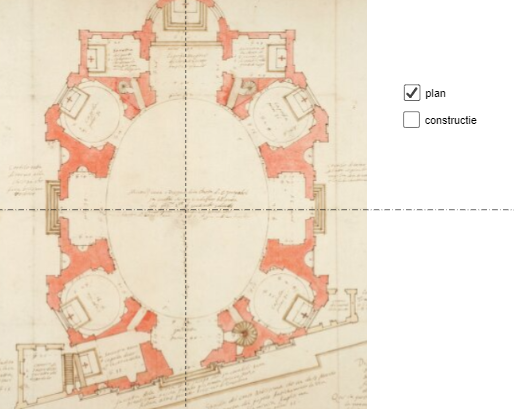
This example demonstrates the geometric construction of circular churches from the Renaissance period, focusing on arcs and circles. Key mathematical concepts include circles, arcs, geometric construction, and coordinate geometry. Construction involves GeoGebra commands such as Point, Circle, CircleArc, etc. Suitable for middle or high school mathematics courses to learn geometric construction and coordinate geometry basics.
GeoGebra Commands & Parameters
Point(f) → DRotate(D, -30°, C) → D'Line(C, D') → gIntersect(g, xAxis) → EMirror(g, xAxis) → g'Mirror(E, vgl1) → E'Mirror(g, vgl1) → g'_{1}Mirror(g', vgl1) → g''Intersect(g, vgl1) → FCircle(F, E') → cIntersect(c, vgl1, 2) → GCircle(G, F) → dIntersect(c, g, 1) → HIntersect(c, g'_{1}, 1) → IIntersect(d, g'', 1) → JIntersect(d, g', 1) → KCircleArc(F, I, H) → eCircleArc(G, K, J) → hCircleArc(E, H, K) → kCircleArc(E', J, I) → pRay(E', F) → iRay(E', G) → jRay(E, F) → lRay(E, G) → mPolygon(F, E, G) → driehoek1, g_1, f_1, e_1
AI Drawing Prompt Reference
In a coordinate plane, start with a point D and rotate it by -30° around point C to get D′. Draw the line g through C and D′, intersect it with the x-axis to obtain E, then reflect g across the x-axis to get g′ and across the given vertical reference line to get g′₁. Intersect the mirrored line with g to obtain F. Construct circle c with center F and radius determined by E′, and intersect c with the vertical reference line to get G. Construct circle d using center G and radius F. Find H as an intersection of c with g, I as an intersection of c with g′₁, and then J and K as corresponding intersections of d with g″ and g′. Draw circular arcs e from (F, I, H), h from (G, K, J), k from (E, H, K), and p from (E′, J, I). Add rays from E′ toward F and G, rays from E toward F and G, and finally form the polygon with vertices F, E, G.
The prompt above was compiled from the original drawing commands and is for reference only.