
Geometric Construction of Addition for Two Complex Numbers
Loading the math board and drawing, please wait…
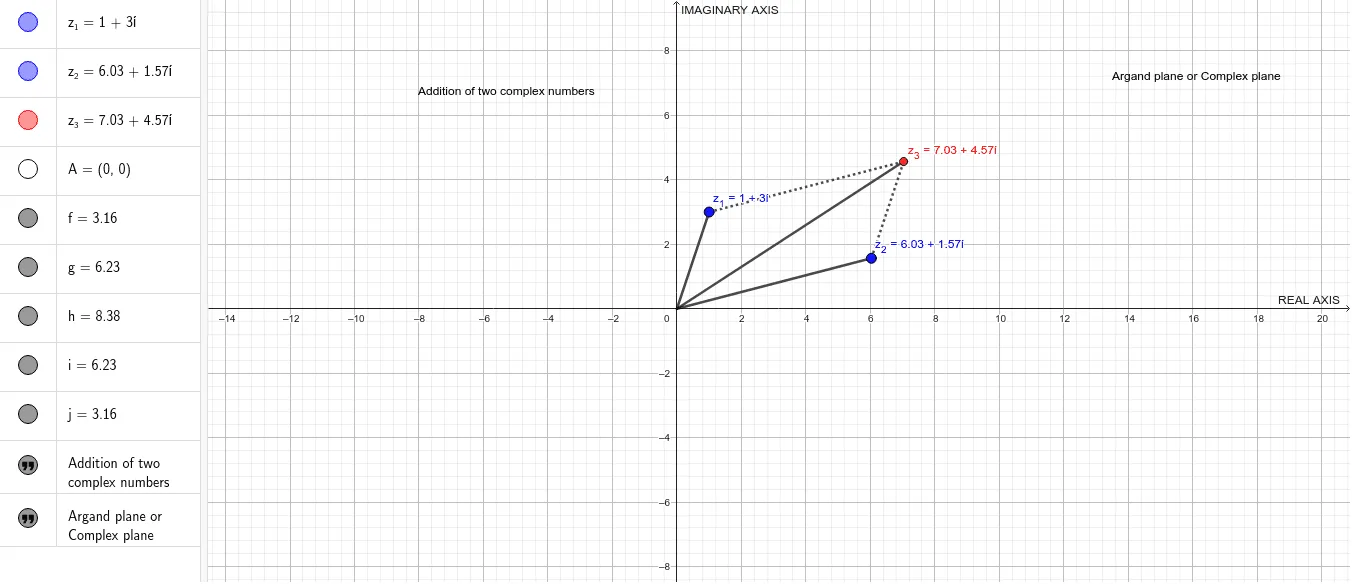
This example demonstrates how to add two complex numbers using a geometric construction. Complex numbers are represented in the complex (Argand) plane, so the sum corresponds to the correct combined position obtained from the vectors/points of the addends. The core ideas are the algebraic addition of complex numbers and its geometric interpretation via translations in the plane (real and imaginary parts mapped to x/y coordinates). Construction focuses on using GeoGebra tools such as Intersect and Segment to create and locate key points—z_1, z_2, and the resulting z_3—together with auxiliary points (e.g., A) that encode the required relationships. Labeled objects (text1, text2) and additional constructed elements (f, g, h, i, j) are used to clearly present the steps and the final sum location. Suitable for advanced high school through early university, especially for teaching complex numbers with geometric intuition and linking complex arithmetic to coordinate geometry and geometric constructions.
GeoGebra Commands & Parameters
Intersect(xAxis, yAxis) → ASegment(A, z_1) → fSegment(A, z_2) → gSegment(A, z_3) → hSegment(z_1, z_3) → iSegment(z_2, z_3) → j
AI Drawing Prompt Reference
In the complex plane, draw the origin and two complex number points. Connect the origin to each point with line segments. Then, using the parallelogram rule for complex addition, locate the point representing the sum of the two complex numbers. Connect this sum point to the origin and to each of the two original points, forming a parallelogram. Label all key points and display their complex expressions to illustrate the geometric interpretation of addition.
The prompt above was compiled from the original drawing commands and is for reference only.