
Geometric Construction of a Vertical Hyperbola in GeoGebra
Loading the math board and drawing, please wait…
In collections
geometriadinamica.es
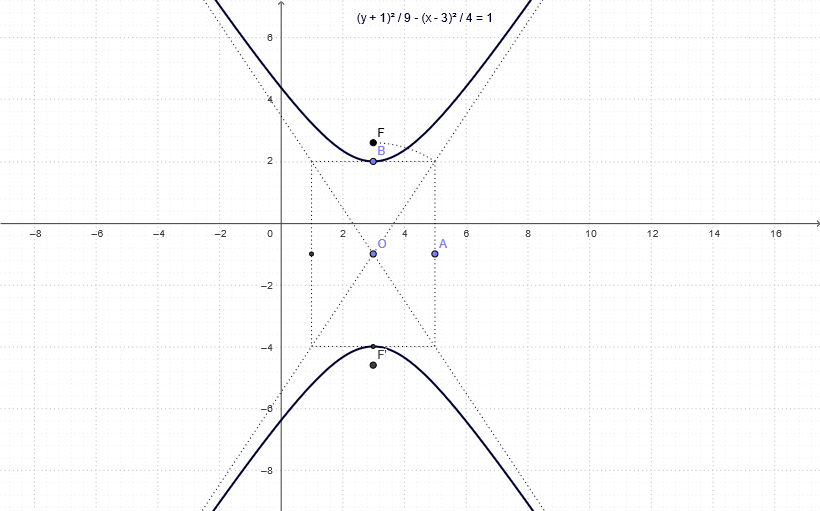
This example demonstrates how to construct a hyperbola with a vertical transverse axis using GeoGebra. It covers key mathematical concepts including the definition of hyperbola, standard equation, foci (F and F'), vertices (A and A'), and directrices in coordinate geometry. The construction uses GeoGebra commands such as Ray, Point, Intersect, Circle, CircleArc, Segment, and Mirror to precisely draw the hyperbola by constructing foci, directrices, auxiliary circles and other objects, with parameters b and c controlling the curve shape. Suitable for high school and college coordinate geometry courses, useful for understanding hyperbola properties or practicing geometric construction techniques.
GeoGebra Commands & Parameters
Ray(O, AA) → semi_aPoint(semi_a) → ARay(O, BB) → semi_bPoint(semi_b) → BIntersect(yAxis, semi_b) → DCircle(O, F) → kCircleArc(O, C, F) → pSegment(B, C) → eSegment(C, A) → fMirror(C, B) → EMirror(E, A') → GMirror(C, A) → HSegment(E, G) → iSegment(G, H) → jSegment(H, A) → lSegment(E, B) → m
AI Drawing Prompt Reference
Construct a vertical hyperbola in a coordinate plane centered at origin O. Use two given scale parameters b and c to set the geometry: draw rays from O to define the semi-length direction for the vertical transverse axis, place the vertex A on the y-axis along that direction (and use the corresponding second vertex A' by symmetry), and determine a y-axis intersection point D from the other semi-length. Then build auxiliary circles related to the foci by drawing a circle centered at O with radius matching the distance to the focus F, and take an appropriate arc to locate the auxiliary intersection point C. Connect B, C, and C, A with segments, then apply reflection across lines through C and the relevant symmetric axis to obtain mirrored points for constructing the lower and upper branches. Finally connect the reflected endpoints with segments to display both symmetric parts of the hyperbola, with the overall shape controlled by parameters b and c.
The prompt above was compiled from the original drawing commands and is for reference only.