
Geometric construction and parametric curves for a New Year design
Loading the math board and drawing, please wait…
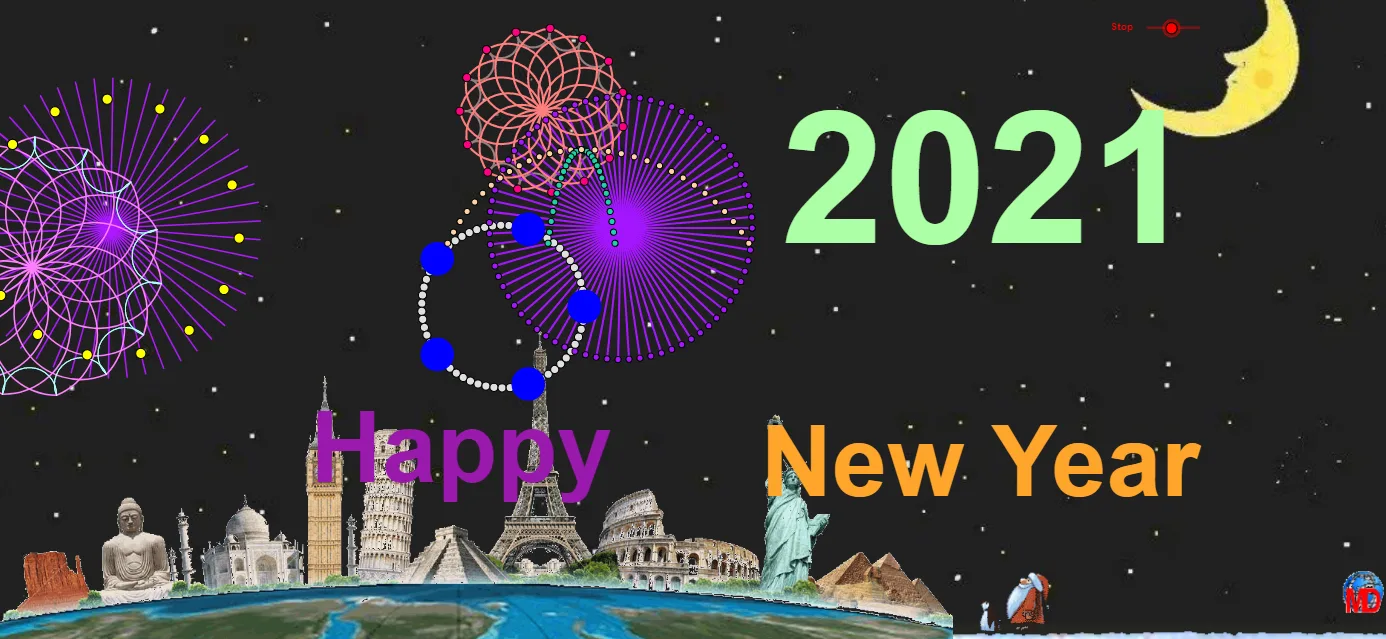
This example demonstrates how to combine circles, lines, and intersections with parameter-driven point generation to produce geometric curves and trajectories that can serve as a New Year themed design. The key math ideas include unit-circle style reasoning, parametric curves (placing points by a varying angle/parameter), vector and line construction to guide the shape, and angle/period handling (including modular behavior) to obtain repeating symmetry. Construction highlights: Circle to set the baseline curve; Point and Intersect to obtain critical points; Segment and Line for connections and reference geometry; Sequence to generate an ordered set of points from the parameter progression; OrthogonalLine and Vector to construct perpendicular constraints and directional control; Mod together with angle-related variables (e.g., ang and related parameters) to enforce periodic/rotational effects; plus additional objects for labeling and presentation (e.g., text/image). Suitable for middle/high school geometry, lessons on parametric modeling, and GeoGebra graphing practice.
GeoGebra Commands & Parameters
Circle(A, a) → cPoint(c) → BSegment(A, B) → bCircle(A, m) → dIntersect(d, b) → C, HSequence(Rotate[B, (i * ang), A], i, 0, nn) → liste1Sequence(Rotate[C, (i * ang) + ang / 2, A], i, 0, nn) → liste3OrthogonalLine(A, b) → eVector(A, B) → uSequence(Semicircle[Element[liste1, i], Element[liste1, i + 1]], i, 0, 30) → liste8Sequence(Segment[A, Element[liste1, i]], i, 0, nn) → liste2Sequence(Semicircle[Element[liste3, i], Element[liste3, i + 1]], i, 0, nn) → liste4Sequence(Semicircle[Element[liste1, i], Element[liste3, i]], i, 0, nn) → liste5Sequence(CircumcircleArc[Element[liste1, i], A, Element[liste1, i + 1]], i, 0, nn) → liste6Sequence(Semicircle[Element[liste1, i], Element[liste3, i + 1]], i, 0, nn) → liste9Circle(A, f) → gLine(A, yAxis) → iSegment(E, A) → jCircle(E, If[(2 * a) < j, (2 * a), j]) → kIntersect(k, i) → F, GCircle(I, o) → pPoint(p) → JCircle(I, m) → qSegment(I, J) → lCircle(I, f) → rSequence(Rotate[J, (i * ang), I], i, 0, (2 * nn)) → L1Sequence(Segment[I, Element[L1, i]], i, 0, nn) → L2Intersect(q, l) → K,Sequence(Rotate[K, (i * ang) + ang / 2, I], i, 0, nn) → L3Sequence(Semicircle[Element[L3, i], Element[L3, i + 1]], i, 0, nn) → L4Sequence(Semicircle[Element[L1, i], Element[L3, i]], i, 0, nn) → L5Sequence(CircumcircleArc[Element[L1, i], I, Element[L1, i + 1]], i, 0, nn) → L6Intersect(r, l) → L,Sequence(Rotate[L, (i * ang) + ang / 2, I], i, 0, nn) → L7Sequence(Semicircle[Element[L1, i], Element[L1, i + 1]], i, 0, 30) → L8Sequence(Semicircle[Element[L1, i], Element[L3, i + 1]], i, 0, nn) → L9Sequence(Semicircle[Element[L7, i], Element[L7, i + 1]], i, 0, nn) → L11_2Sequence(Semicircle[Element[L1, i], Element[L7, i]], i, 0, nn) → liste10Sequence(Semicircle[Element[L1, i], Element[L7, i + 1]], i, 0, nn) → L11Circle(N, (2 * v)) → sPoint(s) → OSegment(N, O) → tCircle(N, (m + v) / 2) → c_1Intersect(c_1, t) → P,Sequence(Rotate[P, (i * ang), N], i, 0, nn) → liste13Segment(I, M) → a_1Circle(M, If[(2 * o) < a_1, (2 * o), a_1]) → d_1Intersect(d_1, a_1) → Q,Segment(N, R) → b_1Circle(R, If[(5 * v) < b_1, (5 * v), b_1]) → e_1Intersect(e_1, b_1) → S,Circle(T, w) → f_1Point(f_1) → USequence(Rotate[U, (i * ang), T], i, 0, nn, 0.2) → liste14Sequence(Rotate[A, (i * ang), O], i, 0, nn, 0.9) → liste15Sequence(Rotate[O, (i * ang), N], i, 0, nn, 0.3) → liste11Sequence(Segment[N, Element[liste11, i]], i, 0, (5 * nn)) → liste16Sequence(Segment[T, Element[liste14, i]], i, 0, (5 * nn)) → liste17Circle(AA, Ra) → g_1Sequence(Rotate[OO, i, AA], i, 0, 6.28319, 1.25664) → liste18Sequence((x(AA) + (Ra / 4 * cos(i)), y(AA) + (Ra / 4 * sin(i))), i, 1.5708, 6.28319, 0.2) → liste19Sequence(AA + (i * Vector[AA, PP]), i, 0, 1, 0.1) → liste20Sequence((x(AA) + (Ra * cos(i)), y(AA) + (Ra * sin(i))), i, 0, 6.28319, 0.1) → liste21Sequence(Circle[Element[liste18, i], Ra / 5], i, 1, Length[liste18]) → liste22Mod(nn, 2) → zzSequence((x(C_1), y(C_1)) + (((-4 * cos(0°)) * sin(i°)), (5 * cos(i°))), i, 0, z, h_1) → liste12Sequence((x(C_1), y(C_1)) + ((cos(0°) * sin(i°)), (5 * cos(i°))), i, 0, z, h_1) → liste23Sequence((x(C_1), y(C_1)) + (((-1 * cos(0°)) * sin(i°)), (5 * cos(i°))), i, 0, z, h_1) → liste24Sequence((x(C_1), y(C_1)) + (((5 * cos(0°)) * sin(i°)), (5 * cos(i°))), i, 0, z, h_1) → liste7
AI Drawing Prompt Reference
Start with a point A and a vertical reference line. Draw two circles centered at A with different radii, then use their intersections with the segments/lines through A and with the vertical line to create several key points. Using an angle parameter ang, generate parametric point sets by rotating points about A for i from 0 to nn; for each consecutive pair, construct semicircles to form a repeating arc band. Construct a second set by rotating points about another center I with an offset of ang/2, then again connect neighboring points with semicircles and corresponding circumcircle arcs to reinforce rotational symmetry. Finish by introducing another circle centered at N, intersecting it with a segment tied to the earlier geometry, and continue the rotated constructions to extend the periodic, New-Year-like geometric curve/trajectory layout.
The prompt above was compiled from the original drawing commands and is for reference only.