
Geometric Comments on Extremely High Powers
Loading the math board and drawing, please wait…
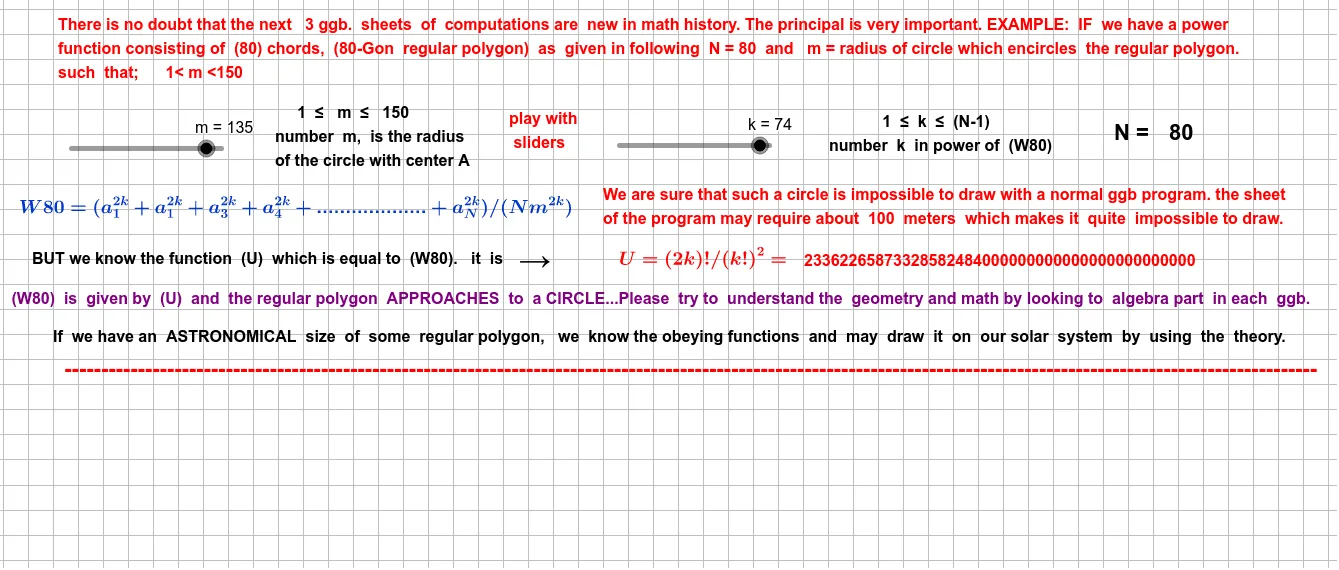
This GeoGebra example demonstrates the behavior of extremely high powers (e.g., k-th powers) within a geometric context, using a slider k to vary the exponent and observing interactions with a circumscribed circle, general quadrilateral, line segments, and symmetry transformations. Core mathematical concepts include power functions, geometric mean, arithmetic mean, circumcircle of a quadrilateral, symmetry, vectors, and three-dimensional distributions. The construction employs multiple text objects (text1 to text15) for labeling values and explanations, sliders k and m to control the power and parameters, key points U and N, and combines circles, segments, vectors, and geometric transformations to build a dynamic model. Suitable for high school to university levels, it helps explore properties of power functions, relationships between geometric and arithmetic means, and intersections with geometric transformations and combinatorics, as well as the impact of high exponents on shape and numerical distribution.
GeoGebra Commands & Parameters
Numeric k(74.0)Numeric m(135.0)((2 * k))! / k!^(2)80
AI Drawing Prompt Reference
Create a geometric representation of a high power function, using slider k to control the exponent and observing its interaction with a circumscribed circle, a quadrilateral, line segments, and symmetry transformations. Start by setting slider k to 74 and slider m to 135. Draw a quadrilateral and mark key points U and N. Adjust the quadrilateral shape using sliders k and m, and draw the circumscribed circle. Apply transformations and symmetry operations to demonstrate the properties of high power functions, including geometric and arithmetic means, and symmetry. Finally, add 15 text objects to explain and label key values.
The prompt above was compiled from the original drawing commands and is for reference only.