
GeoGebra Lesson: Building a Pyramid Volume Formula
Loading the math board and drawing, please wait…
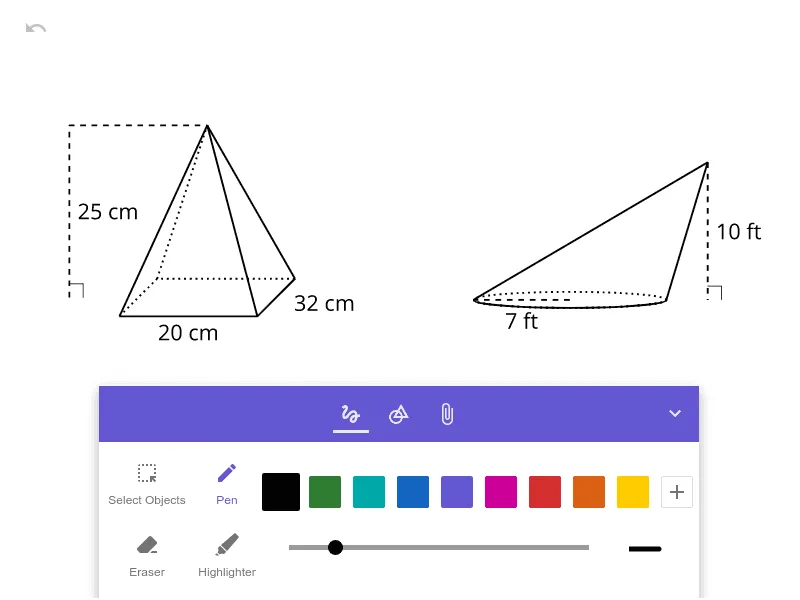
This example demonstrates how to derive a pyramid (prism/pyramid) volume formula by decomposing the solid and relating it to an “equivalent” figure with the same base and height. The key ideas are solid geometry of a pyramid, the roles of base area S and height h, and proportional reasoning obtained from consistent volume correspondence; when using a slicing viewpoint, it naturally connects to the notion behind the cross-section (accumulation) method and may leverage integral-calculus intuition. Construction-wise, the provided record contains no GeoGebra command-level construct summary, so the focus is on the geometric model: create the pyramid and its base plane as the primary objects, then implement the volume relationship via sectional/stacked reasoning or volume comparison until the coefficient 1/3 emerges. Suitable for middle/high school solid-geometry lessons, enrichment on volume reasoning, and students preparing to understand how calculus-based area/volume accumulation connects to classical formulas.
AI Drawing Prompt Reference
Draw a pyramid with its base plane, demonstrating how to derive the volume formula by decomposing the solid and comparing it to an equivalent figure (like a prism) with the same base area and height. Highlight the relationship where the pyramid's volume is one-third the product of the base area and height, using a stacked or sliced perspective to show the proportional reasoning and the emergence of the coefficient 1/3.
The prompt above was compiled from the original drawing commands and is for reference only.