
Geogebra Demonstration of Islamic Geometric Patterns
Loading the math board and drawing, please wait…
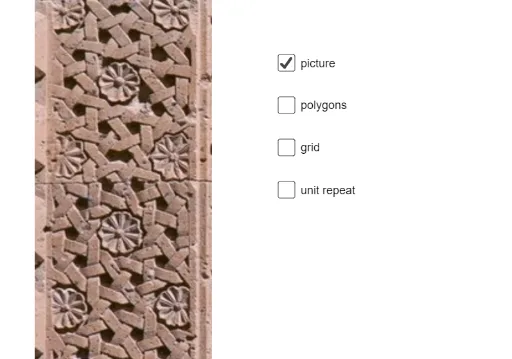
This example demonstrates the construction of Islamic geometric patterns using GeoGebra, showcasing their intricate symmetry and fractal structures. The core mathematical concepts involved include symmetry, polygon construction, geometric transformations, and combinatorics. Key GeoGebra commands and objects used in the construction, as outlined in the summary, are Polygon, Segment, and Intersect. It is suitable for high school and above students to understand geometric constructions, symmetry principles, and the generation of complex patterns.
GeoGebra Commands & Parameters
Polygon(C, D, 10) → veelhoek1, f, p, E, F, G, H, I, J, K, L, g, h, i, j, k, l, m, nPolygon(E, D, 10) → veelhoek2, q, f_1, M, N, O, P, Q, R, S, T, r, s, t, a, b, c, d, ePolygon(C, L, 10) → veelhoek3, g_1, q_1, U, V, W, Z, A_1, B_1, C_1, D_1, h_1, i_1, j_1, k_1, l_1, m_1, n_1, p_1Polygon(N, C_1, 10) → veelhoek4, r_1, g_2, E_1, F_1, G_1, H_1, I_1, J_1, K_1, L_1, s_1, t_1, a_1, b_1, c_1, d_1, e_1, f_2Polygon(H, G, 10) → veelhoek5, h_2, r_2, M_1, N_1, O_1, P_1, Q_1, R_1, S_1, T_1, i_2, j_2, k_2, l_2, m_2, n_2, p_2, q_2Polygon(J, I, 10) → veelhoek6, s_2, h_3, U_1, V_1, W_1, Z_1, A_2, B_2, C_2, D_2, t_2, a_2, b_2, c_2, d_2, e_2, f_3, g_3Polygon(V_1, S_1, 10) → veelhoek7, i_3, s_3, E_2, F_2, G_2, H_2, I_2, J_2, K_2, L_2, j_3, k_3, l_3, m_3, n_3, p_3, q_3, r_3Polygon(H_2, G_2, 10) → veelhoek8, t_3, i_4, N_2, O_2, P_2, Q_2, R_2, S_2, T_2, U_2, a_3, b_3, c_3, d_3, e_3, f_4, g_4, h_4Polygon(J_2, I_2, 10) → veelhoek9, j_4, t_4, V_2, W_2, Z_2, A_3, B_3, C_3, D_3, E_3, k_4, l_4, m_4, n_4, p_4, q_4, r_4, s_4Polygon(J_2, E_3, F_3, Z_1, W_1, K_2) → veelhoek10, a_4, b_4, c_4, z_1, w_1, d_4Polygon(N_2, G_2, F_2, R_1, Q_1, G_3) → veelhoek11, e_4, f_5, g_5, h_5, i_5, j_5Polygon(S_1, V_1, U_1, I, H, T_1) → veelhoek12, k_5, v_1, u_1, i_6, h_6, l_5Polygon(J, D_2, H_3, U, L, K) → veelhoek13, j_6, m_5, n_5, u, l_6, k_6Polygon(M_1, G, F, E, T, I_3) → veelhoek14, p_5, g_6, f_6, e_5, t_5, q_5Polygon(D, C, D_1, C_1, N, M) → veelhoek15, d_5, c_5, r_5, s_5, n_6, m_6Segment(J_3, K_3) → a_5Segment(L_3, M_3) → b_5Segment(N_3, O_3) → p_6Segment(P_3, Q_3) → q_6Segment(R_3, S_3) → r_6Segment(O_3, T_3) → s_6Intersect(a_5, q_6) → U_3Intersect(a_5, r_6) → V_3Intersect(b_5, r_6) → W_3Intersect(b_5, q_6) → Z_3Polygon(U_3, V_3, W_3, Z_3) → vierhoek1, u_3, v_3, w_3, z_3Polygon(A_4, U_3, B_4, Z_3) → vierhoek2, t_6, a_6, b_6, c_6