
GeoGebra Algebra & Geometry Interactive Example
Loading the math board and drawing, please wait…
This example demonstrates geometric phenomena like cylinders and linear regression interactively; involves core math concepts including algebraic equations, linear regression, parallelograms, and differential calculus; constructed using GeoGebra commands/objects like SelectedElement, LaTeX, Slider, Locus; suitable for high school and above mathematics teaching and learning for understanding spatial geometry and data analysis.
GeoGebra Commands & Parameters
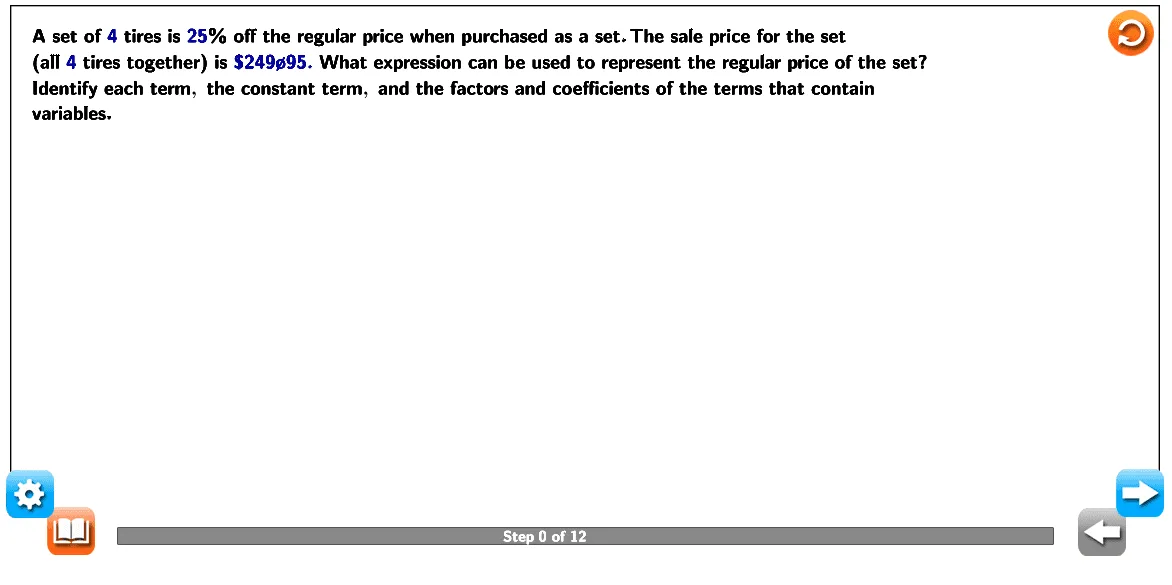
SelectedElement(a1) → a2SelectedElement(L1) → L2LaTeX("\text{Translate the verbal expression into an algebraic expression.}") → text1_4LaTeX("\text{Sale price + discount amount}") → text2LaTeX((((("\text{A set of \textcolor{#000099} { 4 } tires is \textcolor{#000099} {" * a2) * "}% off the regular price when purchased as a set.The sale price for the set\\(all \textcolor{#000099} { 4 } tires together) is \textcolor{#000099}{\textdollar {") * L2) * "}.} What expression can be used to represent the regular price of the set?\\Identify each term, the constant term, and the factors and coefficients of the terms that contain\\variables.}")) → text1LaTeX("\text{Identify each term in the algebraic expression.}") → text11LaTeX("\text{Identify any factors of the non-constant term(s).}") → text12LaTeX("\text{Identify any coefficients of the non-constant term \textcolor{#000099}{(s).}") → text13LaTeX((((("\text{\\ \\The term that does not change in the expression is \textcolor{#000099} {" * L2) * "}.\\Therefore,\textcolor{#000099} {") * L2) * "} is the constant term.}")) → text5LaTeX("\text{Identify any constant terms.}") → text14LaTeX((("\text{Step\;{" * count) * "} of 12}")) → text9LaTeX("\text{First, describe the situation.The regular price is found \\by adding the discount amount to the sale price:") → text1_5LaTeX("\text{Sale price \textdollar}") → text10LaTeX("\text{Discount Price}") → text8LaTeX("\text{%}") → text7LaTeX((((((((("\text{\\ \\There are two terms in the expression:\textcolor{#000099}{" * L2) * "} and \textcolor{#000099} {{") * c) * "}\; \mathit{x}.} \\The term \textcolor{#000099} {") * L2) * "} represents the sale price,and \textcolor{#000099}{ {") * c) * "}\; \mathit{x}} represents the discount.}")) → text2_5LaTeX((((("\text{\\\textcolor{#000099}{" * c) * "} is multiplied by the variable, \textcolor{#000099} {\mathit{x}}\;; therefore, \textcolor{#000099}{") * c) * "} and \textcolor{#000099}{\mathit{x}} are the factors.}")) → text2_6LaTeX((((("\text{\\ \\\textcolor{#000099}{" * c) * "} is multiplied by the variable, \textcolor{#000099} \mathit{x} ; therefore,\textcolor{#000099} {") * c) * "} is a coefficient.}")) → text3LaTeX((((((((((("\text{We know that the sale price is \textcolor{#000099}{\textdollar{" * L2) * "}.}This discount amount is found\\by multiplying the discount percent by the unknown regular price.\\The discount percent is \textcolor{#000099}{{") * e) * "}%}, or written as a decimal, \textcolor{#000099}{") * c) * "}. Let \textcolor{#000099}{\mathit{x}} represent \\the unknown regular price.Therefore, the algebraic expression\\that represents the regular price of the tires is \textcolor{#000099}{{") * L2) * "} + {") * c) * "} \mathit{x}.}")) → text2_2LaTeX("\text{\mathbf{Regular \;price:}}") → text4LaTeX("\text{Equilibrium price of a good or service in a perfectly \\competitive market.}") → text15LaTeX("\text{The price of a good or service that is being offered at a\\discount.}") → text15_1LaTeX("\text{\mathbf{Sale\;price:} }") → text6