
Generating Pythagorean Triples via Gaussian Integers
Loading the math board and drawing, please wait…
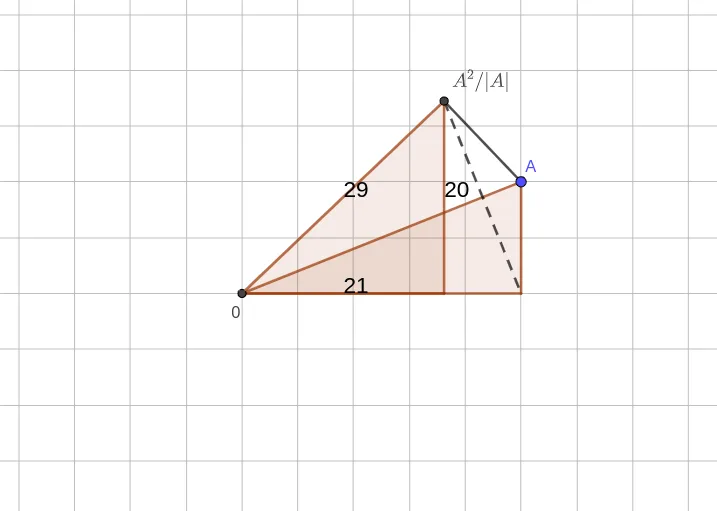
This GeoGebra example visualizes the connection between Pythagorean triples and Gaussian integers by exploring multiplication in the complex plane. It demonstrates how rational complex number multiplication can systematically generate Pythagorean triples, linking algebraic operations with geometric right-triangle properties. Core mathematical concepts include complex numbers, Gaussian integers, and the Pythagorean theorem. Construction uses GeoGebra commands such as Intersect, Polygon, Mirror, Segment, and Text, along with points like A, B, C, and v to build the interactive diagram. It is suitable for high school and early college mathematics, particularly in complex number units, geometry, or number theory modules, offering a visual bridge between algebra and geometry.
GeoGebra Commands & Parameters
Intersect(xAxis, yAxis) → CPolygon(C, B, A) → t1, a, c, bMirror(B, b) → B'Segment(B', B) → fPolygon(C, D, B') → t2, b', c_1, dSegment(B', A) → gText(u^(2) + v^(2), (C + B') / 2) → text2Text(abs(v^(2) - u^(2)), (C + D) / 2) → text1Text(abs(((2 * u) * v)), (D + B') / 2) → text3
AI Drawing Prompt Reference
Draw a coordinate plane with a right triangle having one vertex at the origin and its legs along the axes. Reflect this triangle across one of its legs to create a second right triangle, sharing that leg, forming a symmetric quadrilateral. Label the three key side lengths with algebraic expressions: the hypotenuse as the sum of squares of two parameters, one leg as the absolute difference of their squares, and the other leg as twice their product. Place these labels near the midpoints of the corresponding sides. Ensure the diagram clearly shows the two triangles, their mirror symmetry, and the text annotations.
The prompt above was compiled from the original drawing commands and is for reference only.