
Generate Buoy Surface Area
Loading the math board and drawing, please wait…
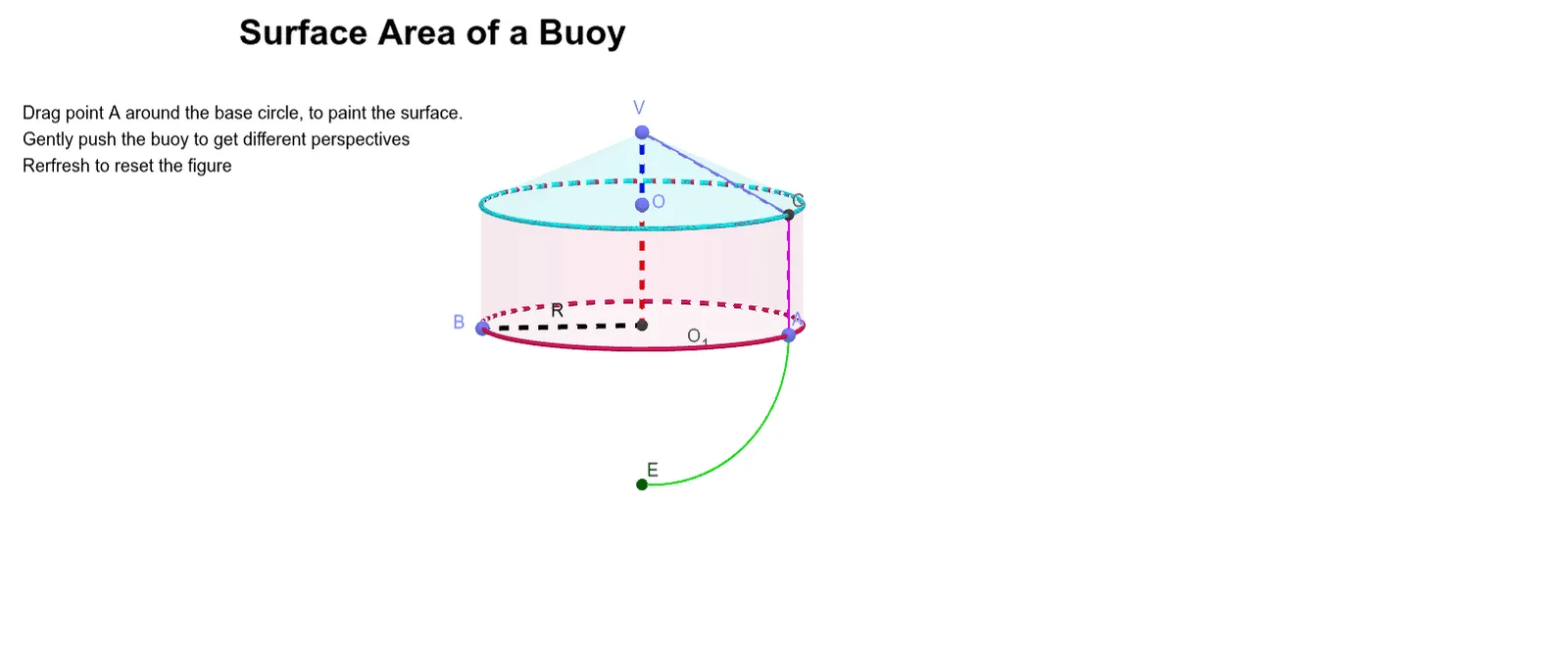
This example demonstrates how to generate the surface area of a buoy. Key mathematical concepts include cylinders, cones, and surface area calculation. Using GeoGebra commands such as Intersect, Point, Cylinder, Cone, etc., a buoy model is constructed and its surface area is calculated. Suitable for high school math education or students learning solid geometry.
GeoGebra Commands & Parameters
Intersect(yAxis, zAxis) → O_1Point(yAxis) → BPoint(zAxis) → OCylinder(O_1, O, Distance[O_1, B]) → a, c, d, bPoint(zAxis) → VCone(O, V, Distance[O_1, B]) → e, f, gSegment(O_1, B) → hSegment(O, O_1) → iSegment(O, V) → jPoint(c) → GCircleArc(O_1, E, G) → pLine(O, O_1) → kLine(O, O_1) → lPoint(c) → ALine(A, j) → mIntersect(m, f, 1) → CCircleArc(O_1, A, E) → qSegment(C, A) → nSegment(V, C) → r